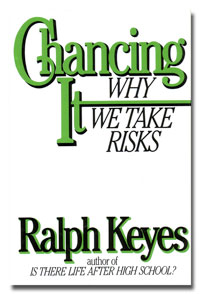
When was the last time you took a risk? Was it thrilling, scary, or both? Do you envy others who summon the courage to dare something you’d never try? Whatever risk actually means to you — whether it’s doing something for sheer adventure or making a life-altering decision — you may suspect that you play it much too safe.
Chancing It asks why so many of us feel that way. It is a provocative, in-depth look at the thirst we all have to both take risks and avoid them. But what do we mean by risk? According to Ralph Keyes, risk is not derived from an actuarial table but from our own inner feelings. “Risk,” he writes, “is in the fears of the beholder.” It is “any act one is afraid of taking.” What is risky to you may not be to someone else. If you can coolly strap on a parachute and leap from an airplane, but break out in a cold sweat at the thought of getting married, then you’re probably a Level I risk taker: one who requires intense doses of physical daring to get the adrenaline flowing. If you are willing to take the lower key, long-term risk of starting a business or staying married, but would no more ride a motorcycle than walk off a cliff, then you are probably a Level II risk taker: one who gets plenty of stimulation just crossing the street.
Either way, the chances we take, as well as the ones we avoid, say a lot about who we are. In order to help us understand our attitudes toward risk for our own benefit, Keyes examines a variety of risks and risk takers. He introduces us to wirewalker Philippe Petit who is afraid of spiders, snakes, and marriage. He talks to “pot stirrers,” who court the forbidden by shoplifting for the thrill of it, and engaging in sexual adventures. He profiles action addicts, such as a Vietnam veteran whose combat-induced craving for danger led him into drug smuggling. We also meet a woman who started her own business with a $500 loan, and a middle-aged man whose commitment to his wife and children spurred him to organize his family into a working jazz band.
Keyes concludes that taking genuine risks is necessary and healthy. Alas, the “American way of risk” glorifies physical daring at the expense of psychic risk, and has led to pseudo and vicarious forms of risk-taking that leave us hungry for the real thing. Keyes offers some perceptive suggestions for assessing our own attitudes toward risk, and taking risks that will enhance the quality of our lives.
- a New York Times “notable book of the year”
- author interviewed on NPR’s Fresh Air (Terry Gross)
- author interviewed in People Weekly, USA Today
- excerpted in New Woman, Newsday Magazine
- discussed in Health, Prevention, Outside, Signature, Human Potential, Marriage Partnership, Playboy, US News and World Report
Where to buy
Follow the links to purchase Chancing It:
Contents
INTRODUCTION
1. The Wire Walker
2. What’s a Risk? Who’s a Risk Taker?
3. Risk Hunger
LEVEL I RISK TAKING
4. Stirring the Pot
5. The Skydiver
6. Wuffo?
7. Mainlining Danger
LEVEL II RISK TAKING
8. The Underlying Risk
9. The Entrepreneur
10. On Your Own
11. Ultimate Risk
12. The Family Man
IN CONCLUSION …
13. The American Way of Risk
14. Genuine Risk
Notes
Excerpt
In this mid-30s, with a new son, mortgage and Maytag washer-dryer, the author’s thoughts turned to risk. Would he be taking any more of them? Or would risk taking be going the way of his Elvis Presley collection and twenty-eight inch waist?
He wondered if others were interested in this subject as well: risks, what they are, who takes them, and why. Many were. When the subject arose, one old friend of thirty-eight, a father of three, mentioned going to an amusement park recently in search of a good scare. That failing, he’d started taking flying lessons.
A newly married woman of the same age said taking risks wasn’t something she was “into.” “I don’t even cross the street when the sign says ‘Don’t Walk,’ ” she explained. The woman wondered if she had a problem.
The most typical response was that of a middle-aged secretary. “I’d like to read something about risk taking,” she told me. “Maybe it would help me take some.
This book is about risk taking. It is not intended as yet another tract urging one and all to “take more risks!” Presumably most of us would like to. Except we don’t know how. Nor is it clear what “risk” means. Getting married? Starting a business? Leaping from an airplane with a parachute? Without one? Getting out of bed in the morning?
The last is not facetious. Among a wide range of definitions I’ve seen, one woman said that “risk” to her meant just that.
I came to feel that much of what we imagine to be courageous risk taking may actually reflect a need for stimulation that is best satisfied by living dangerously. And that less gaudy risks that are low in stimulation may in fact be the more daunting ones to take.
My approach overall is to suggest that the best way to take more risks is to first determine what “risk” means to you. Only when we understand how we perceive risk personally can we proceed to determine which risks we’d actually like to take.
This is why defining “risk” is so much more than a semantic exercise. Repeatedly I’ve discovered that those who are apparently taking big risks turned out on closer examination to to be risking little; little of value that is. (Question: If you risk a life you don’t value, have you taken a risk?) They themselves were often the first to admit this. By contrast, the very, very many who denied taking any risks routinely turned to be daring indeed, in ways they seldom recognized.
There’s not a hero in this book. Like all of us, everyone written about is taking some risks and avoiding others. Often the risks we avoid say more about who we are than those we take. And when we do take risks it’s not always clear — even to ourselves — what is is we’re risking, what’s actually at stake.
RISKLETS
Compare which “risklets” you’ve taken with the percentages of those who filled out a questionnaire for Chancing It.
Leaving home on a dark, cloudy day without a raincoat or umbrella (79% have dared this)
Driving a car whose gas gauge registers EMPTY (69%)
Striking a match from a folder without first closing the cover (66%)
Use a fork or knife to get stuck bread out of a toaster (49%)
Driving through a STOP sign late at night at an uncrowded intersection (47%)
Drinking a beer while driving (43%)
Operating a garbage disposal without a lid (38%)
Lighting a gas oven that has been on for several seconds (37%)
Standing on the platform between two cars of a moving train (36%)
Putting off paying bills you can afford to pay until threatening notices begin to arrive (29%)
Turning on an electrical appliance while taking a bath or shower (24%)
Operating a power mower while barefoot or in sandals (24%)
Reviews
January 27, 2011
Reviews
Coming soon. Please check back shortly, as the website is currently in the process of being updated.
Press
January 27, 2011
Press
Coming soon. Please check back shortly, as the website is currently in the process of being updated.
On the internet
January 27, 2011
Discoverfun.com
I’m reading a book called “Chancing It – Why we take risks” by Ralph Keyes a book about the risk takers of the world. We all know the definition of risk, right? Well, at least we all know how risk applies to ourselves…
What colleagues say
With a fresh eye and a delightful style, Keyes probes the treacherous choices of a decision-filled culture … The risk of buying this book is far outweighed by the lasting benefits of learning how to take chances to make the most of our lives.
Gay Courter, The Midwife
I was amazed by what I learned about myself in this book. Through the prism of risk, Ralph Keyes offers us surprising and useful insights into the self-doubts and aspirations that define our lives. A fascinating study of a value which America purports to prize.
Peggy Anderson, Nurse
An important book and a helpful one.
James Carroll, An American Requiem
One of the best books ever written on the subject [of risk-taking].
Larry Dossey, M.D., Space Time and Medicine
Provides a rich and deep understanding of the topic of risk-taking.
Fred L. Peterson, Ph.D.
Associate Professor, Child, Adolescent, and School Health
The University of Texas at Austin
What readers say
It’s really excellent, one of the few nonfiction books of which I find myself reading every page. … It’s interesting that the people you wrote about were so much more real than the clinical studies in the proliferation of of books written by psychologists about their patients. … Your discussion on control and loss of control was fascinating. The urge to “lose it” comes over me every time I go back to my well-ordered, well-controlled hometown in Missouri — it’s the same sort of urge to mess up someone’s hair when it is too much in place.
Washington, D.C.
It’s so interesting, so well put together. I must say I learned a lot about myself. I’m not only more knowledgeable, but happier. You really did a beautiful job.
Philadelphia, PA
Your style is captivating. It’s what I call a “potato chip” book: I must have just one more vignette before putting it down, then another, then still another. But besides being entertaining, it was a real eye-opener. It revealed why I proceed through life hungering for some risks, yet zealously avoiding others.
Crystal River, FL
The whole book is really interesting. It gave me insight on myself: risks taken, risk-taking. Why I quit my job and got my real estate license.
St. Louis, MO
It’s one of those books I keep referring to in my own mind. Am I a risk-taker? What kind? It’s a really good book.
San Diego, CA
Chancing It has won a place of honor and distinction on my best seller list.
Lansing, MI
There’s some really marvelous writing in it. Some parts are so fluid, marvelously done. I’m really influenced by the craft of it. The writing is sharp, really sharp.
Philadelphia, PA
I enjoyed the book a great deal. Your reporting of actual words people used in talking about themselves and things that had happened made a whole world of realism just leap out of the pages.
Champaign, IL
My husband picked it up then sat there and read the whole book. He read parts aloud to me. Then I read it. It’s a fabulous book.
Gladwyne, PA
I enjoyed it immensely. I suspect it will bring many readers closer to their basic nature. As a “former” risk taker (parachuting, submariner, stunt plane pilot, etc.) I connected with the book.
Plymouth Meeting, PA
It is wonderful! Absolutely terrific! I couldn’t put it down. It taught me things even miss know-it-all didn’t know. I don’t read much anymore I can say that about.
New York, NY
Almost everything I do now I think of in terms of that book.
Boston, MA
You effectively encourage people to take more risks by explaining that preparing or fearing aren’t cheating. I started to think of my own risks– choices, chances, and changes — in new ways.
New York, NY
… wonderful insight into risk taking … extremely valuable and a wonderful read.
East Greenwich, RI
I’m reading a book called Chancing It: Why We Take Risks, and I’d like to share some thoughts with you. An important point in the book was in evolutionary terms, “For 99 percent of human existence, danger, fear, and the need to confront fear were our daily companions. We were risk takers because we needed to be.”
Kevin Thomson, President, Carpe Diem Adventures
We are having a great time with your book in my classes!
Fred L. Peterson, Ph.D.
Associate Professor
University of Texas
Quiz
What Type of Risk Taker are You?: The Chancing It Quiz
INSTRUCTIONS: Circle only one number per question. Answer all questions. If no answer feels exactly right, pick the one that comes closest. To determine your score, total all numbers circled.
1) How many hours of television do you watch in an average week?
1. 0-5
2. 6-10
3. 11-20
4. more than 20
2) Imagine that you’re hungry in a strange city. Nearby are some comparably-priced restaurants. In which would you eat?
1. The Indonesian Isle
2. Pedro’s
3. The Country Kitchen
4. Wendy’s
3) How would you most enjoy spending an afternoon at a resort?
1. learning to hang-glide
2. canoeing on a river
3. talking with a stimulating fellow guest
4. reading a good book
4) Imagine that you’re planning a drive on the Pacific Coast Highway. Driving SOUTH means you’ll have spectacular coastline views but more danger of going off cliff edges. Driving NORTH reduces both your view of the coastline and your risk of going off a cliff. Which way would you go?
1. south
2. north
5) How often do you drive faster than 65 miles per hour?
1. regularly
2. often
3. seldom
4. almost never
6) Does motorcycle riding strike you as PRIMARILY:
1. exhilarating
2. romantic
3. dangerous
4. crazy
Assume that you are equally capable of all the activities listed below. for EACH set, pick the one that you would most enjoy. (If neither appeals to you, pick the one that’s least unappealing.)
7) 1. rollerblading 2. roller skating
8) 1. para-sailing 2. hot air ballooning
9) 1. snowboarding 2. cross country skiing
10) 1. scuba diving 2. snorkeling
Circle the number of the word that BEST describes your reaction to the following activities:
11) Bungee jumping . 1. exhilarating 2. scary
12) Writing a book . 1. tedious 2. satisfying
13) Playing combat video games . 1. arousing 2. jarring
14) Chairing a task force on health benefits at work. 1. boring 2. challenging
15) With a report due in two weeks, would you most likely:
1. start working on this report the afternoon before it’s due, then stay up mostof that night completing it
2. work hard on the report for a day or two before it’s due
3. start working on it during the second week
4. budget time throughout the two weeks to produce the report
16) You are responsible for supervising an employee whose workis not meeting standards. Would you be most likely to:
1. have a candid, face-to-face discussion with the employee
2. send the employee a performance evaluation memo
3. bring the employee up for peer review
4. assume that the employee will eventually straighten out or quit so no action by you is necessary
17) You are about to be vested in a pension plan at work. A fledgling company in your field makes you an attractive job offer. This job has meager benefits but does include an option to buy stock in the firm before it goes public in a few months. Would you:
1. accept the new firm’s job offer
2. try to put the firm off until you can see how well it does
3. use its offer to negotiate a raise from your current employer
4. reject the offer
18) With $5000 to invest, would you be more likely to buy an insured 12-month certificate of deposit paying 6%, or purchase shares in a no-load mutual fund which has earned its investors an average of 8.5% over the past five years?
1. buy a certificate of deposit
2. buy mutual fund shares
19) Which adjective best describes your behavior before age 12?
1. hyperactive
2. mischievous
3. basically well behaved
4. very well behaved
20) Which of the following statements best describes your attitude today?
1. since few things scare me, fear doesn’t usually keep me from doing something I want to do
2. a little fear can make things more exciting
3. even though something might scare me, I’ll do it anyway
4. fear can keep me from doing things I’d like to do
ANALYSIS
Any score below 30 suggests that you are more of a SPRINTER. Sprinters need lots of excitement and have trouble putting up with boredom. This makes them better able to take short-term risks that could involve actual danger. Making lasting commitments is where sprinters have a problem. A score of 30 or above indicates that you are more of a MARATHONER. Physical and financial risks are harder for marathoners. They are well suited, however, to taking long-term risks such as raising families and building careers. Does that sound wimpy? Ask a skydiver what risk scares him more: leaping from an airplane, or walking to the altar.