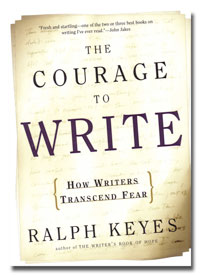
Anxiety is routine among anyone who dares to put pen to paper, or fingers to keyboard. Yet it’s rarely addressed in books about writing. The Courage to Write confronts this topic head-on. Ralph Keyes’s message is not that one shouldn’t be scared. Rather, his book treats fear as a normal, inevitable part of the writing process. Keyes illustrates this point by showing how successful writers deal with what he calls “page fright.” “I have to talk myself into bravery with every sentence,” admitted Cynthia Ozick.
In The Courage to Write, Ralph Keyes shows that anxiety is felt by writers at every level. Drawing on 30 years as an author and writing teacher, Keyes argues that this is inevitable. In his words, “Anxiety is a normal, manageable, and even a useful part of the writing process.”
A normal fear of writing can be transcended. Doing so first calls for identifying the fears of those learning to write. Among them are: fear of self-revelation, fear of being criticized, and fear of self-discovery. Topics covered in The Courage to Write include:
- Why it’s so hard to face the blank page.
- Procrastination: the “as soon as” syndrome. (“As soon as ________, I’m going to get some writing done.”)
- False fear-busters. True courage-boosters.
- How writers use obfuscation to soothe writing nerves. Helping new ones to learn the courage to write clearly.
- Confronting anxiety about the opinion of important others (“What’s Mom gonna think?”). Peer fear. Censors-in-Chief.
- Converting the fear of writing into excitement.
The Courage to Write is also a powerful motivator. The book’s author, said one reader, “wrote this for me, and in many ways, about me.”
Where to buy
Contents
Acknowledgments
I. The Elements of Courage
1. Writing as an Act of Courage
A Dangerous Career / The Great Unspoken / Courage vs. Fearlessness / The Power of Positive Anxiety
2. Points of Courage
Can I Pull It Off? / I Can’t Write About That! / Page Fright / The Paper Partner / Evicting the Baby / Galley Jitters / Advance-Copy Anxiety / Postpublication Panic
3. Will Everyone See Through Me?
That Naked Feeling / Censors in Chief / Spilling the Beans / Scalawags and Spies / Cold Hearts, Hot Words / Beyond “Write and Be Damned!”
4. The Devil in the Inkstand
The Secret Self / Honest Fiction / Peering into the Void / Style Is the Man, and Woman / Why Write? / Lonely Kids, Lovely Writers
II. Coming to Terms with Fear
5. Finessing Fear
Nonwriting, Trunk Writing, and Privishing / Literary Fog / Higher Obfuscation / Transcending Craft
6. Putting Fear to Word
A Taste of Fear/ Counterphobia / The Secret Weapon / Wonderfully Concentrated Minds / Details, Details / Opening Pores
7. Should You Write in the Nude?
The Tactical Writer / Rituals / Totems / Draft Dodgers / Compose First, Worry Later / Block Busting / Writers’ Hours / Customized Fear Management
8. A Little Help from Friends
To Show or Not to Show / Where Have You Gone, Maxwell Perkins? / Courses, Conferences, and Groups / Give Groups a Chance
9. The Courageous Writer
Writing and Ecstasy / The Biggest Risk / No Regrets / The Branwell Brontë Syndrome /Courage Boosters / Setting Sail
Notes
Selected Bibliography
Excerpt
If we had to say what writing is, we would have to define it essentially as an act of courage.
Cynthia Ozick
1: Writing as an Act of Courage
E. B. White was the most graceful of writers. A generation of imitators tried, but seldom succeeded, to match his casual self-assurance. We liked to imagine White up on his New England farm dashing off lighthearted essays and charming books for children when he wasn’t slopping hogs or chopping wood. In fact, White worried over every word. He re-wrote pieces 20 times or more, and sometimes pleaded with the postmaster of Brooklin, Maine, to return a just-mailed manuscript so he could punch up its ending, or re-write the lead.
In addition to being a consummate re-writer, White was a gifted procrastinator. By writing long letters and puttering about his farm, he often managed to avoid the trauma of writing altogether. When the Paris Review wanted to interview him for their “Writers at Work” series, White said he’d be better qualified for one on “Writers NOT at Work.” White later told his friend James Thurber that he considered himself “the second most inactive writer living, and the third most discouraged.”
This would have surprised readers of his essays. To them, E. B. White was a courageous interpreter of the world’s vagaries. That wasn’t how he saw himself. After the president of Dartmouth College paid tribute to his “literary bravery,” White thought, “he little knew.” Dartmouth’s president made that remark while conferring an honorary degree on the nation’s favorite essayist. This was a rare occasion in which White had been lured from his farm onto a public platform. As he sat there, White later wrote his wife, “the old emptiness and dizziness and vapors seized hold of me … Nobody who has never suffered my peculiar kind of disability can understand the sheer hell of such moments … ”
Elwyn Brooks White had a lifelong fear of making public appearances. In his elementary school, students were called on to recite in alphabetical order of their last names. White spent long, agonizing hours dreading his fate as classmates whose names began with the alphabet’s first 22 letters strode to the front of the room. Recitation wasn’t his only childhood fear. Other things that scared White included darkness, girls, lavatories, the future, and “fear that I was unknowing about things I should know about.” Although he outgrew some of these anxieties, others took their place. White’s fear of school bathrooms was replaced by concern that the brakes would fail on a trolley taking him up or down a hill. When he no longer needed to fret about reciting in class, White worried about collapsing on the street. By adding and subtracting fears this way, he kept himself in a steady state of anxiety. “Much of the story of the life of E. B. White,” wrote biographer Scott Elledge, “is the story of how he has come to terms with his fears … ”
The most effective strategy of all was to turn them into stories. White’s books for children conveyed a tone of apprehension with the sure voice of an expert. Stuart Little found Manhattan no less frightening than his creator did. Wilbur the pig, in Charlotte’s Web , was as scared of dying as his literary parent (though with more justification). The best of White’s work had an edgy flavor that demanded readers pay attention. Joseph Epstein has pointed out the many anxious, almost macabre elements in White’s deceptively “light” essays: a hen house consumed with “contagious hysteria and fear;” “faces desperate in the rain;” “the fierce bewildering night.” One of E. B. White’s best essays — “The Second Tree From the Corner” — described a White-like man named Trexler who consults a psychiatrist about his crippling anxieties. Unable to answer the psychiatrist’s questions, Trexler nonetheless leaves his office feeling unburdened, “unembarrassed at being afraid; and in the jungle of his fear he glimpsed (as he had so often glimpsed them before) the flashy tail feathers of the bird courage.”
White personified courage by being so willing to sail boldly into the squall of his own fears, commenting on the trip as he went. That’s why we took to him. This man seemed at least as anxious as we were, but more willing to own up to it. “I am not inclined to apologize for my anxieties,” he once said, “because I have lived with them long enough to respect them … ” When it came to his calling, White wrote eloquently about how much courage it took to write. “A writer’s courage can easily fail him,” he commented while accepting an award from the National Book Committee. “I feel this daily.”
In his simplest testament of all, White said, “I admire anybody who has the guts to write anything at all.”
A Dangerous Career
The saga of E. B. White tells us something about writing fears and the courage to write. On the one hand, anxiety is inevitable among those who put words on paper for others to read. On the other hand, fear can be transcended, can even be made part of the writing process itself. Doing this takes courage. Few authors would dispute that. In talking with writers on this subject and reading about them, I’ve discovered that their attitude differs little from E. B. White’s. John Cheever called the attempt to write seriously “quite a dangerous career.” Katharine Anne Porter thought that for writers, courage was “the first essential.”
Before I began writing for a living, it hadn’t occurred to me that courage was part of the job description. I knew this calling took skill, imagination and persistence, and hoped I had these qualities. By working at a newspaper I’d learned some basics of my craft. With savings and a few contacts among editors, I set out to be a free-lance writer. I outfitted myself with a thesaurus, a style manual, and a brand new Smith-Corona typewriter. Now it was just a matter of getting down to business. Or so I thought.
Only after my tenth sleepless night did it dawn on me that there might be more to this business than recording good words on paper. By the time I started my first book, there was no escaping the fact that anxiety had elbowed its way into my office to sit beside me, scrutinizing every word I wrote. Much of this anxiety showed up in disguise. It expressed itself as stomach trouble, irritability, and restlessness. During toss-and-turn nights I’d jot notes on a pad beside my bed (like marijuana-inspired brilliance, such notes were seldom of any use in the light of day). Seven-day weeks became routine as I tried to build walls of research and rhetoric strong enough to protect me from marauding critics. When a friend offered me a relaxing massage to ease my obvious tension, I turned the offer down from fear that getting too relaxed might keep me from finishing my book. I had trouble even thinking about anything other than getting the book done. Doing so might destroy my concentration, I feared. Taking a weekend off, or even spending an evening with friends might break the writing spell forever. Then I might never return to my desk. I’d no longer be an aspiring writer. Instead I would be revealed as an impostor: someone who said he could write a book but couldn’t.
I did finish that book (We the Lonely People: Searching for Community ), but doubted I’d do another. Why endure such trauma again? Yet within the year I was writing a second book, and three years later, a third. I’ve now been through this process eight times. Along the way, I’ve learned three things. One is that I’ll survive; finish the book and live to write another. Second, I’ll regain my sanity (such as it is). Finally, I’ve learned that a rising tide of anxiety isn’t necessarily a bad thing. It’s a sign that I’m getting serious. Nervousness keeps me alert. Fear forces me to focus, and work longer hours. Restless nights mean I’m gaining momentum. The end is in sight. Getting there isn’t always pleasant. Neither is running in a marathon. Or staging a play. Or climbing a mountain. All such activities take courage. And all reward those who complete them not only with an unparalleled feeling of achievement, but a thrilling sense of adventure.
Writers sometimes compare themselves to explorers. John Ashbery said that for him, the excitement of writing poetry lay in going to new places. Heidegger called writing “a voyage of inner discovery.” Any writing worth doing is a trek into the unknown. Writers never know where their pen or keyboard will take them. “You go in with a certain fear and trembling,” said James Baldwin of writing books. “You know one thing. You know you will not be the same person when this voyage is over. But you don’t know what’s going to happen to you between getting on the boat and stepping off.”
The longer I write, the more my admiration has grown for those who set out on this journey. They are apprehensive and should be. Writing is a daring act. Any time we put so much as a word on paper we’re in jeopardy. (Suppose someone thinks we could have chosen a better one?) Whoever writes for public scrutiny is subject to a form of what psychologists call “performance anxiety.” Polls routinely confirm that public speaking is our number-one fear. (Dying ranks sixth, according to one such poll.) Writing is merely public speaking on paper, but to a much larger audience. For some, writing to publish is even more daunting than speaking in public. Spoken words blow away in the wind. Published ones last as long as the paper on which they’re printed.
A psychologist I know named Bryan makes a good living giving lectures. In the world of public speakers writing a book is considered a first-rate marketing tool. An author who speaks has far more panache than a speaker alone. Bryan knows this. He wants desperately to write a book, and not just as a marketing tool. There are things Bryan has to say that he’d like people to read: about the environment, family issues, and social ethics. So far he hasn’t been able to put them on paper. This man can electrify thousands of listeners when he gives a keynote address. He does so dozens of times a year. But whenever Bryan approaches a typewriter his fingers rebel. They refuse to convey messages from his brain to the paper. It’s as if some bio-chemical reaction triggered by looking at a blank page destroys every synapse in the writing center of his brain.
Bryan has lots of company. The trail of literary history is littered by those who fell along the way because the anxiety of trying to write crippled their hand. Many non-writing writers are gifted. The best writers I know teach school and sell life insurance. Some still plan to write, “some day.” Others have given up altogether. Their block doesn’t lie in the area of ability, or skill, but of nerve.
“You need a certain amount of nerve to be a writer,” said Margaret Atwood, “an almost physical nerve, the kind you need to walk a log across a river.” Few of her colleagues would disagree. Yet too many writers think it’s their shameful little secret that they’re scared. That’s simply not so. Fear is felt by writers at every level. Anxiety accompanies the first word they put on paper, and the last. “I write in terror,” said Cynthia Ozick. “I have to talk myself into bravery with every sentence, sometimes every syllable.”
Its psychic demands make writing an exercise in courage little different from climbing a sheer granite cliff, or skiing down a steep slope. This often surprises new writers. No literary neophyte doubts that hard work lies ahead. Most realize that certain skills must be mastered to compose a coherent text. They hope their intellectual gifts will allow them to produce work of substance. The real shock is discovering how demanding writing is not just of their skill, talent and work ethic but of their valor.
The Great Unspoken
My friend Cal recently completed a short story. Cal had taken a writing class, gotten tutoring from his teacher and joined a writer’s group. More importantly, he wrote. The results were promising. I’ve read worse stories in print. Would he try to get his published? Cal said he was thinking about it. He’d gone so far as to collect the names of magazines, but hadn’t sent his story to any of them.
Why not, I asked?
“I’m too scared.”
During a quarter-century as a writer and teacher of writing, I’ve heard hundreds of variations on this theme. An inability to write, finish a piece of writing, or put completed writing in the mail is routine among those who want to see their words in print. Had they known that all writers are anxious — but that writing fears are predictable, and manageable — perhaps more discouraged writers would be writing today. Although crippling anxieties are as much a part of the writing process as punctuation, they also are a Great Unspoken.
The huge database Nexis has only 12 references to “writing anxiety.” By contrast, Nexis has well over 1000 citations for the term “writer’s block.” There’s a reason for this. Calling an inability to write a “block” suggests there’s just some obstruction down the line that can be cleared with a literary Roto Rooter. According to one school of thought, writing blocks are primarily due to faulty technique. In other words, blocked writers simply haven’t learned their literary lessons. That’s a promising premise. The notion that writing problems can be solved by learning how to choose better words and move more smoothly from one paragraph to the next is reassuring. One more course and I’ll be writing away.
But writing problems aren’t that easily solved. Few result from ignorance alone. Most writers know the basics of their craft: show, don’t tell; use active verbs; be sparing with adjectives and adverbs; make effective use of detail. It’s important to learn and re-learn these lessons. Yet there’s a limit to how much mastering writing rules can do to improve prose or poetry. In the long run, learning techniques does far less to improve our writing than finding the will, the nerve, the guts to put on paper what we really want to say.
Unfortunately, there is not much help available to do this. Most writing courses and books only strike fear a glancing blow. They rarely address the crippling inhibitions that keep even gifted writers from getting material out of their head, onto paper and into the mail. According to University of Iowa Writing Workshop graduate Bonnie Friedman, her seminars there dealt with words on the page, but not how to find them. Among the key questions she and her fellow students never asked was: how to write despite fear? Where to find courage? “‘Courage’ is from the word for heart,” said Friedman in her book, Writing Past Dark . “School had little to do with heart, and everything to do with technical perfection.”
Even programs and books that do acknowledge how daunting writing can be usually advise anxious writers to just roll up their sleeves, sharpen their pencils, and get busy. The obvious advice for anyone intimidated by writing fears is: “Don’t be scared. What are you afraid of? Just do it!” Such exhortations are offered most freely by those who aren’t up on the high wire themselves (i.e., teachers, editors, critics). But there are genuine, serious and understandable reasons to be anxious about writing. Advising writers to ignore their anxiety and forge ahead is like telling a 10 year-old who’s about to get a shot: “There’s nothing to be scared of.” That kid knows better. So do aspiring writers.
When I lecture on writing fears, listeners usually sit up straight and pay close attention. This has nothing to do with my speaking ability and everything to do with their personal stake in this topic. Most know exactly what I’m talking about. They know because they’re so eager to write, and so anxious about the prospect. At the same time they can’t imagine that anyone else feels the same way, let alone published authors. As we’ve seen, writing fears are nearly universal. But because they’re seldom discussed openly, we feel alone with ours’. Much of the paralyzing fear of writing is due to the fact that its power isn’t dissipated by opening windows to air this subject out.
Courage vs. Fearlessness
That is this book’s goal. It deals openly with writing fears because these fears are so seldom acknowledged, leaving each of us to feel we’re the only one who has them. Considering directly how scary writing can be, and why, can do more to facilitate writing than a dozen classes on technique. All writers must confront their fears eventually. The sooner they do this, the better their work will be.
Finding the courage to write does not involve erasing or “conquering” one’s fears. Working writers aren’t those who have eliminated their anxiety. They are the ones who keep scribbling while their heart races and their stomach churns, and who mail their manuscripts with trembling fingers. The key difference between writers who are paralyzed by fear and those who are merely terrified is that — like E. B. White — the latter come to terms with their anxieties. They learn how to keep writing even as fear tries to yank their hand from the page. They find the courage to write.
We often use the terms “fearless” and “courageous” as if they were synonyms. In fact they’re closer to antonyms. Mark Twain defined courage as “resistance to fear, mastery of fear — not absence of fear.” General Omar Bradley called it “the capacity to perform properly even when scared half to death.” In The Courage to Create , Rollo May pointed out that existential philosophers such as Kierkegaard, Nietzsche, Camus and Sartre all concurred that courage didn’t mean the absence of despair; rather it meant “the capacity to move ahead in spite of despair.”
Trying to deny, avoid, numb, or eradicate the fear of writing is neither possible nor desirable. Anxiety is not just an inevitable part of the writing process, but a necessary part. If you’re not scared, you’re not writing. No message in this book is more important. A state of anxiety is the writer’s natural habitat. Yet those who live there are seldom bold. Bullfighting Hemingways and Africa-settling Dinesens are the exception among writers. Most seek adventure only in their own imagination. Like most of us they’re brave here, timid there, trying to muddle through, to sneak enough good words onto paper before a surge of anxiety erases their literary hard drive. At the same time they’re driven to seek attention, and must peddle their wares to the public. This leads to a psychic conundrum that writers often note in themselves; “a combination of an almost obscene self-confidence and an ongoing terror,” John Barth called it.
To love writing, fear writing and pray for the courage to write is no contradiction. Nor is it paradoxical to be both scared and thrilled by the prospect. Kids on skateboards and writers at their desk share the same insight: fear fuels excitement. Writing is both frightening and exhilarating. It couldn’t be one without the other. The best writers exploit fear’s energy to billow the sails of their imagination. They convert anxiety into enthusiasm, and an unparalleled source of energy.
The Power of Positive Anxiety
In my writing classes, there’s one student I always look for eagerly. It’s usually a woman. She sits close to the door, to make for an easier getaway. This student seldom says much. She often accosts me after class to say she’s about to drop out. Why? “I’m too scared,” the woman tells me. “I can’t do it.” I always urge that student to stick around. I know she’ll produce some of our best work.
During one workshop, a computer programmer named Julie kept warning me that she was about to jump in her car and drive back to Pittsburgh. Luckily for us, she didn’t. When assigned to write a profile, Julie spent two hours circling the home of an artist she’d chosen to portray, working up the courage to knock on his door. The visit she described was filled with the spilled turpentine, half-squeezed paint tubes, partly-smoked reefers, and empty matchbooks that brought her subject’s surroundings to life. Julie wrote about this artist’s studio with the acute awareness of a victim in a torture chamber. To her that’s just what it felt like.
Students such as Julie have already won half the battle: they’ve lifted the lid of their defenses to let anxiety bubble up to the surface. If they can then use that anxiety to fertilize their work, writing may be in their future. A willingness to confront the fear of putting words on paper is an excellent basis for becoming a writer. “My students often told me they didn’t have anything to say,” reported the University of New Hampshire’s Donald Murray in his book Shoptalk . “They were silent. Empty. They felt anxiety. Panic. Terror. ‘Good,’ I’d answer. ‘You are a writer. You are at the place from which writing comes.'”
We can’t eradicate our writing fears. Nor would we want to. They’re what make writing so challenging, and satisfying. That is this book’s premise: that anxiety is a normal, manageable and even useful part of the writing process. The book is divided into two sections. Its first section considers different types of writing anxiety, analyzes their causes, and assesses how fear influences our work. The second section suggests ways not only to write in the face of fear, but to enlist its energy in the cause of becoming a better writer.
Reviews
January 26, 2011
Reviews from Amazon.Com
This book does not attempt to teach the craft or writing, such as plotting, characterization, dialog, etc., nor is it appropriate for non-fiction writing. Keyes’s intent is to help the aspiring novelist deal with the…
January 26, 2011
Reviews from Amazon.Com
I’ve had The Courage to Write for about 5 years now. Since I bought this book, I’ve seen my first article published, followed by regular publication in several regional and national magazines in my genre. I’ve also just…
January 26, 2011
Reviews from Amazon.Com
I recommend this book to all of my classes, workshops, in most of my speeches and everywhere online. Keyes directly addresses the fears that so many writers (most writers, I think) are prey to and then gives coping…
January 26, 2011
Reviews from Amazon.Com
I usually read more fiction than anything else, as I am a fiction writer myself. The Courage to Write is without a doubt the best non-fiction I have read in years–maybe ever! … For decades I have wondered what was wrong…
January 26, 2011
Reviews from Amazon.Com
I am a writer and have spent the past two years desperately trying to finish two business books. Until I read The Courage to Write , I couldn’t figure out why I was having such a hard time finishing what I had started…
January 26, 2011
Reviews from Amazon.Com
I use this book sort of as a reference, to meditate on. It’s reassuring to know that my anxiety need not interfere with writing. This book brings me back to the view that anxiety is only so much background noise. I also…
January 26, 2011
Laura Tripp, hercorner.com
The hardest part of being a freelance writer is finding the courage to put your neck on the line. First, when you open yourself up to write, whether its fiction, non-fiction or a letter to your best friend, you have to…
January 26, 2011
Philadelphia Business Journal
A compelling and helpful book for incipient or experienced writers.
January 26, 2011
Bookpage
Keyes shares his insights with us, encouraging us to find and use the power of positive anxiety, to write beyond all those concerns, to write in the nude if it stimulates you to write at your best.
January 26, 2011
Cleveland Plain Dealer
Although aimed at those who toil in the writing trenches, Keyes’s anecdotal approach to the topic makes the book interesting for nonwriters as well. Stories of the rituals, totems and habits of working writers trying to…
January 26, 2011
Alpena News (Michigan)
Ralph Keyes’s marvelous little book, The Courage to Write , is full of uplifting suggestions … [a] down-to-earth book full of encouragement and wisdom suitable for both the master writer and the timid novice.
January 26, 2011
Kansas City Star
Keyes includes an insightful chapter on motivations to write, including the desire to stick one’s tongue out at the people from one’s past … Keyes has written interesting chapters about writer’s block as well as the…
January 26, 2011
Louisville Courier-Journal
[Keyes’s] latest work is, on the surface, an entertaining and insightful how-to book for aspiring and working writers….What makes it so appealing is its straightforward approach to the writing life and to its often…
January 26, 2011
Dayton Voice
The Courage to Write: How Writers Transcend Fear is unlike many previous how-to books about writing. Why? Because most books focus on how to overcome fear. Keyes bases his book on the premise that writers should face…
January 26, 2011
Trenton Times
His book taught me more about the “creative process” than all the writers’ voices shelved in my bookstore’s “elite corps.” Keyes succeeds where others have failed because he understands that “There are very few ‘writing…
January 26, 2011
Pittsburgh Post-Gazette
Keyes can be helpful to fledgling writers who are struggling with doubt and lack of confidence. The Courage to Write can be read in times of tribulation, much like a collection of inspirational verses, then put away…
January 26, 2011
Columbus Dispatch
Highly readable and laced with true-confession anecdotes about the trepidations that dog most writers, Keyes’s book is an attempt to show nervous novices how to turn fear toward more productive ends.
January 26, 2011
San Diego Magazine
Keyes provides compelling reading for writers at all levels, from student to journeyman.
January 26, 2011
Cincinnati Post
Keyes is not convinced that anxiety is a bad thing. He documents so much fear experienced by so many writers — from E.B. White to Gail Godwin — that fear emerges as a given. The trick is to manage it and reap its energy.
January 26, 2011
Fresno Bee
Anyone who is a writer, wants to be a writer or knows a writer will want to pick up a copy of The Courage to Write by Ralph Keyes. It is one of the best books about the writing profession ever published.
January 26, 2011
New York Times
He lists the many reasons writers have been afraid, from fear of falling short of their ideals to anxiety about self-exposure. … Having made the game of writing sound like a descent into hell, he sets out in the second…
January 26, 2011
Antioch Review
Keyes explores inner struggles that grad schools, conferences, and craft books usually ignore … [an] intimate examination of the writing mind …
January 26, 2011
Library Journal
Highly recommended for anyone who writes, wants to write, or is taking a writing course.
Press
January 26, 2011
Press
Coming soon. Please check back shortly, as the website is currently in the process of being updated.
On the internet
January 26, 2011
Internet
A book I recently read that you might enjoy is The Courage to Write by Ralph Keyes. I found it very comforting to discover that virtually all writers, even the “greats,” are frequently near-paralyzed with fear at any or…
What colleagues say
The Courage to Write is fresh and startling — one of the two or three best books on writing I’ve ever read. I expect it to be around, and quoted, for years.
John Jakes, The Kent Chronicles; North and South
A sensitive and thought-provoking treatment of a problem I didn’t realize so many other writers shared.
Julia Alvarez, Yo; How the Garcia Girls Lost Their Accents
Here’s practical and positive advice that can help every writer capitalize on anxiety, instead of knuckling under to it. Writers not only need this book — they know they need it.
Judith Appelbaum, How to Get Happily Published
Facing one’s deepest fears resides at the very heart of any creative act, and Ralph Keyes has written thoughtfully and well about the roles of fear and courage in the writing process. Bravo!
Lawrence Block, The Matt Scudder Series
The Courage to Write delivers fresh understanding of the enigmatic process that transforms ideas and stories into text. Anyone facing a blank page will find consolation here in the company of other writers who have been there.
Gay Courter, The Midwife
The great obstacle for many writers has nothing to do with talent — the demons lie deep within, and Keyes brings them to the surface. His new book is irresistible reading.
William Novak, co-author, Man of the House
It’s both frightening and reassuring to learn that all who write and aspire to write go through the same agonies, public and private. Ralph Keyes has brought the beast out of hiding, and done a beautiful job of it. I love this book.
Robert Inman, Home Fires Burning
I found The Courage to Write captivating, intriguing, and reassuring reading. Much of it hits very close to the bone. This fascinating book will be devoured by writers and would-be writers alike, and savored for its many delights.
Musa Mayer, Night Studio
I found The Courage to Write heartening and inspiring. The kind of fear that writers experience is so different that most others have trouble grasping it. I am thankful for Keyes’s thoughtful work on this book.
Andrea Louie, Moon Cakes
The book is magnificent, the best of its kind, a classic. It’s one of the most important books on the subject I’ve ever read. I’m recommending it to everyone I see.
Patrick O’Connor, So Far, So Good
It was so helpful that I give it routinely to writer-friends as an inspirational gift.
Patricia Bell-Scott, Flat-footed Truths
A stunning, intricately woven piece of work.
Rosalie Maggio, How to Say It
[A] wonderful book. Letty Cottin Pogrebin, Getting Over Getting Older
The Courage to Write was a very helpful tool to me as a writer and as a mentor for writers.
Bruce Holland Rogers, Word Work: Surviving, Thriving as a Writer
I’m a great fan of The Courage to Write. It provided me with much insight and encouragement as I was co-writing my own book, Marriage from the Heart.
Nelly Bly
I recommend this book to all of my classes, workshops, in most of my speeches and everywhere online. Keyes directly addresses the fears that so many writers (most writers, I think) are prey to and then gives coping strategies. The worst thing about writing is that the longer you do it, the harder it gets, and Keyes is invaluable for dealing with that. This is a wonderful book.
Jennifer Crusie, Strange Bedpersons
I’ve been a huge fan of The Courage to Write for years–it’s THE book I recommend to writing students in my Internet classes, offered at 800 colleges and universities worldwide … I constantly review books to recommend and “The Courage” is HEAD AND SHOULDERS above the others … “
Eva Shaw, Ph.D, Writing the Nonfiction Book
The Courage To Write has been immensely helpful in my writing endeavors.
Dan Bruder, Glimpses from the Edge
What readers say
This is the best book I’ve ever read about the fear of writing. I highly recommend it. When I start feeling my writing isn’t good enough, I pull out this book and read a chapter.
Carmel Thomaston, owner, Book in a Week
This morning I discovered The Courage to Write, bought it, read it, highlighted it so that it is a mass of pink ink and have benefited from it more than any book on writing I have ever encountered.
Sarasota, FL
This is just the book this aspiring writer needed to revolutionize the way I think about writing. I’m not alone in my fears and silly writing habits! If you think you might like to write but you’re not sure how, why or whether, read this.
Los Angeles, CA
This book hit many sore spots, made me take a good hard look at myself, and got me to write some of the best work I’ve come up with in a long time.
“Carolyn,” Useful Books for Writers
I like the way it’s written: open, friendly, reassuring. It’s a fantastic piece of work.
New York, NY
It really is a wonderful book. I’ve already recommended it to a couple of people
La Jolla, CA
I recommend it to everybody. I’ve lent my own copy to half a dozen people.
Dayton, OH
I’m not someone who struggles much with writer’s block, and I still appreciate this book.
Carolyn L. Smith, children’s book writer
I’m impressed with its research and practical insights. Wish I had found The Courage to Write before I completed my dissertation.
Mike Bellah, PhD
Keyes has a delightful section in which he explains why university teachers encourage vague, flowery, jargon-ridden prose.
Bryan M. Knight, PhD
This book – itself an example of good writing … offers readers valuable insights from an experienced author and teacher … This man has amazing insight.
Bryan M. Knight, Knight Reading (Internet)
[The Courage to Write] is a wondrous book. It has something of relevance to say to anyone who writes, anyone who dreams of writing, anyone who has always promised himself “someday I’m going to write a book.” Holly Lisle, Holly Lisle’s Writing Pages
I only consider a few books essential to every writer … now this book.
Holly Lisle, Internet (HollyLisle.com)
A very useful and inspiring book about getting past your fears of failure or whatever, and getting the words out on the page. I really, really liked this book.
Carolyn K. Armistead
On nearly every page I found a new source of inspiration.
Evanston, IL
This book was inspirational because it lets us struggling writers know that all writers struggle with the same doubts, fears, and hindrances to writing.
Westlake, OH
Keyes’s words fairly leapt off the page and grabbed me by the throat. Often, I couldn’t read fast enough to keep up with my racing thoughts.
Ontario, Canada
Helped me realize that performance anxiety is quite common among even famous writers.
Contributor to Inkspot Writer’s Poll
This is an exceptional book about the fear all writers face, and on some ways to deal with it.
Very inspirational.
Inkspot Writers’ Bookstore customer
This author taps into the soul of every writer, professional or aspiring.
Inkspot Writers’ Bookstore customer
This is just the book this aspiring writer needed to revolutionize the way I think about writing. I’m not alone in my fears and silly writing habits! If you think you might like to write but you’re not sure how, why, or whether, read this.
Amazon.Com customer
[Since reading The Courage to Write] I feel so much better. I’m not the only one! And it’s simply one of the conditions of being a writer, like having fingers! Santa Fe, NM
I like how the author talks about the fears that go along with putting your writing out there, that someone you know and love will read what you write and will hurt them, the baser motives we have for writing.
Diane Patterson, The Paperwork
Each fear described is of acute familiarity to me. I could read The Courage to Write in small installments only, until I appreciated its insights.
Ontario, Canada
It’s a great book. Not only did I learn from it, I loved it because it made me both laugh and cry at the personal experiences of other writers. Best of all, your book encouraged me.
Wellington, NV
No writing book I’ve ever assigned has stimulated so much classroom discussion among first-year students.
Richard Bullock, Wright State University
I liked your book so much I’ve decided to use it as part of my Spring curriculum.
Santa Cruz, CA
This book has really inspired me to at least consider becoming a writer and has definitely enhanced my desire to teach writing.
Dayton, OH
I have begun talking about your book to the writing instructors, as well as to students looking for further stimulation and “courage.”
San Francisco, CA
What a success The Courage to Write has been in my creative writing classes. It makes an excellent reference book for students, classes, creative writing programs.
Springfield, OH
One of my students calls it her “Bible.”
Charleston, SC
I am thrilled that Keyes has assembled enough anecdotal evidence to convince any abashed freshman that they, too, can write despite their personal fears. Every fear is accounted for and answered in a reassuring, humorous, and often-times sympathetic voice.
Fairborn, OH
After reading Keyes, I feel motivated and inspired to write, not totally courageous but more so than before I read this book.
Beavercreek, OH
I loved the book. It spurred me to write spontaneously — unsolicited — a story I otherwise wouldn’t have written as it happened around me when I was reading your book at the laundromat. A story erupted and I had the courage to write it down.
Dayton, OH
I was thrilled to be able to find myself on so many pages: To know that the fear is common — normal, and probably healthy.
Nova Scotia, Canada
Keyes wrote this book for me, and in many ways, about me.
Enon, OH
Ever since I found this book in the local library, I’ve needed to read it every few months to keep my strength up. Yesterday I finally purchased it. Thank you for creating this book.
I have enjoyed your books, but especially The Courage to Write.
Hawthorne, CA
I wish I had read your book years ago, if it had been available. Perhaps I wouldn’t have wasted so much time wondering if I could write something meaningful. It has given me new dedication to go on.
Brighton, MI
Thank you for your book The Courage to Write . For a long while I was (and am) dealing with the kind of issues you wrote of. The writers I knew rarely discussed anxiety, or failure, or even fear. I thought we were supposed to strut around with this hard shell attitude, this blazing self-confidence, and I always wondered why I alone suffered these crippling anxieties and doubts. Could it be I was just a big old fraud who thought he could write but couldn’t? I’m glad to say I have overcome this to a degree. My first book will be out in Canada in September and I am happily, if anxiously, at work on my second. Again, thanks. The Courage to Write has been a big help.
I’m now halfway through The Courage to Write — haven’t finished it yet, because I rushed to my computer and started outlining ideas for several books I want to write but just couldn’t get cracking on!
I enjoyed your book. It is one of a very few to which I turn for inspiration and counsel.
I cannot tell you how much your book, The Courage to Write comes to grips with my past and write what I know best. I’ve purchased countless copies of The Courage to Write for other writers.
I just finished reading your book, The Courage to Write and I wanted to thank you profusely for saying the exact words I needed to hear. I hope that one day you may see my writing on the shelves of your local bookstore and know you had a huge part in helping me understand that what I was feeling was normal, and, in fact, necessary, to produce a published work.
I’ve been looking for something like this for years. My book shelves are stocked with ‘how-to’ write books, but none come close to what you have accomplished in yours.
This is an exceptional book about the fear all writers face, and on some ways to deal with it. Very inspirational.
Internet
This author taps into the soul of every writer, professional or aspiring.
Internet
I consider this book my personal savior. … Very warm and compassionate, and without even a hint of that presumptuous “self-help book” element.
Internet
A very useful and inspiring book about getting past your fears of failure or whatever, and getting the words out on the page. I really, really liked this book.
Carolyn K. Armistead, Internet
Whenever I am feeling insecure about my writing, I reread this book and take great comfort in the fact that other writers go through the same thoughts and fears as I do.
Susan Taylor Brown, Children’s Author & Motivational Speaker, Internet
The best thing I ever did was read The Courage to Write by Ralph Keyes. This book goes into the personal struggles of writing better than any I’ve read.
Lynda S. Robinson, Internet (Sisters in Crime)
This is one of my all-time favorite books because it inspires me to know that even ‘successful’ writers face the same panic that I do from time to time.
Lisa Burks, Internet (lisaburks.com)
I can’t say enough about this book. It’s brilliantly honest.
Christi, Internet (Writer’s Notebook)
This book is one self-help book I would suggest that any would-be writer and any writer read.
Kitsune, Internet
This is not a superficial how-to, but an educated, assuring essay from a professional and prolific writer and teacher who really knows and understands the demons and self-doubts that can invade the solitary life of the writer.
The Writer’s Store
I just finished reading your book, The Courage to Write, and I wanted to thank you profusely for saying the exact words I needed to hear.
I hope that one day you may see my writing on the shelves of your local bookstore and know you had a huge part in helping me understand that what I was feeling was normal, and, in fact, necessary, to produce a published work.
I’ve been looking for something like this for years. My book shelves are stocked with ‘how-to’ write books, but none come close to what you have accomplished in yours.
I cannot tell you how much your book, The Courage to Write come to grips with my past and write what I know best. I’ve purchased countless copies of The Courage to Write for other writers.
It is one of a very few books to which I turn for inspiration and counsel.
Wayne, NE
I’m now halfway through The Courage to Write – haven’t finished it yet, because I rushed to my computer and started outlining ideas for several books I want to write but just couldn’t get cracking on!
It is 1:44 on this Saturday morning and I woke from a dead sleep, the kind where you don’t know if hours or days have passed, and as drifting back to sleep, a short story began to emerge in my sleepy mind. On any other night, I would have just let myself fall to sleep to that story, much like a lullaby, but tonight was different, because I spent the hours before reading The Courage To Write. Instead of falling back to peaceful sleep, I went to my computer and wrote it out.
The most amazing part about this is I haven’t written, for a variety of reasons, for over 10 years. I haven’t felt this good in a long, long time.
I happened upon The Courage to Write at Barnes & Noble the other day, bought it, and have set aside my other reading until I finish it. It’s kind of consuming.
Manchester, NH
I absolutely loved the book. I checked it out at the library, and liked it so much I will buy one for myself. I feel a tad bit more “normal” having read it.
Suffering with “writer’s block,” I decided to go to Borders – just to get away and take my mind off things. I really had no intention of buying any book – especially a book on writing (I have millions). [But] I noticed a book on the shelf. The word “COURAGE” jumped out at me. Something told me to pick it up. “Ah, a book on writing,” I thought to myself. Once I opened your book I couldn’t put it down. I was hooked. I was helped. I’m in love with your book. Thank you so much for writing it. I’m also recommending The Courage to Write to non-writers I know who struggle with anxiety in one form or the other. It has great therapeutic value. Your book has given me courage to go places that I am terrified of getting lost in. I’m able to write again – thanks to you.
St. Louis, MO
I’ve read The Courage to Write twice and perused it often. Thank you for a book that has been one of the most helpful to me as a writer. I have underlined many passages that I keep coming back to …
Saco, ME
I recently read your The Courage to Write and it gave me the kick-start I’ve been needing to ‘hit the road running.’ … I can’t thank you enough for helping to guide me there. Writing has always been at the core of my being, but you are helping it ‘come out of the trunk.’
Columbus, OH
As a terrified, panic-stricken writer, I found it most encouraging to learn that not only am I not alone, I am actually in good company.
Triona
I just finished The Courage To Write, and I just had to tell you what a great book it is. A few other books that deal with writing have crossed my path, but your book connected with me like no other. As I was reading, there were so many times I was nodding “yup, that’s me” that my fellow train commuters must have thought I was deranged. Clearly, you put a lot of effort into the book, and it shows. And you took away my remaining excuses for not writing. Dammit. Thanks
Mark
Thank you! The Courage to Write is just what I needed.
Glassboro, NJ
Your book helped me to take the leap of faith necessary. Since then, I’ve published over a dozen short stories, won two contests, and had a couple of my works chosen for anthologies. Your book had something to do with that. A few weeks ago, after finishing the first draft of a long, draining new novel, I again picked up The Courage to Write and found even more wisdom there than I did the first time.
Mount Vernon, NY
I just finished reading The Courage to Write – it helped me to send in a short story to a Writer’s Digest contest …
Indianapolis, IN
If you have not read this book, please do so. When I am finished this one, The Writer’s Book of Hope is next on my list.
San Diego, CA
On the advice of a fellow struggling writer, I picked up a copy of The Courage to Write. I read it over the weekend, highlighting many passages and came away with one feeling… “I’m normal!” You see, I’ve been a writer all my life…ten years ago I won a short story contest, but it wasn’t until two years ago that I decided I couldn’t ignore the voices in my head. I was determined to fulfill a dream and finish a romance novel I’d started a few years before. Well, the novel is now complete and I have an editor in NYC who has requested to read it. I am in the editing/cutting/polishing stage at the moment, and of course, I hit the “this book is terrible, no one will want to read it, I can’t do this, what was I thinking!” wall. One of my critique partners sent me a story about E.B. White and how he worried over every word and told me to buy The Courage to Write. So I did (and also picked up The Writer’s Book of Hope which I am reading now) … [This] wonderfully en”couraging” book … has done more for my writing than any of the numerous technical how-to books I have down in my basement office.
I’m just beginning my writing journey and have gleaned a bit more inspiration and an extra dose of courage from The Courage to Write.
What helped me the most from The Courage to Write and The Writer’s Book of Hope was understanding vividly for the first time that a writer’s feelings of insecurity/anxiety/demoralization is not a good indicator of their talent or lack of talent.
Rockville, MD
My two favorite books on writing are The Courage to Write and Bird by Bird.
Butte, MT