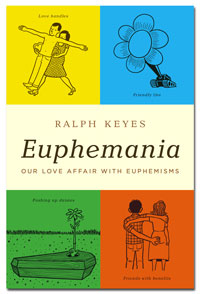
In this engaging, thoughtful book, Ralph Keyes explores where euphemisms come from, why we use them, and what they tell us about who we are. Keyes suggests that a good way to determine what concerned human beings at any given moment is to examine their verbal evasions. Why did die become kick the bucket, underwear become unmentionables, and having an affair become hiking the Appalachian trail?
Euphemisms provide an accurate barometer of what’s on our minds. What makes us uncomfortable. What we consider taboo. Was that talk of God? Better we should say golly. Did discussing breasts make us queasy? Try bosoms. Lying sounds bad, but spinning not so much. Those who once were broke now show negative cash flow. Yesterday’s disabled today have special needs. Erectile dysfunction is better to have than impotence, certainly, and ED better yet.
Any word or phrase that gives us pause is a candidate for euphemizing. What gives us pause varies from place to place, however, and epoch to epoch. Euphemania shows how euphemisms went from a tool of the church to a form of gentility to today’s instrument of commercial, political and politically correct doublespeak. Categorizing high-risk loans as subprime made it easier to extend them. Controversial tax cuts are more palatable when called tax relief. Calling hungry families food insecure households makes them easier to ignore.
An overlooked source of euphemisms is current events that become part of the vernacular. One reason this happens is the entertainment they provide. Wardrobe malfunction is no more descriptive than “flashing” or simply “exposing body parts,” but is a lot more fun to say. And who wouldn’t rather say “I inhaled” than “I smoked marijuana”?
That is why, as Keyes’s subtitle suggests, we have a love affair with euphemisms.
End Notes
The Euphemania end notes can be accessed here.
Where to buy
Contents
1. Mincing Words
2. From Bears to Bowdlerism
3. Speaking of Sex
4. Anatomy Class
5. Secretions and Excretions
6. Under the Weather and In the Ground
7. Comestibles
8. Show Me the Liquidity
9. Words of War
10. Brave New Words
11. Why We Euphemize
Acknowledgements
Bibliography
Index
Excerpt
3. Speaking of Sex
In 1638, my ancestor Robert Keyes had to spend an hour in the Cambridge, Massachusetts stocks because he’d engaged in “unseemly behavior” with Goody Newell of Lynn. She and Robert then sat side by side for an hour in Lynn’s stocks. Why were these two punished this way? Did they kiss? Fondle each other? Make love? Talk dirty? Any of these acts might have qualified for such a vague charge. In the Massachusetts Bay Colony, “unseemly behavior” was a catchall description for activities considered too scandalous to mention aloud.
Several years after Robert and Goody paid their debt to society, a Boston sea captain named Thomas Kemble spent two hours in the stocks for “lewd and unseemly behavior.” It seems that Captain Kemble had kissed his wife on their doorstep after returning from three years at sea. The charge was, in other words, a euphemism for what was considered inappropriate physical contact between members of the opposite sex – even when they were married.
There were many other such euphemisms. A few years before Robert and Goody served their sentence, a Massachusetts clergyman condemned marital sex engaged in for reasons other than procreation as “mutual dalliances for pleasure’s sake.” In 1672, Sarah Roe and Joseph Leigh of Ipswich, Massachusetts were brought up on charges for “unlawful familiarity.” Their crime? Conducting an adulterous affair while Sarah’s husband was off at sea. Joseph was whipped for his offense, and Sarah jailed for a month. After that she was ordered to appear before congregants in the Ipswich meetinghouse wearing a sign that read FOR MY BAUDISH CARRIAGE.
….
Sexual activity could be the all-time most popular inspiration for euphemisms, many of which are remarkably creative. Much ingenuity and wit are employed when we wish to talk about sex without saying what it is that we’re talking about. From courtship to consummation, euphemistic talk abounds.
Courtship
During the past several decades personal ads have become a common mating tool. Making sense of them requires an ability to navigate their euphemistic rapids. “Eligible,” for example, is a word commonly used by women to describe the type of man they’re looking for (“eligible bachelor”). After studying personal ads, psychologist David Buss concluded that this vague word refers less to a man’s eligibility for marriage and more to his status and wealth. As Buss puts it, eligible is “a euphemism for the highest-status, most resource-laden man around.”
“Professional” is in a league with “eligible,” a word that women in particular use to indicate that they’re only interested in well-educated, white collar, and, presumably, well-paid men. Older man can also be a euphemism for “financially secure.” Financially secure itself is euphemistic for “wealthy,” as is financially independent. Solvent suggests if not wealthy then at least not in debt. In transition probably means “unemployed.” Unencumbered is short for “not married or in a relationship” (and perhaps not even paying alimony). It can also refer to not having children to support. Reliable is euphemistic for, among other things, “emotionally stable,” a sought-after trait mentioned most often by men. Experienced could mean any number of things but alludes to sex.
When it comes to personal traits, good listener might mean what it says, or it could be a euphemism for “catatonically shy.” Outgoing, on the other hand, may refer to someone who can’t stop talking. As for physical attributes, curvy, full-figured, and classically proportioned are, of course, synonymous with “overweight woman,” one with a mature figure. Short men, in turn, can describe themselves as compact, or built for speed. (One bold man did begin his ad “Life is short and so am I.”) Short women can be petite without penalty.
One study of online ads pointed out the ambiguity in some modifiers. Does self-educated mean “worldly and well read” or “high-school dropout”? Should still believes the best things in life are free be interpreted as “has great spiritual vision and lives in delight of the moment” or “has no money; don’t expect gifts”? Only the ad writer knows for sure.
Gay ads historically have had a nomenclature all their own. This was particularly true during more closeted times. In personal ads after World War II, discreet gay men advertised for “roommates,” “bachelors,” “servicemen,” and men interested in “adventure.” Some simply sought “male friendship.” Houseboys was one euphemism for those on offer, chauffeurs another.
Once face-to-face (f2f) contact is made, today’s minefield of courting nomenclature grows particularly explosive. At one time, the euphemistic question, “Would you like to come up and see my etchings?” reflected a Playboy approach to seduction in which a suave man lured a naive woman into his sexual lair under false pretenses (or so he assumed). See my etchings lingers as a euphemism for seduction under false pretenses. An ironic variation on this theme among postwar teenagers was submarine watching, or heavy sex play in parked cars involving a gullible girl who was invited by a wily boy to “watch the submarines race” in some isolated setting. (She may not have been so gullible.) While watching submarines race, they engaged in necking, petting, or even boodling.
Although there’s some debate about what kind of activity merits which label, in general necking is the milder version of petting. Based on her experience, a veteran of the 1950s sex wars had a bit more nuanced explanation: “necking was above the neck, boodling was between the neck and waist, and petting was below the waist.” Much was left to the imagination. Spooning was an older euphemism for non-specific foreplay. So were billing and cooing, or simply fooling around. Getting fresh involved what the Victorians called unwanted attentions. So did making a pass at. Then, as now, men who made passes were thought to be horny, a concept that dates back to Biblical times when animal horns represented virility and, metaphorically, an erect penis.
….
Doing It
….
[In the late nineteenth century,] American word compilers John Farmer and William Henley published a massive compilation of slang that recorded hundreds of words referring euphemistically to sexual activity. These ranged from the coarse (ballocking, belly bumping, under-petticoating) to the vulgar (take in cream, feed one’s pussy, suck the sugar stick), the banal (have connection, be intimate, be familiar), and the inventive (go star-gazing on one’s back, get a handle for the broom, dance the mattress jig, and do a four-legged frolic). Women who were captured and raped by Indians used elliptical words to describe this experience once they were rescued. One Coloradoan who survived such an ordeal in 1878 told a military hearing that she was “insulted” several times by her Ute captors. Under questioning, the young woman elaborated a bit by saying that she’d been subjected to “outrageous treatment.” When the presiding officer asked, “Am I to understand that they outraged you several times at night?” she responded “Yes, sir.”
Sexual euphemisms no less than any other kind tell us something about their times. In the Decameron (1353), Boccaccio used “Put the devil into hell” as a metaphor for sex. Five centuries later, the common expression “forced his attentions on” suggested euphemistically that when it came to sex, dominant men imposed themselves on passive women. Such men took advantage. They had their way. Women, in turn, submitted. They surrendered. They sacrificed their honor. Or so it was assumed in Victorian times. By contrast what would Queen Victoria make of today’s euphemism friendship with benefits?
Late in her era “think of England” became a euphemistic way to allude to a certain kind of dutiful sex. It was based on a popular assumption that brides at this time were advised to “Close your eyes and think of England” when letting their husband have his way. This advice was so Victorian that it was widely assumed to come from Queen Victoria herself. (It didn’t. Among other things, the queen was hardly dutiful.) Wherever this recommendation originated, the image of a compliant young bride lying limply on her honeymoon bed with eyes shut and a head filled with thoughts of Trafalgar Square, the Union Jack, and a nice hot cup of tea, was so evocative that close your eyes and think of England is still a euphemism for submissive sex.
As sexual euphemisms illustrate better than any others, the hotter the activity, the cooler the language we use to describe it in polite company. Such euphemisms put a placid verbal veneer on the fevered goings-on they describe. In one translation of Herodotus’s writing about the Nasamoni of northern Africa, the Greek historian reported, “When a Nasamonian man takes his first wife, it is the custom that on the first night the bride should be visited by each of the guests in turn.” According to another translation the guests “lie” with the bride. Old Testament figures would often lie with their wives too, the better to know them.
For such a spicy endeavor, the euphemisms we use for sexual activity can be remarkably bland (which is the whole point, of course). In a mid-sixteenth-century book, French physician Ambroise Paré referred to wives being “strongly encountered by their husbands.” Pioneering sexologist Ivan Bloch described the case of a late-nineteenth-century British junior officer who visited a superior officer, then “enjoyed his wife on the sofa.” This resulted in a criminal conversation charge being filed against the younger man, a common euphemism for adultery in England between the seventeenth and nineteenth centuries. Crim. Con. trials – in which a husband brought charges against his wife’s lover – excited much public interest. Reading about them in the press was as close as many respectable Britons could get to consuming pornography.
Of course, it was possible to have a conversation without its being criminal. This is just one of many ordinary words that have been pressed into service as allusions to sex. Consider a sampling of ones that begin with c: commerce, communion, congress, connect, consort, convene, correspondence, couple, cover. Coital activity is more specific, as are coition, carnal knowledge, and conjugal relations. A 1940 study of “Morbid Sex Craving” among women converted cohabit, a euphemism for unmarried couples living together, into a much more active concept when discussing a 25-year-old subject who “journeyed to a distant city and cohabited with at least ten of the football squad on the night before the game.”
Countless numbers of ordinary words may, or may not, refer to sexual activity depending on the arch of one’s eyebrow. “See” is not an inherently erotic word, unless in the mouth of Mae West inviting Cary Grant to come up sometime and see her. Practically any verb can refer to sexual activity in context. Among the many meanings of the word “be” is “fuck.” (“I’d like to be with you tonight.”) “Know” is a perfectly innocent word until used, as it once was, to refer to sexual intercourse. (“She has known man”; “Adam knew his wife … and she conceived.”) At one time, this synonym for sex was embellished a bit to know biblically. (“They knew each other biblically.”) More recently, when a man on the make says “I’d like to get to know you better,” a woman at the alert takes precautions.
Even an innocuous word like “it” has erotic overtones when coupled with “do,” which is why the song “Let’s Do It” was at one time banned from the airwaves. From this perspective, a couple on a bed who are thrashing about, moaning, and shouting ecstatically, “Oh, my God. Yes! Yes! Yes!” are, you know, doing it. Sometimes “it” itself is dropped, leaving do as the operative euphemism, as in the woman’s magazine article “Six Guys to Do Before You Say ‘I Do.’” Based on such usage a Miami Herald columnist once suggested that this two-letter word should only appear as “d-“ in family newspapers.
In the recurring contamination process, though, over time even such innocuous euphemisms can take on the erotic charge of the act they allude to. “Copulate” evolved from a Latin term meaning “join together.” (Students in the 1970s, ridiculing the euphemisms of their parents’ generation, would ask “Cop you late? What’s that supposed to mean?”) Intercourse itself originally referred to interaction between two or more people in the broad sense. At one time, to say “they had intercourse” meant simply “they communicated” or “they interacted” (though that, too, could have sexual connotations nowadays). Today it would be suggestive in the extreme to say “Jason had some intercourse with Amy.”
“Making love” used to refer to little more than some ardent kissy face. In the early twentieth century, it escalated into something more, abetted by D. H. Lawrence’s frequent use of this phrase as a euphemism for sex in his fiction. By now, of course, making love and its close cousin lovemaking are the most genteel of euphemisms for this least genteel of activities. Sleep with is perhaps the most venerable euphemism of all, well known to the ancient Greeks and Romans, and featured in a legendary courtroom exchange several centuries later:
“Did you sleep with this woman?”
“Not a wink, your honor.”
Go to bed with is a related euphemism, referring to an act that can take place not just on a bed but on the floor, in a car, or even inside a phone booth. Yet what is one to do? As C.S. Lewis pointed out, when dealing with sex, “you are forced to choose between the language of the nursery, the gutter, and the anatomy class.” When discussing this topic in polite company, our options are limited. Slang is out. Childish terms are, well, childish. (“They played doctor.”) Clinical words sanitize. One can foreignize, of course, referring to couples who have a liaison or a rendezvous, which, perhaps due to their Gallic origins, sound somewhat more reputable than their having an affair or an assignation. In general, though, we are left with all the it’s, do’s, and be’s, trusting context and knowing looks to convey our meaning.
Reviews
February 7, 2012
New Book Review
Book for Writers, Linguists, Anthropolgists and Lovers of Language by Carolyn Howard-Johnson • Jan. 30, 2012 (originally reviewed for MyShelf.com) If you don’t love language, it’s a good bet you aren’t a writer. But if…
October 22, 2011
The Moscow News
Frankly, my dear, I don’t give a…what? by Mark H. Teeter at 17/10/2011 At the end of the movie Gone with the Wind, Rhett Butler leaves his mercurial wife Scarlett with perhaps the most memorable line in the history of…
June 22, 2011
Toward Freedom
Euphemisms: The Politics of Language June 16, 2011 Reviewed: Euphemania: Our Love Affair with Euphemisms , by Ralph Keyes. New York. Little, Brown and Company, 2010. As Ralph Keyes notes in his book Euphemania…
May 2, 2011
Star Tribune
EUPHEMANIA By Ralph Keyes (Little, Brown and Co., 279 pages, $24.99) Ever ponder what makes a nacho chip “authentic” or “restaurant-style”? Or why it’s a “courtesy call” when the credit-card company tries to push…
April 18, 2011
Figuring Out the Small Stuff
Book Review: Euphemania by Ralph Keyes It took me longer to finish this book than the others. Probably because it’s a nonfiction book that talks about euphemisms. Since it wasn’t a story with a plot, I didn’t read it as…
March 21, 2011
Amazon Review
***** 5 Stars Love this book – I actually bought two – one for me and I sent one to my daughter. It is a really interesting and easy read that makes you think about where some of our language has come from. Will pass it…
March 15, 2011
Publishers Weekly
After a lively examination of catch phrases in his previous book, I Love It When You Talk Retro , Keyes takes on the use of euphemisms. With a variegated assortment of verbal evasions, which he sees as tools for…
March 14, 2011
Amazon Review: Explores the history, culture and literature of euphemisms
***** 5 stars EUPHEMANIA: OUR LOVE AFFAIR WITH EUPHEMISMS explores the history, culture and literature of euphemisms, offering a lively discussion tracing the origins and changing usage of language. Politics…
March 11, 2011
Amazon Review: Fun with Words
**** 4 stars This is the first e-book that I ever read. Not that it’s relevant to the review of the book itself, but somehow it seems important to note following all of the physical books that I’ve reviewed on Amazon…
March 2, 2011
Tampa Tribune
Euphemisms: Only your cognoscenti know what you mean “ Euphemania: Our Love Affair With Euphemisms” by Ralph Keyes (Little, Brown, $24.99) Was Shakespeare right? Would a rose by any other name smell as sweet? Surely…
February 27, 2011
Tampa Bay Online
Euphemisms: Only your cognoscenti know what you mean BY ROGER K. MILLER Published: February 27, 2011 “Euphemania: Our Love Affair With Euphemisms” by Ralph Keyes (Little, Brown, $24.99) Was Shakespeare right? Would a…
February 14, 2011
PasteMagazine.com
Once during a dinner party, British statesman Winston Churchill asked the server for a breast of chicken. A woman sitting next to Churchill scolded him for uttering the vulgar word “breast.” Churchill wondered how he…
January 27, 2011
Los Angeles Times review of Euphemania
Book review: Euphemistically speaking In ‘ Euphemania ,’ Ralph Keyes looks at euphemisms — how they came to be and why we use them. His earlier book looked at vintage phrases. By Lori Kozlowski Los Angeles Times January…
January 17, 2011
Winnipeg Free Press
How to phrase this in a family newspaper? This book is about saying what we mean without being lewd or crude while still being shrewd. Prolific American author Ralph Keyes has a love of language — his 15 books include…
January 16, 2011
Charlotte Observer
Speaking euphemistically Ever ponder how much we rely on euphemisms? I didn’t, until I dipped into “Euphemania” (Little, Brown; $24.99), a new book sure to delight language lovers. The book, by Ralph Keyes, explores how…
January 15, 2011
Richmond Times-Dispatch
Spend a weekend reading Ralph Keyes’s fascinating new book, “ Euphemania: Our Love Affair with Euphemisms ,” and you’ll become convinced that language is a complicated network of discreet evasions that stretches back to…
January 14, 2011
Cleveland Plain Dealer
Ohio author Ralph Keyes’ ‘Euphemania’ is a fun history of how and why we mince our words So why in the world would wildlife officials actually kill any of the detestable, projectile-vomiting, double-crested cormorants…
January 13, 2011
National Post (Canada)
The softest slurs: Humans have always needed to avoid saying what they’re saying As long as we have had language we have had the need not to say what we have to say. No culture and no period in history have been exempt…
January 12, 2011
New York Journal of Books
Ralph Keyes begins his book, Euphemania: Our Love Affair with Euphemisms , with a rather dull example from another author’s book. This is unfortunate because Euphemania , a fascinating and current treatise on what Keyes…
January 11, 2011
Dayton Daily News (Ohio)
Author’s ‘Love Affair With Euphemisms’ is a classic My dictionary defines “euphemism” as: “the substitution of a mild or indirect expression for one thought to be offensive or blunt.” We all employ euphemisms, some of…
January 10, 2011
Yellow Springs News (Ohio)
The Quirky History of Euphemisms I have been having a lot of fun reading Ralph Keyes’s latest book Euphemania: Our Love Affair with Euphemisms . He’s a smart guy and he’s written a lot of smart books – this is his…
January 10, 2011
Business Standard
Usage, abusage and cover ups Winston Churchill once said, “In wartime, truth is so precious that she should always be attended by a bodyguard of lies.” But the shrewd political leader took little care to avoid plain…
January 9, 2011
Daily Mail
Blimey! The rude truth behind those euphemisms We live in a world of euphemism. Are you ill, or just a little under the weather? Are you an oldie, or a pensioner, or a senior citizen? Are you unemployed, or between…
January 9, 2011
Sunday Guardian Snippets
Sunday Guardian snippets: on euphemisms . . . Ralph Keyes’ book Unmentionables (originally published as Euphemania and now subtitled “From Family Jewels to Friendly Fire – What We Say Instead of What We Mean”) is an…
January 8, 2011
Amazon Review: Do You Have to Do #1 or #2?
***** 5 stars Ralph Keyes has done it again. in EUPHEMANIA he has written another “read it in one sitting.” book. I had other things to do — it’s a week before Christmas — but I couldn’t stop reading it. The naughty…
January 7, 2011
Amazon Review: A "page turner"
***** 5 stars It’s unusual to call a non-fiction book a “page turner.” Yet Ralph Keyes’ EUPHEMANIA fits the bill. Once I started reading his exploration into the many facets of euphemisms, I was enthralled. Keyes has…
January 6, 2011
The Telegraph (Calcutta, India)
A hilarious study of the “birth,” “death” and functions of euphemisms. Euphemisms, or “comfort words” as Keyes calls them, serve the purpose of camouflaging what is considered to be socially unpalatable. More often than…
January 6, 2011
Amazon Review: Gadzooks, zounds, sugar and fudge!
***** 5 stars While not providing the definitive list of euphemisms in the English language, Ralph Keyes’ “Euphemania” provides just enough word history and naughtiness to make it entertaining throughout. I had no idea…
January 5, 2011
Amazon Review: Choosing words with care
***** 5 stars Ralph Keyes has delved into our human nature here. We use euphemisms to soften our words. To disguise them. To wrap them in pretty distracting language. We say what we mean on occasion but mostly we…
January 5, 2011
Amazon Review: Bridget Hopper
**** 4 stars I had so much fun reading this book! EUPHEMANIA is unbelievably witty and entertaining. I never really gave much thought about where euphemisms came from and why they started. Ever since I finished reading…
January 4, 2011
Amazon Review: Euphemisms from One Culture to Another
***** 5 stars A great title for a well researched (check the complete bibliography) and enjoyable book that, anyone who likes language, and the way it evolves will read in a day. Keyes draws almost all of his examples…
January 3, 2011
Amazon Review: Mary L. Jacobs
**** 4 stars If you are a word freak like me, you are going to love this book. Euphemania explains where we get common turns of phrase like “pushing up daisies” and other obscure references. The book is very…
January 2, 2011
Amazon Review: A treasure trove for wordsmiths or anyone who loves language
***** 5 stars Before I picked up Ralph Keyes’ latest book, Euphemania: Our Love Affair with Euphemisms, I admit, my understanding and appreciation of the role and breadth of euphemisms in our society and language was…
January 1, 2011
Amazon UK Reviews: Dave Mearns
***** 5 stars ‘Unmentionables’ is an analysis of the use of euphenism in our language. The days are long gone when we can use straightforward language to describe everyday events. Instead we must dress our concepts with…
January 1, 2011
DNA Daily News & Analysis, Mumbai
When you can’t call a spade a spade To cover our ears when we say what we simply must not say, we constantly coin instead words that are more muted and polite. Thus underdeveloped countries became developing ones, a…
December 31, 2010
Amazon UK Reviews: A good read and a thoughtful analysis
**** 4 stars Ralph Keyes is well known in the US for producing books featuring both analyses of social trends, and a knack for writing well and entertainingly about them. This book focuses on euphemisms and how they are…
Press
October 9, 2011
The Register-Guard
Some words designed to delude The shady art of the euphemism has been used to veil body parts and deceive investors By Diane Dietz The Register-Guard Published: Monday , Sep 26, 201 When the stock market takes a tumble…
April 20, 2011
Christian Science Monitor
Euphemistically speaking / The impulse to find more refined ways to talking about unpleasant truths is a constant of the human experience; what changes over time are the topics deemed to need sugarcoating. By Ruth…
February 21, 2011
Columbus Dispatch
So to Speak | Joe Blundo commentary: Euphemisms waged, won ‘incursion’ on language Sunday, February 20, 2011 I was reading a book about euphemisms just as federal spending was being relabeled “investments” and new…
February 14, 2011
Boston Globe
Don’t say it: The art of dodging bad words February 13, 2011 What could be more fun than mocking yesterday’s euphemisms? Open a copy of Mencken’s “The American Language” and you find our American forebears exclaiming…
February 7, 2011
Ralph on NPR’s All Things Considered
Ralph recently appeared on NPR’s All Things Considered program. Transcript below: MELISSA BLOCK, host: This is ALL THINGS CONSIDERED from NPR News. I’m Melissa Block. ROBERT SIEGEL, host: And I’m Robert Siegel. In his…
January 17, 2011
Marie Claire
Marie Claire has featurette about Euphemania
January 15, 2011
charlotteobserver.com
THE READING LIFE Hiking the Appalachian Trail, and other euphemisms Ever ponder how much we rely on euphemisms? I didn’t, until I dipped into “Euphemania,” a new book sure to delight language lovers. The book, by Ralph…
January 14, 2011
Asbury Park Press (NJ)
FIRST READ Once upon a time, there was a body part we couldn’t mention. Instead, we used words such as dagger, lance, stake and sword. There were other make-nice substitutes (which we also can’t print here), but it all…
January 13, 2011
BIG ISSUE IN THE NORTH (UK)
Author Q & A: Ralph Keyes In his time prolific American writer Ralph Keyes has tackled a whole range of non-fiction topics, from the lingering effects of life at high school to the importance of one’s height (or lack…
January 12, 2011
The Antioch Review
Euphemania: Show Me the Liquidity an excerpt by Ralph Keyes Euphemisms are an accurate barometer of changing attitudes. Verbal evasions put a spotlight on what most concerns human beings at any given time. This is as…
January 10, 2011
Time Magazine Interview with Ralph Keyes
Hooking Up and Using the John: Why Do We Use So Many Euphemisms? Author Ralph Keyes is intrigued by how we say certain things without quite saying them. In Euphemania: Our Love Affair with Euphemisms , he explores…
December 29, 2010
Ralph interviewed on AirTalk (KPCC)
Ralph was interviewed on AirTalk, a program on KPCC in Los Angeles on December 29, 2010 about his book Euphemania . More information is available on the KPCC website.
December 21, 2010
Ralph interviewed on Moncrieff (Newstalk of Ireland)
Ralph was interviewed on Moncrieff , a program on Newstalk of Ireland on December 21, 2010 about his book Euphemania.
December 20, 2010
Ralph interviewed on The Book Nook (WYSO)
Ralph was recently interviewed on The Book Nook, a program on WYSO in Yellow Springs, Ohio. Part 1 (December 20) and Part 2 (December 27) of the interview are available on the WYSO website.
December 15, 2010
Ralph interviewed on The Brian Lehrer Show (WNYC)
Ralph was recently interviewed on The Brian Lehrer Show on WNYC about his book Euphemania .
December 14, 2010
Ralph interviewed on Talk of the Nation (NPR)
Ralph was interviewed by Neal Conan on NPR’s Talk of the Nation program on December 14, 2010.
Radio
February 7, 2011
Ralph on NPR’s All Things Considered
Ralph recently appeared on NPR’s All Things Considered program. Transcript below: MELISSA BLOCK, host: This is ALL THINGS CONSIDERED from NPR News. I’m Melissa Block. ROBERT SIEGEL, host: And I’m Robert Siegel. In his…
January 17, 2011
Talk of the Nation
NPR’s writeup of Euphemania and audio of Ralph’s Talk of the Nation appearance can be accessed by clicking on the link.
January 15, 2011
Voice of America
VOA ‘s program on euphemisms that features an interview with Ralph can be accessed by clicking on the link. Listen:
January 14, 2011
Moncrieff
Ralph’s interview with radio host Sean Moncrieff of Dublin, Ireland can be heard by clicking here: Euphemisms
January 13, 2011
Air Talk
Hear Ralph on this KPCC show in Los Angeles by clicking on the link.
January 12, 2011
Book Nook I
Part one of Ralph’s two-part appearance on Vick Mickunas’s Book Nook show can be heard by clicking on the link.
January 11, 2011
Book Nook II
Click here for part two.
December 29, 2010
Ralph interviewed on AirTalk (KPCC)
Ralph was interviewed on AirTalk, a program on KPCC in Los Angeles on December 29, 2010 about his book Euphemania . More information is available on the KPCC website.
December 21, 2010
Ralph interviewed on Moncrieff (Newstalk of Ireland)
Ralph was interviewed on Moncrieff , a program on Newstalk of Ireland on December 21, 2010 about his book Euphemania.
December 20, 2010
Ralph interviewed on The Book Nook (WYSO)
Ralph was recently interviewed on The Book Nook, a program on WYSO in Yellow Springs, Ohio. Part 1 (December 20) and Part 2 (December 27) of the interview are available on the WYSO website.
December 15, 2010
Ralph interviewed on The Brian Lehrer Show (WNYC)
Ralph was recently interviewed on The Brian Lehrer Show on WNYC about his book Euphemania .
December 14, 2010
Ralph interviewed on Talk of the Nation (NPR)
Ralph was interviewed by Neal Conan on NPR’s Talk of the Nation program on December 14, 2010.
On the internet
October 9, 2011
Hardwired to Prevaricate?
By Suzi Steffen · September 22, 2011 Euphemania: Our Love Affair With Euphemisms by Ralph Keyes “I prefer not to say we are killing other people,” an American artillery captain said during the Gulf War. ‘I prefer to say…
July 8, 2011
Euphemisms: The Politics of Language
Reviewed: Euphemania: Our Love Affair with Euphemisms, by Ralph Keyes. New York. Little, Brown and Company, 2010. As Ralph Keyes notes in his book Euphemania, “Euphemisms can have a bright side and a dark side.” They…
June 22, 2011
Weeklyseven.com
Euphemania: Our Love Affair With Euphemisms June 16th, 2011 Ralph Keyes’ Euphemania: Our Love Affair With Euphemisms (Little, Brown and Co., 2010) will delight anyone who loves words, their origins and the way that they…
April 15, 2011
Collateral Bloggage
Back in January, I saw Ralph Keyes’s Euphemania: Our Love Affair With Euphemisms come through on the Washington County Libraries New Materials RSS feed, and I just knew i had to read it. It met my very tough and…
April 15, 2011
Gintastic Reads
I’m a word nerd, but I don’t often read books about language. I’m not sure if this is because I get enough of grammar at work, or because as a hopeless smartypants I prefer to feel like I know it all already, or because…
March 2, 2011
Writers Read
Ralph Keyes’ books include The Courage to Write and I Love It When You Talk Retro . He has written for Esquire, Glamour, Cosmopolitan, GQ, Newsweek , and Harper’s. His new book is Euphemania: Our Love Affair with…
February 28, 2011
technorati.com
Reviewed by: FC Etier Published: February 27, 2011 at 11:43 am “You son-of-a-bitch!” like many exclamations takes on a different meaning with different voice inflections and in different contexts. Remember the old story…
February 14, 2011
PasteMagazine.com
Once during a dinner party, British statesman Winston Churchill asked the server for a breast of chicken. A woman sitting next to Churchill scolded him for uttering the vulgar word “breast.” Churchill wondered how he…
January 17, 2011
Talk of the Nation
NPR’s writeup of Euphemania and audio of Ralph’s Talk of the Nation appearance can be accessed by clicking on the link.
January 15, 2011
Voice of America
VOA ‘s program on euphemisms that features an interview with Ralph can be accessed by clicking on the link. Listen:
January 14, 2011
Moncrieff
Ralph’s interview with radio host Sean Moncrieff of Dublin, Ireland can be heard by clicking here: Euphemisms
January 13, 2011
Air Talk
Hear Ralph on this KPCC show in Los Angeles by clicking on the link.
January 12, 2011
Book Nook I
Part one of Ralph’s two-part appearance on Vick Mickunas’s Book Nook show can be heard by clicking on the link.
January 11, 2011
Book Nook II
Click here for part two.
January 10, 2011
All Sides
An hour-long interview with Ralph on WOSU in Columbus can heard by clicking on the link.
January 9, 2011
State of Affairs
Another hour-long interview with Ralph, on WFPL in Louisville can be heard by clicking the link above.
January 8, 2011
TresSugar
7 Outdated Sex and Dating Euphemisms Euphemisms aren’t going anywhere. We still use them for war, weight, and vaginas. The euphemism-word ratio in romance novels is too much trouble to calculate. But euphemisms change…
January 7, 2011
Just Another New Blog
Euphemania: Our Love Affair with Euphemisms is a joy to read. Well written, smart and thoroughly entertaining, this book should be on the must-read list of anyone who enjoys words and / or is fascinated by the English…
January 6, 2011
The Road to Here
The Road to Here In polite society (we are polite here aren’t we?) there are certain words and terms used to describe bodily functions, sex, etc that we do not like to utter aloud. So what do we do? We could perhaps…
January 5, 2011
Evelyne Holingue, A French Woman Living and Writing in the USA
Evelyn Holingue, A French Woman Living and Writing in the USA One of the best things after the excitement of Christmas is to enjoy the gifts offered by family and friends. Once more, my husband managed to give me great…
January 4, 2011
Librarians Do It Between the Covers
I’ll have the toothfish and the thymus glands, please. From NPR’s Talk of the Nation last week, a great bit on euphemisms — where they come from and why we use them — and the new release by Ralph Keyes, Euphemania: Our…
January 3, 2011
A Momentary Taste of Being
A Momentary Taste of Being This sounds like one of those really interesting books I would never pick up if not recommended by so redoubtable a source as Biblioklept, with whom I do not agree on everything, but whose…
January 2, 2011
The Hope Chest Reviews
Star Rating: 5 Author Ralph Keyes takes readers on an exploration of euphemisms past and present. How and where did some of our most popular euphemisms originate? Why are some formerly popular euphemisms no longer in…
January 1, 2011
Sweeps4Bloggers
Sweeps4Bloggers Euphemania is just perfect for my family. You can read it straight through or it’s nice to leave it sitting out and pick it up every now and then for a little fun. This book is great for anyone who loves…
December 31, 2010
Biblioklept
Biblioklept In his new book Euphemania , a cultural history of euphemisms, Ralph Keyes takes a frank and often bawdy look at why we use euphemisms in social and political discourse, even when such evasions can degrade…
December 30, 2010
Readaholic
Readaholic I had so much fun reading this book! EUPHEMANIA is unbelievably witty and entertaining. I never really gave much thought about where euphemisms came from and why they started. Ever since I finished reading…
December 29, 2010
The First Gates
The First Gates Show of hands: how many know why the British used to refer to bedbugs as Norfolk-Howards? Just as I thought. Or why a one-o’clock meant a fart in Australia? You can find out in: Euphemania: Our Love…
December 28, 2010
Plime
Plime “[At] one time, Patagonian toothfish was freely available to anyone because no one wanted to eat it,” Keyes says, “until a very clever entrepreneurial sea importer renamed it Chilean sea bass.” Current events have…
December 27, 2010
Satisfaction for Insatiable Readers
Satisfaction for Insatiable Readers First things first…what IS a euphemism? What…you didn’t think that I’d just assume everyone knows what that word means, did you? Pffft! No way. It’s one of those oddball words that’s…
December 26, 2010
npr.org
Talk of the Nation Ralph Keyes, author of many books including the new Euphemania: Our Love Affair with Euphemisms, talks about the prevalence of euphemisms in our culture—particularly when talking politics. ‘Pushing Up…
December 25, 2010
Scoffery
Scoffery Have you ever wondered just why we as people have such a terrible issue with plain speaking? It seems that we are always looking for ways to express ourselves in the unclearest of ways, whether it be with…
December 24, 2010
Brazen Broads Book Bash
A Book About Why We Speak As We Do We tend to read a lot of fiction here at the Brazen Broads Book Bash, so it’s always nice to get our hands on some good nonfiction books almost as a way to cleanse our palettes…
December 23, 2010
Fritinancy
Fritinancy In his new book Euphemania: Our Love Affair with Euphemisms2 Ralph Keyes devotes two pages to the language of US workplace firings: Discharging employees is one of the leading occasions for euphemistic…
December 22, 2010
As the Page Turns
As the Page Turns I love learning where certain words and phrases come from and this book was a pleasure to read. We all rely on euphemisms to tiptoe around what makes us uneasy, and have done so for most of recorded…
December 21, 2010
CMash Loves to Read
CMash Loves to Read Just in time for the holidays. This book is informative, filled with trivia and a fun read. I found it to be quite interesting as to where and how certain terms came in to being such as “a loose…
December 20, 2010
Minding Spot
Minding Spot A euphemism is a substitution for an expression that may offend or suggest something unpleasant to the receiver, using instead an agreeable or less offensive expression,[1] or to make it less troublesome…
December 19, 2010
The Romantic Type
The Romantic Type I have to say Euphemania was very funny! I loved every bit of it. What is a Euphemism? The act or an example of substituting a mild, indirect, or vague term for one considered harsh, blunt, or…
December 18, 2010
Our Whiskey Lullaby
Our Whiskey Lullaby Have you ever wondered how euphemisims started and why? This is a very funny and interesting book that takes you through the birth of them and why they were started in the first place. It’s actually…
December 17, 2010
Bookhounds
My Thoughts: Loved It If you are a word freak like me, you are going to love this book. Euphemania explains where we get common turns of phrase like “pushing up daisies” and other obscure references. The book is very…
December 16, 2010
Wonders & Marvels
Grease Us Twice and Going Offline: The History of Euphemisms By Ralph Keyes Bears are scary animals. They are so scary that early northern Europeans referred to them by substitute names for fear that mentioning their…
December 15, 2010
History News Network
The Golden Age of Euphemism By Ralph Keyes Ralph Keyes is an author, speaker and teacher. His latest book is Euphemania: Our Love Affair with Euphemisms (Little, Brown). H.L. Mencken called the early nineteenth century…
December 15, 2010
Ralph interviewed on The Brian Lehrer Show (WNYC)
Ralph was recently interviewed on The Brian Lehrer Show on WNYC about his book Euphemania .
What colleagues say
Whether you’re looking for information or just browsing, Euphemania is a classic. It is beautifully written, uniformly delightful, and a pleasure to read. Keyes has spread a broad net and offers the tastiest morsels to his readers. I love this book!
Rosalie Maggio, author of How to Say It and The Art of Talking to Anyone
The title of this smart new book, Euphemania, is no euphemism. Author Ralph Keyes is right: We are crazy about euphemisms. For good reasons and bad, euphemisms help us speak the unspeakable, describe what cannot, in decent society (if only we lived in one!), be described. Those are not rings of fat around my waist; that’s my spare tire. Or, should you want to know me better, just grab my love handles. Hang on tight and we’ll ride through the wise and witty work of a writer who handles his love for the language on every page.
Roy Peter Clark, author of Writing Tools and The Glamour of Grammar
Funny and thoughtful and scholarly aren’t often found in the same sentence. Lucky us – Euphemania is both. Ralph Keyes’s treatment of our everyday attempts to ameliorate through language the unpleasantries of life is brilliant – and a great read.
Tom Dalzell, author of The Slang of Sin and Flappers 2 Rappers
Fascinating! If you think you already know how we human beings shape language to create the kind of relationships we want, wait until you read Euphemania. Ralph Keyes opens the reader to a new world of thoughtfulness, embarrassment, manipulation, and even criminality through euphemisms. While much of the book is just plain funny, one cannot help but develop a new respect for the complexity of our language and for our amazing inventiveness as we cope with every imaginable situation by avoiding the truth. An engrossing, amusing and highly informative read.
Richard Farson, author of Management of the Absurd
If “Euphemisms are unpleasant truths wearing diplomatic cologne,” as Quentin Crisp once said, then Ralph Keyes has given word and language lovers a deeply fragrant-and thoroughly enjoyable-book.
Dr. Mardy Grothe, author of /Oxymoronica /and other quotation anthologies
What readers say
The book is sensational. Read it in one sitting
Pompano Beach, FL
I couldn’t put it down. Can I be trite and say it’s like eating popcorn?”
Frazier Park, CA
I’m about halfway through the book and I love it! Wonderful work!
Wilmington, NC
It is a delight.
Philadelphia, PA
I think you’ve really struck a nerve.
La Jolla, CA
Quiz
The Euphemania Quiz
1. Match these contemporary euphemisms with what they refer to:
| 1) scooping technician | a) lie |
| 2) decruit | b) threats of war |
| 3) thermal therapy | c) sweat |
| 4) biosolids | d) fire |
| 5) glow | e) kill |
| 6) misstate | f) ice pack |
| 7) coercive diplomacy | g) dog walker |
| 8) render inoperative | h) deceive |
| 9) urban unrest | i) manure |
| 10) manage expectations | j) riots |
2. Match these old-time euphemisms with what they refer to.
| 1) flower time | a) underwear |
| 2) chip | b) excrement |
| 3) inexpressibles | c) menstruation |
| 4) linen | d) copulate |
| 5) charms | e) pregnant |
| 6) jerk | f) breasts |
| 7) body wax | g) testicles |
| 8) gooseberries | h) a masturbator |
| 9) occupy | i) trousers |
| 10) confined | j) dried cow plop |
3. Which one of these words has not been used as a euphemism for “prostitute”?
a) professional b) academician c) cat d) stress consultant e) counselor f) hostess g) guest relations officer h) model
4. European lifestyle refers to
a) copious wine consumption b) long vacations c) promiscuity d) drinking lots of gourmet coffee
5. A Hollywood hello is
a) an insincere expression of pleasure when meeting someone b) an elaborate air kiss c) a brisk clap on both shoulders d) oral sex
6. Some gay men call themselves a friend of Dorothy because Judy Garland, who played Dorothy in The Wizard of Oz, is a gay icon.
True False
7. We say someone is three sheets to the wind when their life is going smoothly, like a sailboat with every sail billowed.
True False
8. Match the bureaucratic euphemism with what it refers to.
| 1) wind energy drying device | a) fire |
| 2) ground-mounted confirmatory route marker | b) janitors |
| 3) localized capacity deficiency | c) handwashing |
| 4) sudden deceleration | d) bomb |
| 5) unscheduled energetic disassembly | e) tissues |
| 6) thermal event | f) road sign |
| 7) hygiene event | g) nuclear plant accident |
| 8) vertically deployed antipersonnel device | h) traffic bottleneck |
| 9) environmental services | i) clothesline |
| 10) disposable mucous recovery system | j) car crash |
9. Match the euphemistic name of the following foods with their actual name.
| 1) prairie osiers | a) offal |
| 2) Chilean Sea Bass | b) rapeseed |
| 3) variety meats | c) crayfish |
| 4) rock lobster | d) fried testicles |
| 5) Alaska strawberries | e) Chinesegooseberry |
| 6) sweetbreads | f) seaweed |
| 7) orange roughy | g) Patagonian toothfish |
| 8) Canola | h) dried beans |
| 9) kiwifruit | i) slimehead |
| 10) sea vegetable | j) thymus glands |
10. A patient who hyperingested ethynol
a) consumed antifreeze b) consumed premium gasoline c) had too much to drink d) consumed so much corn that it has fermented in his/her stomach
11. IV bags is a euphemism for women’s breasts among medical personnel.
True False
12. Aunt Flo’s come is a British euphemism for menstruation.
True False
13. Netherlands is a euphemism for genitals because
a) that country is shaped like male genitalia b) nethers is a longtime euphemism for genitals c) Dutch men are notorious flashers d) the Dutch are unusually active sexually
14. Match these body-based euphemisms with what they refer to.
| 1) svelte | a) genitals |
| 2) voluptuous | b) tall |
| 3) compact | c) legs |
| 4) imposing | d) overweight |
| 5) lungs | e) behind |
| 6) kidneys | f) anorexic |
| 7) lower abdomen | g) belly button |
| 8) waist dimple | h) short |
| 9) limbs | i) testicles |
| 10) chair | j) breasts |
15. Which of the following has not been used as a euphemism for bathroom?
a) where you cough b) smallest room c) necessarium d) summer parlor e) jakes f) wardrobe g) confessional h) comfort station
16. Godfrey Daniels was a screenwriter’s invention for W.C. Fields to say instead of “God damn.”
True False
17. “One foot on the floor” became a popular euphemism for heavy petting without consummation because of a widespread misconception that movie censors prevented men and women from appearing together in a bed with four feet off the floor.
True False
18. In lieu of “Frankly, my dear, I don’t give a damn,” screenwriters suggested as an alternative for Rhett Butler’s exit line in Gone With the Wind:
a) “I don’t give a hoot.” b) “It’s all the same to me.” c) “My indifference is boundless.” d) all of the above
19. Match the euphemism with the activity it describes.
| 1) boodling | a) infidelity |
| 2) horizontal aerobics | b) female masturbation |
| 3) extrapair sex | c) sex play in parked cars |
| 4) polyamory | d) fellatio |
| 5) blanket drill | e) copulating |
| 6) bj | f) vibrator |
| 7) cuddliness | g) foreplay between neck and waist |
| 8) double clicking | h) promiscuity |
| 9) marital aid | i) male masturbation |
| 10) submarine watching | j) cunnilingus |
20. Which of the following comments does not have a sexual subtext?
a) I got lucky. b) Would you like to party? c) I’d like to get to know you better. d) Let’s get together some time. e) I’ve always wanted to drive through the Holland Tunnel. f) Let’s discuss Uganda. g) Your place or mine? h) Shall we do some star gazing?
21. Which of these antiquated euphemisms at one time referred to sex?
a) dock b) swive c) roger d) clicket e) wap f) all of the above
22. Match the euphemism with the financial situation.
| 1) leverage | a) bribe |
| 2) negative cash flow | b) shrinking |
| 3) negative growth | c) risk |
| 4) parallel pricing | d) corporate spying |
| 5) competitive intelligence gathering | e) price fixing |
| 6) reverse engineering | f) losses |
| 7) consideration | g) stock market crash |
| 8) softening of the economy | h) borrow money |
| 9) equity retreat | i) recession |
| 10) downside potential | j) copying someone’s else’s product |
23. Here are some euphemisms that are unique to families. Match them with what you think they refer to
| 1) greebles | a) boring |
| 2) goozlies | b) bra |
| 3) scenic | c) vagina |
| 4) bookcase | d) urination |
| 5) tushie music | e) lint between toes |
| 6) big business | f) penis |
| 7) little job | g) sex |
| 8) special cuddle | h) flatulence |
| 9) handy gadget | i) body secretion |
| 10) fuzzy peach | j) defecation |
24. Which of the following is not a euphemism for penis?
a) Dr. Johnson b) celery stalk c) tube d) Hubble
25. Euphemisms for the devil include
a) dickens b) deuce c) Harry d) all of the above
26. Which of the following verbs refer to torture?
a) apply pressure b) use special techniques c) put to the question d) all of the above
27. Match these words of war with what they refer to.
| 1) air support | a) expel |
| 2) area denial weapon | b) loot and steal |
| 3) force package | c) refugees |
| 4) cleanse | d) mercenaries |
| 5) transfer | e) bombing |
| 6) ambient noncombatant personnel | f) kill unwelcome minorities |
| 7) incontinent ordnance | g) bomber |
| 8) soft targets | h) cluster bomb |
| 9) civilian contractors | i) wayward shells and bombs |
| 10) self-provision | j) human beings |
28. When Spanish authorities accused Benvenuto Cellini of enjoying a woman’s company in the Italian manner, they alleged that the artist had engaged in
a) fondling her behind b) deep tongue kissing c) anal sex d) flagellation with linguine
29. Match the euphemism cum ethnic slur with what it refers to.
| 1) talk German | a) paper bag |
| 2) Dutch concert | b) an unreliable partner |
| 3) Turkish ally | c) stripping |
| 4) French leave | d) leprosy |
| 5) English education | e) fart |
| 6) Italian briefcase | f) using cologne instead of bathing |
| 7) Chinese disease | g) flagellation |
| 8) Spanish pox | h) desertion |
| 9) Portuguese shower | i) a drunken revel |
| 10) Canadian ballet | j) syphilis |
30. Match the “sensitive” euphemism with what it refers to.
| 1) confirmed bachelor | a) obese |
| 2) exuberant | b) handicapped |
| 3) gravitas | c) failure |
| 4) free-spirited | d) drunk |
| 5) person of size | e) poor |
| 6) urban | f) gay man |
| 7) emerging consumer | g) promiscuous |
| 8) differently abled | h) pomposity |
| 9) pre-orgasmic | i) frigid |
| 10) deferred success | j) black |
ANSWERS:
1. 1 g, 2 d, 3 f, 4 i, 5 c, 6 a, 7 b, 8 e, 9 j, 10 h
2. 1 c, 2 j, 3 i, 4 a, 5 f, 6 h, 7 b, 8 g, 9 d, 10 e
3. e 4. c 5. d 6. T 7. F
8. 1 i, 2 f, 3 h, 4 j, 5 g, 6 a, 7 c, 8 d, 9 b, 10 e
9. 1 d, 2 g, 3 a, 4 c, 5 h, 6 j, 7 i, 8 b, 9 e, 10 f
10. c 11. F 12. T 13. b
14. 1 f, 2 d, 3 h, 4 b, 5 j, 6 i, 7 a, 8 g, 9 c, 10 e
15. g 16. T 17. T 18. d
19. 1 g, 2 e, 3 a, 4 h, 5 i, 6 d, 7 j, 8 b, 9 f, 10 c
20. e 21. f
22. 1 h, 2 f, 3 b, 4 e, 5 d, 6 j, 7 a, 8 i, 9 g, 10 c
23. 1 e, 2 i, 3 a, 4 b, 5 h, 6 j, 7 d, 8 g, 9 f, 10 c
24. d 25. d 26. d
27. 1 e, 2 h, 3 g, 4 f, 5 a, 6 c, 7 i, 8 j, 9 d, 10 b
28. c
29. 1 e, 2 i, 3 b, 4 h, 5 g, 6 a, 7 d, 8 j, 9 f, 10 c
30. 1 f, 2 d, 3 h, 4 g, 5 a, 6 j, 7 e, 8 b, 9 i, 10 c
End notes
Notes
These notes cite sources I consulted while writing Euphemania. A page number from Euphemania appears at left, followed by a keyword or keywords from the relevant passage, then the source. Because most of these sources are listed in the bibliography of Euphemania, only brief citations are given here. If a source is not included in the bibliography, complete publication information is provided.
1. Mincing Words
3 Haruf: Kent Haruf, Plainsong (New York: Knopf, 1999), 127.
4 Churchill: Holder, 404. Although Langworth, 581, questions the authenticity of this episode, as do others, Churchill’s granddaughter Celia Sandys recounts it in a Daily Mail interview, September 6, 2008.
5 environmentalist: Elizabeth Kolbert, “Green Like Me,” New Yorker, August 31, 2009, 73.
5 FBI agent: NBC Nightly News, January 17, 2009.
5 homosexuals: Ayto, 105–7; Bertram, 163, 197, 270–71; Holder, 181, 285; George Pelecanos, The Big Blowdown (New York: St. Martin’s Press, 1996), 193; McHenry, 533–48; Anthony, 202.
6 Müller: Müller, Land of Green Plums, 71.
7 Eupheme, euphemism: David Kravitz, Who’s Who in Greek and Roman Mythology (New York: Clarkson Potter, 1975), 95; Burchfield, “An Outline,” 13; OED.
9 Cape of Good Hope: Griffin, 32; Cape Point, https://www.capepoint.co.za/flying\_dutchman/follow\_the\_map/ (accessed March 25, 2010).
9 emerging consumers: New Yorker, December 21 & 28, 2009, 96.
9 Greeks and Romans: Griffin, 33–34.
9 execution: Griffin, 34; OED.
10 BBC correspondent: Mark Doyle, The World (PRI), November 25, 2008.
12 2008 press account: New Yorker, July 21, 2008.
12 Holder: R. W. Holder, A Dictionary of Euphemisms: How Not to Say What You Mean. (Oxford: Oxford University Press, 1995), viii.
13 pass away: Gross, 205–6.
13 penis, Cicero: Griffin, 35; OED.
13 Schulz: Schulz, 65–70.
14 a linguist: Bache, 126–27. Bache spelled it “ornary.”
15 Cicero, Roman youth: Griffin, 35; Allan and Burridge, Euphemism, 22–23; Cicero, 293–96.
16 Allan and Burridge: Allan and Burridge, Euphemism, 187–88; Allan and Burridge, Forbidden Words, 213–16. See also McKnight, 269–70; Ayto, 213–14, 222.
16 concentration camp: Flexner, I Hear, 431; Dent, 5–6; OED.
16 Sri Lankan: BBC Newshour, December 1, 2009.
17 college students: Eble, 130; Rait, 59.
17 modern sex educators: Yahoo! Answers, November 24, 2008, https://uk.answers.yahoo.com/question/index?qid=20081124154218AAdHVs8 (accessed October 13, 2009).
17 British soldier: Graves, 14–15.
18 Lakoff: Robin Lakoff, Language, 67.
18 Holder: Holder, 357.
19 Florida judge: Judge Richard Ervin in Coughlin, 2150.
19 Maugham, Muggeridge: Epstein, 61; Malcolm Muggeridge, Tread Softly for You Tread on My Jokes (London: Readers Union/Collins, 1967), 142.
19 Harte: Bret Harte, “In the Carquinez Woods,” in A Waif of the Plains (New York: Collier, 1883), 330–31.
20 Madoff: ABC World News Tonight, July 28, 2009.
20 Puritans, Pennsylvanians: Fischer, 499; Frost, 181–82, 185–86.
21 Scunthorpe: “Scunthorpe Problem,” TVTropes; “Scunthorpe Problem,” Wikipedia; Philadelphia Inquirer, July 30, 2008.
21 Tyson Gay: “Homophobic News Site Changes Athlete Tyson Gay to Tyson Homosexual,” Boing Boing, June 30, 2008, https://boingboing.net/2008/06/30/homophobic-news-site.html (accessed March 14, 2010).
22 chat rooms: “Scunthorpe Problem,” TVTropes.
22 Craig Cockburn: Sydney Morning Herald, February 26, 2004.
22 work arounds: Ibid.; “Scunthorpe Problem,” TVTropes.
23 Sheidlower, Siegel: All Things Considered (NPR), November 3, November 4, 2008.
23 Tad Friend: New Yorker, October 19, 2009, 30.
23 cicer, Juvenal: Adams, 28.
24 mathematician: Storr, 84.
24 Allan and Burridge: Allan and Burridge, Forbidden, 174.
24 “Queen goes on foot”: Fryer, 63.
25 Reger: Caldwell Titcomb letter to New Times, February 6, 1976, 5; Stephens, 129.
25 duty: Adams, 163–64; M. Winterbottom, trans., The Elder Seneca, Declamations, vol. 1 (Cambridge, MA: Harvard University Press, 1974), 428–31.
25 passion of the cut sleeve: Bret Hinsch, Passions of the Cut Sleeve: The Male Homosexual Tradition in China (Berkeley: University of California Press, 1990), 53, 147.
25 discussing Uganda: Enright, Other Words, 59, 64; Ayto, 75–76; Phrase Finder.
26 a one-o’clock: Keesing, 49.
26 Norfolk-Howard: Mencken, 316.
26 Obama: New York Times, December 15, 2007.
27 Emma Watson: Daily Telegraph, July 10, 2009.
27 Steely Dan: Dictionary of Sexual Terms, https://www.sex-lexis.com/Sex-Dictionary/Steely+Dan (accessed March 8, 2010).
27 sunglass alert: Urban Dictionary, https://www.urbandictionary.com/define.php?term=sunglasses (accessed December 4, 2009).
2. From Bears to Bowdlerism
29 bears: Bloomfield, 400; Williams, 198–99; Pei, Story, 254; Burchfield, “An Outline,” 16; OED.
29 Wajagga, Malays, Oraons: Frazer, Aftermath, 286–88.
30 Alfoor: Frazer, Aftermath, 284.
31 Trobriand islanders: Bronislaw Malinowski, Coral Gardens and Their Magic (New York: American Book, 1935), 143, 178.
31 Mehinaku: Thomas Gregor, Mehinaku: The Drama of Daily Life in a Brazilian Indian Village (Chicago: University of Chicago Press, 1977), 142–43.
32 eupheme, blaspheme: Ruskin, 362–63; Andreea-Tereza Niţişor, “Speaking the Despicable: Blasphemy in Literature,” JSRI (Current Topics in Religious Studies) no. 16 (Spring 2007), 71; Online Etymology Dictionary; OED.
32 Greek and Roman deities: Partridge, Words, 91.
32 good folk: Holder, 201.
33 tinkers: Safire, Coming to Terms, 51; No Uncertain Terms, 63; Quinion, 242; OED.
34 California linguist: Hills, 259–62, 274.
36 Kiernan: Kiernan, 29, 33, 35, 46–47.
37 Puritans in Massachusetts: Fischer, 87.
37 English travel writer: Ned Ward, The English Literatures of America, 1500–1800, ed. Myra Jehlen and Michael Warner (New York: Routledge, 1997), 402; English clergyman: Reverend Jonathon Boucher, in Mencken, 313.
37 Maryland: Time, May 16, 1969, 69.
37 James I: Kiernan, 18; Bryson, 219.
38 Cromwell: McArthur, 54–55.
38 William and Mary professor: Hugh Jones, An Accidence to the English Tongue. (London: John Clark, 1724), 57.
38 minced oaths: Jesperson, 227–28, Bryson, 217; Steinmetz, Semantic, 263; Pei, Story, 256; Flexner, I Hear, 171–73.
38 Sterne: Laurence Sterne, The Life and Opinions of Tristram Shandy, Gentleman, vol. 2 (New York: J. F. Taylor, 1904), 24.
38 Samuel Johnson: For various accounts of this exchange, see Hitchings, 139–40; McArthur, 55; Fryer, 36; Sheidlower, xxxii–xxxiii. Read, “Obscenity,” 271, recounts what may be the earliest version.
39 Dickens: Charles Dickens, Little Dorrit (1857; London: Penguin, 1967), 530.
39 Ferrier: Ferrier, 91.
40 Austen; Austen, 380; Linfoot-Ham, 235.
40 “a little movement”: Austen, 339; “go away”: Austen, 13; “flutter:: Austen, 376; “her situation”: Austen, 13, 247.
40 Bowdler: Perrin, 91, 95; Mr. William Shakespeare and the Internet, Shakespeare’s Editors, https://shakespeare.palomar.edu/editors/Bowdler.htm (accessed March 27, 2010).
40 Webster: Read, “Noah Webster,” 387–89; Online Parallel Bible.
41 Mencken: Mencken, 302.
41 Ames: Ames, 277–78; Edward A. Stephenson, “Miscellany,” American Speech 4 (1963): 289–95.
41–42 trousers: Partridge, Words, 100; Burchfield, “An Outline,” 16; McDonald, 15; Meredith, 285; Farmer and Henley, 6–7; Greenough and Kittredge, 304–5; Clapin, 234; Bache, 52; Mencken, 302; Pei, Story, 255; Holder, 135, 158, 249; Ayto, 153–54; Howard, 110–11; Jesperson, 231; OED.
42 Dickens: Charles Dickens, Sketches by Boz (1836; London: Thomas Nelson, 1926), 310; Pickwick Papers (1837; New York: Books, Inc., 1868), 204; American Notes (1842; Greenwich, CT: Fawcett, 1961), 195.
42 underwear: Meredith, 287; Fryer, 58, Holder, 350.
42 German tourist: Trollope, 136.
43 Trollope: Ibid., 103.
43 de Tocqueville: Tocqueville, 246.
43 legs, limb: Fryer, 34; Marsh, 215.
43 Marryat: Marryat, A Diary, 273–74.
44 Longfellow: Henry Wadsworth Longfellow, Kavanaugh, ed. Jean Downey (1849; New Haven, CT: College & University Press, 1965), 55.
44 Bache: Bache, 35.
44 English visitor: W. F. Goodmane, Seven Years in America (London: R. Jones, 1845), 16.
44 Marryat: Marryat, Peter Simple, 264.
45 cock: Mencken, 301, 304; Randolph, “Verbal Modesty,” 58–59; Pyles, 146–47; Bryson, 220–21; Allan and Burridge, Euphemism, 105–8; OED. Lorrayne Y. Baird, “O.E.D. Cock 20: The Limits of Lexicography of Slang,” Maledicta 5 (1977): 213–26, argues that the association of “cock” with virility and the penis antedates its use as a term for spigots and is related more to the virile reputation of cockerels.
45 names: Hey, 69; Pyles, 147.
45 Bronson Alcott: Farb, 80; “Alcock Families (2) 1561–1975,” Online Descent Trees, https://freepages.genealogy.rootsweb.ancestry.com/~dav4is/ODTs/ALCOCK.shtml (accessed December 16, 2008).
45 Bache: Bache, 35–36.
45 compiler of Americanisms: de Vere, 380.
45 English visitor: Ibid.
45 Haliburton: Haliburton, 247–49.
45–46 bulls: de Vere, 381, 488; Randolph, “Verbal Modesty,” 57–58; Mencken, 301; Rowe, 114, 116.
46 Longfellow: Fryer, 69–70.
46 British legal scholar: Marsh, 241.
46 Marsh: Ibid.
47 Houghton: Houghton, 419.
47 Thackeray: Marsh, 220.
47–48 Carlyle: Gay, Education, 415.
48 Hawthorne: Ibid., 457–58; Hawthorne, American Notebooks, xvi.
48 English author: Reverend Sabine Baring-Gould, Devonshire Characters and Strange Events (London: John Lane, 1908), 16.
48 linen, lingerie: Dent, 127; OED.
48 Queen Victoria: Gay, Education, 181.
48 mid-nineteenth-century doctor: Dr. William Acton, 1857, in Houghton, 366.
49 legal proceedings: Gay, Cultivation, 205–6; Graves, 61–62.
49 a contributor: Edward Finegan, Cambridge History, vol. 4, 562.
49 Our Mutual Friend: Beer, 117; Charles Dickens, Our Mutual Friend (1864–65; London: Thomas Nelson, 1926), 765–67.
50 1861 book: Mayne Reid, A Hero in Spite of Himself (London: Hurst & Blackett, 1861), in OED under “expectant.”
50 proper Victorian lady: White, 178–79.
50 Anna Karenina: Gay, Education, 411.
50 I Love Lucy: Bart Andrews, The ‘I Love Lucy’ Book (New York: Dolphin/Doubleday, 1985), 263–64, 266–68.
51 back trouble: Elting, 16.
51 Pennsylvania’s censors: James R. Quirk, “The Wowsers Tackle the Movies,” American Mercury 11 (1927): 349–56, 355.
51 Will Hays: Hays, 395.
52 Gardner: Gardner, xx–xxi.
52 Hays: Moley, 79; Harmetz 137; Gardner, xx, 4, 53, 135; Mencken, 305; Fryer, 28.
52 For Whom the Bell Tolls: Gardner, 52.
52 Mae West: Leider 6, 142, 282; Leff and Simmons, 47–48.
53 Gone with the Wind: Harmetz, 101–2, 137–39, 145–46; Leff and Simmons, 100–8.
54 unfounded rumor: Susan Jonas and Marilyn Nissenson, Going, Going, Gone: Vanishing America (San Francisco: Chronicle, 1994), 93.
54 Rebecca Miller: Lauren Collins, “Metamorphosis,” New Yorker, November 23, 2009, 39–40.
3. Speaking of Sex
55 Keyes, Newell: Anderson, 1131; Records and Files of the Quarterly Courts of Essex County, Massachusetts, vol. 1, 1636–1656 (Salem, MA: Essex Institute, 1911), 8.
55 Kemble: James A. Cox, “Bilboes, Brands, and Branks: Colonial Crimes and Punishments,” Colonial Williamsburg, https://www.colonialwilliamsburg.org/foundation/journal/Spring03/branks.cfm (accessed December 20, 2009).
56 Massachusetts clergyman: Time, July 7, 2008.
56 Sarah Roe and Joseph Leigh: Fischer, 88–89.
56 Rochester: The Complete Poems of John Wilmot Earl of Rochester, ed. David M. Vieth (New Haven, CT: Yale Nota Bene, 2002), 60–61; The Poetical Works of John Wilmot Earl of Rochester, ed. Quilter Johns (Halifax, UK: Haworth, 1933), 165. Some Rochester scholars question the attribution of “Et Caetera” to him.
57 personal ads: Celia Shalom, “That Great Supermarket of Desire: Attributes of the Desired Other in Personal Advertisements,” in Harvey and Shalom, 186–203; Charlotte De Backer, Johan Braeckman, and Lili Farinpour, “Mating Intelligence in Personal Ads,” in Geher and Miller, 77–101.
57 Buss: David M. Buss, The Evolution of Desire (New York: Basic, 1995), 27.
58 bold man: Shalom, “That Great Supermarket,” 191.
58 study of online ads: Kris Paap and Douglas Raytbeck, “A Differently Gendered Landscape: Gender and Agency in the Web-based Personals,” Electronic Journal of Sociology 9 (2005): 17–18.
58–59 gay ads: Daniel Harris, “Personals,” Antioch Review 55 (1997): 285–86, 288, 290, 295.
59 veteran of the 1950s sex wars: Anthony, 37–38.
60 noon, stand: Partridge, Shakespeare’s Bawdy, 118, 216, 247; Paros, 32; Holder, 362.
60 “Is that a gun”: Leider, 289; John Kobal, “Mae West,” Films and Filming (September 1983), 22.
60 pencil: Holder, 243–44, 294; Murphy, 27.
61 English euphemism: Farmer and Henley, 208; Fryer, 78.
61 Kiernan: Kiernan, 29.
62 Byrd: Fischer, 301–3, 327; Byrd, London Diary, 482.
62 Grose: Grose, 27, 64, 282, 304–5.
62 John Farmer and William Henley: Farmer and Henley, 206–9.
63 Coloradoan: Bradley Smith, 111.
63 Boccacio: Kiernan, 60.
64 Nasamoni: Bloch, Sexual Life in England, 190; Herodotus: A New and Literal Version, trans. Henry Cary (New York: Harper, 1868), 296.
64 Paré: Maines, 9.
64 Bloch: Bloch, Sexual Life in England, 72.
65 1940 study: Groneman, 71.
66 columnist: Bob Tischenkel, Miami Herald, December 29, 1996.
66 sleep with: Adams, 177–78.
66 courtroom exchange: Healey, 192.
66–7 Lewis: Geoffrey Hughes, Swearing, 1.
67 Chesterton: Shipley, 192.
67 professionals: Holder, 308–9; Ayto, 95; Ken Smith, 120.
67 academy, academicians: Burchfield, English, 134; Schulz, 66.
67–68 prostitute: OED; McDonald, 118; Ayto, 94; Rawson, 7.
68 whore: OED; Online Etymology Dictionary; Flexner, Listening, 447; Rawson, 7; McDonald, 118; Shipley, 156; Burchfield, “An Outline,” 22–23, 26–27.
68 harlot: OED; Pei, Story, 255; Shipley, 157; McDonald, 67; Flexner, Listening, 448; Pickett, 123; Schulz, 69–70.
68 tart: OED; MacDougald, 594.
68 camp followers: Tannahill, 274.
68 hooker: Flexner, Listening, 450; Holder, 216; Pickett, 132–33; OED; Online Etymology Dictionary.
69 play: Mencken, 305.
69 Bette Davis, Donna Reed: “Sexual or Erotic Films,” Filmsite; IMDB.
69 Amy Fisher: Amy Fisher with Sheila Weller, My Story (New York: Pocket/Simon & Schuster, 1993), 67.
69 GRO: New York Times, February 7, 2010.
69 compensated dating: CNN.com/asia, October 13, 2009, https://edition.cnn.com/2009/WORLD/asiapcf/09/24/hongkong.teenage.prostitution/ (accessed October 13, 2009).
69–70 Waters: Oliver, 209. “My Handy Man” by Andy Razaf and Eubie Blake, 1928.
70 Miles’s “My Man O’ War”: Ibid., 180–81; by Andy Razaf and Spencer Williams, 1930.
70 Kirkman’s “He’s Just My Size”: by Lillie Mae Kirkman, 1939.
70 disco stick: “Mommy, What’s a Disco Stick? What to Tell Your Kids,” Squidoo, https://www.squidoo.com/disco-stick (accessed May 2, 2010).
70 Linfoot-Ham: Linfoot-Ham, 256–58.
71 porne: Shipley, 156; OED.
71 sexual diary: “Daily Intel,” New York, August 25, 2009, https://nymag.com/daily/intel/2009/08/the\_ex-banker\_living\_on\_alcoho.html (accessed August 3, 2010).
72 hooking up: Kathleen A. Bogle, Hooking Up: Sex Dating and Relationships on Campus (New York: New York University Press, 2008).
72 Tapper: Howard Kurtz, Washington Post, March 2, 2009.
72 French noblewoman: Lehman, 51.
72 McCourt: Frank McCourt, Angela’s Ashes: A Memoir (New York: Scribner, 1996), 291.
73 suggestions: “Mommy, What’s a Disco Stick? What to Tell Your Kids,” Squidoo, https://www.squidoo.com/disco-stick (accessed March 8, 2010).
73 nymphomania: Groneman, xv, xxii, 11, 135, 143.
74 Kinsey: Groneman, xxii.
74–75 sex addiction: Groneman, 174–79; Cheever, 11–20.
75 Moreau de St. Méry: Moreau de St. Méry, 286.
75 depiction of masturbation: Rusbridger, 41–53; Gay, Education, 299–312; Groneman, 297, 302; Ayto, 83–85; Allan and Burridge, Forbidden Words, 146–48.
75 Grose: Grose, 348.
75–76 Byrd: Byrd, Secret Diary, 429.
76 Onanism: Fischer, 93; Rusbridger, 41, 43.
76 “Onania”: Gay, Education of the Senses, 293; Allan and Burridge, Forbidden Words, 146.
76 Hall: Rusbridger, 49.
76–77 masturbation: Allan and Burridge, Euphemism, 15, 134; Aman, Best of Maledicta, 93; Rusbridger, 43; Ayto, 85; Grahn, 107.
77 killing kittens: Urban Dictionary.
77 Franklin: New Yorker, November 28, 2005, 184.
4. Anatomy Class
78 Mencken: Mencken, 307.
78 Michigan woman: “What Euphemisms Did Your Mum Use for “Downstairs”? Yahoo! Answers, https://answers.yahoo.com/question/index?qid-20070926055434AA0Warh&cp-2 (accessed October 13, 2009).
79 Smith: Alexander McCall Smith, Tea Time for the Traditionally Built (New York: Pantheon, 2009), 10, 110.
79 Jaffe: Rona Jaffe, Class Reunion (New York: Dell, 1980), 14.
79–80 height: Ralph Keyes, The Height of Your Life (New York: Little, Brown, 1980), 27–29.
80 “he is thin and spry”: New Yorker, February 1, 2010, 51.
80 Moreau de St. Méry: Moreau de St. Méry, 288.
81 Hawthorne’s: Hawthorne, American Notebooks, ed. Stewart, xv.
81 Englishman: Buckingham, 133.
81 French physician: Bloch, Sexual Life in England, 11.
81 Salome: Fryer, 32; “The Stomach Dance Cartoons,” CSL Vintage Cartoons, https://www.cartoonstock.com/vintage/directory/t/the\_stomach\_dance.asp (accessed March 31, 2010).
81 Carousel: McKnight, 129.
82 Mencken: Mencken, 191.
82 both sides of the Atlantic: Mencken, 310; Bryson, 220; Flexner, I Hear, 361.
82 McDonald: McDonald, 65.
82 abdomen: Adams, 49; Holder, 253.
82 Rabe: David W. Rabe, The Basic Training of Pavlo Hummel (New York: Samuel French, 1969), 9.
83 Webster: Read, “Noah Webster,” 386.
83 Thackeray: William Makepeace Thackeray, Vanity Fair (1847–48; New York: Modern Library, 1950), 190.
83 bosom-pin: Fryer, 34.
83 BBC: McDonald, 16.
83 Smothers Brothers: “13 More Outrageous Moments of U.S. TV Censorship,” SodaHead, https://www.sodahead.com/entertainment/13-more-outrageous-moments-of-us-tv-censorship—which-is-the-most-ridiculous/question-221541/ (accessed December 9, 2009).
83–84 breasts: Allan and Burridge, Euphemism, 98; Fryer, 34; McDonald, 16, 88; Ayto, 143–46; Howard, 110; Flexner, I Hear, 361.
84 Welch: Rolling Stone, August 29, 1974, 41.
84 Briggs: Dallas Observer, February 1, 1996; “Unusual Euphemism: Anime and Manga,” TVTropes (accessed March 31, 2010).
84 Pelecanos’s: George Pelecanos, The Big Blowdown (New York: St. Martin’s Press, 1996), 251, 265.
84 tit: McDonald 147–48; Fryer, 35; OED.
84 “Save the Boobs”: “Save the Boobs”: Is This Breast Cancer Awareness Ad Too Sexy?” Huffington Post, September 24, 2009.
85 Favreau, Kathleen Parker: Washington Post, December 12, 2008.
85 Campe: Gay, Education, 307.
85 1615 book: Markham, 38, 45.
86 loins: Holder, 273; Ayto, 22–23; Gay, Education, 307.
86 pudenda: Adams, 55; OED.
86 genitalia: Adams, 57–58.
87 Aristophanes: MacDougald, 595; Healey, 193.
87 boody: Randolph, Blow the Candle, 297.
87 old story: Healey, 189–90.
87 Adams: Adams, 19–22, 77.
88 Montaigne’s: Montaigne, 115.
88–89 Caro: Robert Caro, Master of the Senate (New York: Vintage, 2003), 121.
89 Leonard: Elmore Leonard, Road Dogs (New York: Morrow, 2009), 127–29.
89 inventive woman: Cornog, 394.
89 Partridge: Partridge, Dictionary of Slang, 229.
90 Roker: “Meredith Vieira Kicks Matt Lauer in the Groin,” Huffington Post, September 24, 2009.
90 Blagojevich’s: CNN commentators Rick Sanchez, Kyra Phillips, CNN Newsroom, December 30, 2008.
90 Will: This Week (ABC-TV), December 21, 2008.
90 Internet commentator: Bottom Line Up Front via Amy Proctor, November 29, 2007, https://amyproctor.squarespace.com/blog/2007/11/29/cnns-damage-control-over-fake-undecided-voters-at-gop-debate.html (accessed December 31, 2008).
90 McDonald: McDonald, 98.
90 movie censors: Pyles, 151; Gardner, xx, 104.
91 Jackson: About.com Political Humor, Daniel Kurtzman, July 10, 2008, https://politicalhumor.about.com/b/2008/07/10/jesse-jackson-nuts-about-obama.htm (accessed November 11, 2008); Maureen Dowd, New York Times, November 9, 2008; John Hallman, The Room, July 17, 2008, https://www.huffingtonpost.com/archive/236/blog/w/john\_hallmann/worse\_fox\_news\_gaffes\_jesse\_ja\_7778.html; 1600 Pennsylvania Avenue (MSNBC), November 10, 2008.
91 testicle: Adams, 49; Howard, 107; McDonald, 146–47; OED.
91 ovarimony: Michiko Kakutani; New York Times, January 31, 1993.
91 ballocks, bollocks: Grose, 23; Pyles, 149–50; Fryer, 44; McDonald, 7, 14; OED.
92 “bollixed up”: Pyles, 149; OED.
92 Webster: Read, “Noah Webster,” 387, 389.
92 Buckingham: Buckingham, 133.
93 aristocratic young woman: Fryer, 47.
93 Elizabethan times: Shipley, 169; Blackledge, 58.
93 Grose: Grose, 76, 182, 234, 264.
93 papaya: MacDougald, 596; “Spanish Profanity,” Wikipedia.
94 clam that shrinks: John Solt, “Japanese Sexual Maledicta,” in Aman, Best of Maledicta, 51; “Yahoo Answers,” Yahoo.com, December 11, 2007.
94 Müller: Müller, Land of Green Plums, 138.
94 BBC: Millwood-Hargrave, 9.
94 Allan and Burridge: Allan and Burridge, Euphemism, 53–54, 68.
94 Russo’s: Richard Russo, Mohawk (New York: Knopf, 2001), 47.
94–95 sheath: Adams, 115; OED.
95 piggy: Howard, 107.
95 Blackledge: Blackledge, 61.
95 one Englishwoman: Storr, 86.
95 Joyce: James Joyce, Ulysses (New York: Modern Library, 1934), 743; Anthony, 114.
95 Steinem: Hartford Courant, October 3, 1999.
97 Burton: Mencken, 303; Fryer, 35.
98 pecker: Brain, 86; McDonald, 106; OED.
99 Lord Methuen: Holder, 181.
99 Johnson: Read, “Obscenity Symbol,” 271; Fryer, 36; Brain, 93; Ayto, 140.
99 chair: Mencken, 302.
99–100 Johnny bum: Grose, 206.
100 Jolson’s: Leff and Simmons, 74.
100 Allan and Burridge: Allan and Burridge, Euphemism, 53.
100 Bonwit Teller: Mencken, 307.
100 keister: Safire, Coming to Terms, 109; “The Mavens’ Word of the Day,” Words@Random, April 17, 1997, https://www.randomhouse.com (accessed March 9, 2009).
101 bottoms: Graves, 47–50; Hays, 80, 111; Ayto, 139.
5. Secretions and Excretions
102 Truman: Ralph Keyes, The Wit and Wisdom of Harry Truman (New York: HarperCollins, 1995), 94, 184–85.
102 excrementum: Griffin, 38; McDonald, 46; OED.
102 defecate: OED; James Russell Lowell, The Biglow Papers, Second Series (Boston: Houghton Mifflin, 1885), 20.
103 Victorian era commentator: Cunnington, 194.
103–4 study of three-year-olds: Sabbath and Hall, 16.
104 Miller: Miller, 152.
104 “break wind”: OED.
105 Johnson: E. L. McAdam Jr. and George Milne, Johnson’s Dictionary: A Modern Selection (New York: Pantheon/Random House, 1963), 176.
105 fart catcher: Grose, 140; Farmer and Henley, 375.
105 cutting cheese: Dawson, 24.
106 Price: Reynolds Price, The Tongues of Angels (New York: Atheneum, 1990), 26.
106 Brown: Bob Burton Brown, “Windy Words,” in Aman, Opus, 207–12.
107 dachshund with four puppies: Reynolds, 219.
107 Quaker: Fryer, 62, 275; Holder, 109.
107 Pilgrim’s salve: Grose, 261.
107–8 elimination of body wastes: Swahili: Brain, 93; Bulgarians: Pudney, 25; Señor Roca: Brian Leonard Mott, Introductory Semantics and Pragmatics for Spanish Learners of English (Barcelona: Universitat de Barcelona, 2009), 199; French resistance: Pudney, 30; postwar London: Pudney, 34; Storr, 85.
108 Randolph: Blow, 688.
109 Garner: Time, February 1, 1963, 17; O. C. Fisher, Cactus Jack (Waco, TX: Texian, 1982), 118.
109 Olbermann: Countdown (MSNBC), November, 14, 2008.
109 a pissing while: E. P. Thompson, “Time, Work-Discipline, and Industrial Capitalism,” Past and Present 38 (1967): 58.
109 schoolbook: Frost, 180.
109 dandelion: Allan and Burridge, Forbidden Words, 48; McDonald, 112.
110 Obama, Gibbs: Los Angeles Times, August 21, 2009.
110–11 The Wire: season three, episode four.
111 Adams: Adams, 2.
111 Moreau St. Méry: Moreau de St. Méry, 289.
112 crap, feces: Rawson, 315; McDonald, 32, 47; OED.
112 Reagan: Safire, Coming, 174.
112–3 Noonan: Washington Post, September 4, 2008.
113 National Public Radio: Weekend Edition, January 17, 2009.
113 Bush: ABC World News Tonight, May 30, 2009.
113 Rockefeller: Sabbath and Hall, 1–3.
113 Linkins: “Obama Media Strategy Insight: Ignore The Page, Politico,” Huffington Post, December 18, 2008.
114 Judges: Mullen, 159–60; Online Parallel Bible.
115 seventeenth-century historian: Pudney, 99.
115 Ironside: Pudney, 103; Reynolds, 23, 239–40; Sharon Turner, The History of the Anglo-Saxons from the Earliest Period to the Norman Conquest, vol. 2 (Philadelphia: Carey and Hart, 1841), 28.
115 James I: Reynolds, 325.
115 Henry III: Pudney, 109.
115 wardrobe, privy: Burchfield, “An Outline,” 24; McDonald, 83; Pudney, 33; Jesperson, 230.
115–16 closet stool: Flexner, I Hear, 18; McDonald, 83; Ayto, 185; Holder, 125; Fryer, 63; Pudney, 105.
115–16 Rochester: The Poetical Works of John Wilmot Earl of Rochester, ed. Quilter Johns (Halifax, UK: Haworth, 1933), 161.
116 my favorites: Fryer, 63.
116 jakes: Burchfield, “An Outline,” 25; Shipley, 161; Flexner, I Hear, 18; OED.
116 Cousin John: Flexner, I Hear, 18; McDonald, 76; William Bentinck-Smith, ed., The Harvard Book: Selections from Three Centuries (Cambridge, MA: Harvard University Press, 1953), 146.
116 the necessary: Flexner, I Hear, 18; Fryer, 63; Ayto, 186.
116 Chesterfield: The Letters of the Earl of Chesterfield to His Son, ed. Charles Strachey (New York: Putnam’s, 1925), 192.
117 Quincy: Flexner, I Hear, 19.
117 toilet: Shipley, 161; Steinmetz, Semantic, 222–23.
117 bathing room: Flexner, I Hear, 19–20; Green, 104; Gregory and Beverly Frazier, The Bath Book (San Francisco: Troubador, 1973), 28.
117 commode: Holder, 130; Flexner, I Hear, 18; Fryer, 64; OED.
117–18 washroom: Flexner, I Hear, 19–20; Marckwardt, 132; OED.
118 public comfort stations, public convenience facility: Flexner, I Hear, 20; Fryer, 64; Mencken, 304; Holder, 173.
118 Kira: Kira, 99.
118 Victoria: Ayto, 187.
118 newspaper feature: Newark Star-Ledger, March 28, 2008.
118 “show you the geography”: Graves, 55–56; Pudney, 22; Storr, 84.
118 geography, WC: Mitford, Noblesse Oblige, 77; Ayto, 183–85.
118–19 lavatory: Ayto, 180; OED.
119 young Englishman: Pudney, 22–23. For a different version of this story, see Robert M. Adams, Bad Mouth: Fugitive Papers on the Dark Side (Berkeley: University of California Press, 1977), 32.
119 Waugh: Mitford, Noblesse Oblige, 112.
119 loo: Quinion, 179–80; Howard, 111–12; McDonald, 84; Pudney, 28–29; Partridge, Origins, 364.
120 Ross: Howard, 112.
120 bagaduce: Dickson, Family Words, 16–17.
120 Storr’s: Storr, 89.
120 collection of college slang: Eble, 72.
121 “visit cousin John”: Flexner, I Hear, 18; Holder, 233.
121 Boswell: Rawson, 361.
122 Woolworths: Reuters, February 1, 2008.
122 Curtis: Curtis, 660–64.
6. Under the Weather and In the Ground
124 disease: McKnight, 269; Allan and Burridge, Euphemism, 172.
125 TB: Rothstein, 267.
126 Rothstein: cited in Patterson, 33, 328.
126 Stendhal: Stendahl, Armance, trans., Gilbert and Suzanne Sale (1827; Chester Springs, UK: Dufour, 1961), 11; Sontag, 6.
126 Kafka: Kafka, 411; Sontag, 6.
126 Dickinson: review of Lives Like Loaded Guns: Emily Dickinson and Her Family’s Feuds, by Lyndall Gordon, Guardian, February 13, 2010.
127 Frazer: Frazer, Aftermath, 285.
127 Spanish flu: John M. Barry, The Great Influenza (New York: Viking Penguin, 2005), 171; New York Times, September 1, 2009.
127 German measles: Flexner, I Hear, 168.
128 Geographic euphemisms: Ayto, 177–79; Holder, 149, 318, 357.
128 medical yarn: Johnson and Murray, 154.
129 Joffe: Natalie Joffe, “The Vernacular of Menstruation,” Word 4 (1948): 181–84.
129 P-plates; Allan and Burridge, Forbidden, 167; Urban Dictionary.
130 Brumberg: Brumberg, 33–34, 40–41, 53.
130–31 syphilis: “Syphilis,” Wikipedia; Allan and Burridge, Euphemisms, 174; Forbidden Words, 206–7; Brasch, 176; Robert W. Bailey, “American English Abroad,” in Cambridge History, vol. 6, 460–63.
131 French-based disease names: Kiernan, 75, 77, 228, 230, 232; Sterling Eisiminger, “A Continuation of a Glossary of Ethnic Slurs in American English,” in Aman, Opus, 268–69; McDonald, 57; Allan and Burridge, Forbidden, 207.
131 Fracastoro: Robert W. Bailey, “American English Abroad,” in Cambridge History, vol. 6, 462–63; OED.
131 syphilis: Fryer, 84; Mencken, 304; Pyles, 143; “Syphilis,” Wikipedia; McDonald, 116; Holder, 99, 353.
132 venereal: McDonald, 155; Ayto, 205; OED.
132 newspapers: Mencken, 306; Fryer, 84.
132 A Farewell to Arms: Gardner, 61.
132 West Side Story: Ibid., 181–82.
132–33 AIDS: David Black, The Plague Years: A Chronicle of AIDS (New York: Simon & Schuster, 1986), 59–60.
133 H1N1: ABC World News Tonight, April 27, 2009; Guardian, April 28, 2009; New York Times, April 29, 2009, May 5, 2009; New Yorker, October 12, 2009, 39.
133 BSE: “Bovine spongiform encephalopathy,” Wikipedia.
133–34 cancer: Patterson, 12; Online Etymology Dictionary; OED; Allan and Burridge, Euphemisms, 182–84, Forbidden Words, 221; Holder, 264; Johnson and Murray, 155.
134 Burridge: Allan and Burridge, Euphemisms, 182.
134 Grant: Patterson, 30.
134–35 Yeats: Gogarty, 18–19; O’Brien, 87.
135 Johnson: Johnson, 507; see also Hudson, 28–29.
136 abbreviations and slang: Harrell and Firestein, 142, 155–60; Holder, 345; Safire, What’s the Good Word?, 152–59; Pinker, 119; Sexton, 338–41; Johnson and Murray, 157–58; David Paul Gordon, “Hospital Slang for Patients: Crocks, Gomers, Gorks, and Others,” Language in Society 12 (1987): 173–85; “Workplace Lingo,” Schott’s Vocab (accessed January 15, 2010).
137 startled doctor: James C. Sisson to Safire, What’s the Good Word? 156.
137 immigrant doctor: Sexton, 339.
137–38 As one put it: James C. Sisson to Safire, What’s the Good Word? 156.
138 one young doctor: Stephenson, 105.
138 Rawson: Rawson, 312.
138–39 Middle Ages: Gustaffson, 7; Boase, 20; David S. Landes, Revolution in Time: Clocks and the Making of the Modern World (Cambridge, MA: Harvard University Press, 1983), 91; Allan and Burridge, Euphemism, 154–55.
139 Wakeman: Boase, 240.
139 New England gravestones: Deetz, 70–72.
139 1615 book: Markham, 39.
139–40 liturgy: Cook and Walter, 371, 374–76, 384.
140 Laderman: Laderman, Sacred Remains, 169.
140 Willard: Willard, 344.
140 Beverly, Massachusetts, tombstones: “Beverly Inscriptions,” The Essex Antiquarian, 3 (1899): 1–5.
141 Beecher: Green, 172.
141–42 analysis of obituaries: Crespo Fernandez, 114–22.
142 good death: Faust, 6–11; Gorer, 195; Garces-Foley, 210–11.
142 Civil War interrupted: Laderman, Sacred, 95–103; Hume, 54–55.
142 Civil War deaths: Faust, xi–xiv; Laderman, Sacred, 95–103.
142 letters: Faust, 15–16, 20.
142 Clara Barton: Laderman, Sacred, 131.
142–43 ballad: Faust, 13.
143 Hume: Hume, 90.
143 cadavers, markers, caskets: Laderman, Sacred, 46, 166; Jessica Mitford, 77–78, 231; Mencken, 287; Marckwardt, 133; Pyles, 142; Online Etymology Dictionary; OED.
143 Hawthorne, Bache: Hawthorne, Our Old Home, 110; Bache, 169.
144 funeral directors: Mencken, 287; Jessica Mitford, 18–19, 60–61, 77–78, 208, 219, 229–31; Aries, 97–100; Flexner, I Hear, 160; Bertram, 148, 222; Gross, 210–11; Laderman, Rest, 101–14, 112; Garces-Foley, 211–15.
144 Kübler-Ross: Kübler-Ross, 6.
144 Postwar advice books: Laderman, Rest, 103.
144 survey of British parents: Gorer, 10–19.
144–45 hospice social worker: Sexton, 342.
145 medical journal suggestions: Robert Hughes, 20; Holder, 276, citing Daily Telegraph, May 2, 1993.
145 Pound: Pound, 197, 199–200; Holder, 280–81; Word Spy.
146 nontraditional funerals: Bertram, 9; Ayto, 257; Garces-Foley, 218–21, 226; Baird, 89.
7. Comestibles
148–49 Montana recipe: Grandma’s Favorite Recipes (Miles City, MT: Range Riders, 1976), 28.
149 1905 cookbook: Ralston Meals (Washington, DC: Ralston, 1905), 42.
149 fries: Shipley, 161; New York Times, March 18, 2009.
149 Sakai: Frazer, Aftermath, 285–86; Ivor H. N. Evans, Studies in Religion, Folk-Lore, and Custom in British North Borneo and the Malay Peninsula (1923; London: Cambridge University Press, 1970), 235.
150 haggis: Simon, 434.
150 Dickson: Dickson, Drunk, 10.
150 Drunktionary: The Drunktionary, https://freaky\_freya.tripod.com/Drunktionary/drunkcentral.html
151 Mencken: Dickson, Drunk, 7–8.
151 British politician: Sunday Times (London), January 7, 2006.
151 Dickson: Drunk, 7.
151 Acocella: New Yorker, May 26, 2008, 32–37.
152 Prohibition: Dickson, 17–19.
152 Romans ate: Time-Life, 5; Vehling, 300.
152 earliest known cookbooks: Vehling, 12, 114, 117, 148, 160, 168, 202, 217, 228–29, 300.
153 gastronomic red herrings: Allan and Burridge, Forbidden Words, 180.
153 country rabbits, Hoover Hog, Alaska strawberries: Adrienne Lehrer, “As American as Apple Pie—and Sushi and Bagels: The Semiotics of Food and Drink,” in Thomas A. Sebeok and Jean Umiker-Sebeok, Recent Developments in Theory and History: The Semiotic Web (Berlin: Mouton de Gruyter, 1991), 394; Ayto, 11; “Dried Beans,” FoodReference.com, https://www.foodreference.com/html/fbeansdried.html (accessed March 14, 2010).
154 Costco spokesman: On Point (NPR), October 6, 2009.
154 English cookbook: Markham, 88.
155 Mrs. Beeton’s: Beeton, 98.
156 social scientists: Wansink, Mindless, 134–35.
156 1982 cookbook: Time-Life, 5.
156 English-speaking consumers: Drury, 63.
156–57 Russo: Richard Russo, Nobody’s Fool (New York: Random House, 1993), 5.
158 French, continentalize: Thompson, 256; Zwicky, 91.
158 Wansink: Wansink, Mindless, 127–29.
159 Batali: New Yorker, August 19–26, 2002, 122; Quad City Times, May 24, 2005.
159 offal chic: Slate, April 22, 2004; Newsweek, October 29, 2009; Offal Good, https://www.offalgood.com/ (accessed April 16, 2010).
159 Oliveto: San Francisco Chronicle, July 30, 2008.
159–60 survey of Floridians: Robert L. Degner, “Should You Market Chevon, Cabrito or Goat Meat?” 1991, https://www.agmarketing.ifas.ufl.edu/pubs/1990s/GOAT.pdf (accessed April 16, 2010); Robert L. Degner and C. T. Jordan Lin, “Marketing Goat Meat: An Evaluation of Consumer Perceptions and Preferences,” 1993, https://www.agmarketing.ifas.ufl.edu/pubs/1990s/Marketing%20Goat%20Meat%20An%20Evaluation.pdf (accessed April 16, 2010).
160 anti-German hysteria: Flexner, I Hear, 169; Allan and Burridge, Euphemism, 177; Keesing, 121.
160–61 Chilean sea bass: Knecht, 5–9, 46–48.
161–62 fish whose stock soared: Knecht, 178; Wansink, 134; Allan and Burridge, Forbidden, 182; Postman, 344; Men’s Health, May 2007.
162 Asian carp: All Things Considered (NPR), January 8, 2010; Medill Reports, January 26, 2010.
162 original name: McDonald, 117; “Dictionaries—The Lower Registers,” a href=“https://encyclopedia.jrank.org/articles/pages/662/Dictionaries.html” (accessed February 25, 2010).
162 University of Florida group: Degner, “Should You Market Chevon, Cabrito or Goat Meat?” 1991, https://www.agmarketing.ifas.ufl.edu/pubs/1990s/GOAT.pdf (accessed November 11, 2009).
163 kiwifruit: “Kiwifruit,” Wikipedia; “Kiwi Fruit Came from the Chinese Gooseberry,” HealthRecipes.com, https://www.healthrecipes.com/kiwi.htm (accessed April 22, 2009).
163 portobello: “Agaricus bisporus,” Wikipedia; “Portobello Mushrooms,” GourmetSleuth.com, https://www.gourmetsleuth.com/Articles/Produce-638/portobello.aspx (accessed April 16, 2010).
163 rapeseed, canola: “Canola,” Wikipedia; “Oil of Olé,” Snopes; OED.
163 sugars: Consumer Reports, March 2010, 11; “Guidance for Industry: Ingredients Declared as Evaporated Cane Juice; Draft Guidance,” FDA, https://www.fda.gov/Food/GuidanceComplianceRegulatoryInformation/GuidanceDocuments/FoodLabelingNutrition/ucm181491.htm (accessed April 16, 2010); “Sugarcane Juice,” “Turbinado sugar,” “Demerara (sugar),” Wikipedia.
163–64 dried plums: Larry F. Lamb and Kathy Brittain McKee, Applied Public Relations: Cases in Stakeholder Management (Mahwah, NJ: Erlbaum, 2005), 70–71; Mary Roach, “The Power of Prunes,” Salon, November 5, 1999; Jason Zasky, “Prunes: Turning Over a New Leaf,” Failure, 2002, https://failuremag.com/index.php/feature/article/prunes\_turning\_over\_a\_new\_leaf/ (accessed January 1, 2010); “You Won’t Have Prunes to Kick Around Anymore—California Prunes Change Name to Dried Plums,” https://www.iabc.com/cwb/archive/2003/0203/Prunes.pdf (accessed April 22, 2009).
8. Show Me the Liquidity
165 anthology on money: Jenny Offill and Elissa Schappell, Money Changes Everything: Twenty-two Writers Tackle the Last Taboo with Tales of Sudden Windfalls (New York: Doubleday, 2007); Alina Tugend, New York Times, February 3, 2007.
165 Ms. magazine: Ms., November 1988, 63–64.
167 Friedman: New York Times, September 21, 2008.
169 robbed bank: Lutz, 136.
170 equity retreat: Robert Hughes, 27.
170 correction: Safire, You Could, 6.
170 Paulson: Ventura County Star, November 20, 2008.
171 home loans: New York Times, August 15, 2008.
172 insider lingo: New York Times, August 17, 2008; New Yorker, April 6, 2009, 36; Investopedia.
173 Patent Office: “Foundation Garments,” U.S. Patent and Trademark Office, https://www.uspto.gov/web/offices/ac/ido/oeip/taf/def/450.htm (accessed May 3, 2010).
173 jock strap: “C. F. Bennett, Combined Jock Strap and Suspensory,” No. 594, 673, Patented November 30, 1897, Google Patents, https://www.google.com/patents?hl=en (accessed May 3, 2010).
173–74 jock itch: Flexner, Listening, 92, 94.
174 Savan: Savan, 197.
174 halitosis: Flexner, Listening, 94–95.
174 athlete’s foot: Ibid., 92–93.
174 BO: Ibid., 94; “Who Invented Body Odor?” Center for History and New Media, https://chnm.gmu.edu/sidelights/who-invented-body-odor/ (accessed August 7, 2009); “Does Traffic Get On Your Nerves?” Duke University Libraries Digital Collections, https://library.duke.edu/digitalcollections/adaccess.BH1200/ (accessed April 17, 2010).
175 cheap: McKnight, 270; OED.
175 Whole Foods executive: New Yorker, January 4, 2010, 44.
176 hard-chilled, MSM: “Food Labeling: Meat and Poultry Terms,” USDA Food Safety and Inspection Service, https://www.fsis.usda.gov/Factsheets/Meat\_&\_Poultry\_Labeling\_Terms/index.asp (accessed December 15, 2009).
176–77 irradiation: Ken Smith, 45; Garry Gibbs, The Food That Would Last Forever (Garden City, NY: Avery, 1993), 60–63.
177 Spirit Airlines: Orlando Sentinel, April 20, 2010.
177 hospital billing: New York Times, August 8, 2009.
178 Consumer Reports: Consumer Reports, May 2004, 34; January 2010, 7.
178 merchant function charge: “Understanding Your Bill,” Orange and Rockland Utilities, Inc., https://www.oru.com/customerservice/askusaquestion/aboutbilling/understandingyourbill.html (accessed August 21, 2009).
178 Sullivan: Sullivan, 5, 22.
179 Churchill: speech to Parliament, February 22, 1906; Langworth, 45.
179 Armstrong: New Statesman, April 14, 2003; Armstrong was adapting Edmund Burke’s phrase “an economy of truth”; The Phrase Finder.
179 Browning: Pauline Leavens, Browning, Biographical Notes, Appreciations, and Selections from His “Fifty Men and Women” (New York: Alice Harriman, 1910), 84.
179 members of Canadian parliament: “Telling Lies vs. Being a Liar,” Globe and Mail (Toronto), November 3, 2009.
179 Lerner: Harriet Goldhor Lerner, The Dance of Deception: Pretending and Truth-Telling in Women’s Lives (New York: HarperCollins, 1993), 118.
180 Madoff: Reuters, June 29, 2009.
180–81 William Masters and Virginia Johnson: Paul A. Robinson, The Modernization of Sex: Havelock Ellis, Alfred Kinsey, William Masters and Virginia Johnson (New York: Harper & Row, 1976), 125.
181 psychiatrist: Arnold Goldberg, “On Telling the Truth,” in Sherman C. Feinstein and Peter L. Giovacchini, Adolescent Psychiatry, vol. 2 (New York: Basic Books, 1973), 104.
181 Mad Men: second season, second episode.
181 working environments: “Code word,” Wikipedia; Urban Dictionary; “Commonly Used Euphemisms,” DontCostNothing.com, April 26, 2007, https://dontcostnothing.wordpress.com/2007/04/26/commonly-used-business-jargon/ (accessed February 28, 2010); “The MBA Jargon Index,” MBA Jargon Watch, May 17, 2009, https://www.johnsmurf.com/jargon.htm (accessed February 28, 2010); “Workplace Lingo,” Schott’s Vocab (accessed January 15, 2010).
183 gender-based ads: Chris Kennedy, “ ‘La Crème de la Crème’: Coercion and Corpus Change—An Example from Recruitment Advertisements,” in Coleman and Cameron, 35.
183–84 setting specific: “Work Life Euphemisms,” Smaller Indiana, April 3, 2008, https://www.smallerindiana.com/group/rainmakersmarketinggroup/forum/topics/1736855:Topic:72844 (accessed November 15, 2009); “Workplace Euphemisms,” Jodiferous, February 10, 2005, https://www.jodiferous.com/blog/archives/001898.html (accessed November 15, 2009); “Euphemisms for Workplace Incompetence,” jaypeeonline, September 15, 2007, https://jaypeeonline.net/humor/euphemisms-for-workplace-incompetence/ (accessed November 15, 2009); “Workplace Lingo,” Schott’s Vocab (accessed January 15, 2010).
184 Rees: Guardian, October 14, 2006.
184–85 study of loggers: Stevens, 136, 138, 139.
186 uninstalled: Word Spy, https://www.wordspy.com/words/uninstalled.asp (accessed February 16, 2009).
187 Hafner, New York Times, December 23, 2006.
188 Boorstin: Daniel Boorstin, The Americans: The National Experience (New York: Vintage/Random House, 1965), 289–98.
188 grocery chain: Sobey’s, in “Job Ads,” weaselwords.com, https://www.weaselwords.com.au/Job%20Ads.htm, April 17, 2010.
189 Rees: Guardian, October 14, 2006.
189–90 engineer: Mencken, 289–91.
190 American Dialect Society: Steinmetz, There’s a Word, 224.
190–91 Realtors: Mencken, 285–86; Fussell, Class, 155.
191 unicyclists, museum employees: The World (PRI), January 15, 2009; Safire, William Safire on Language, 213; “Workplace Lingo,” Schott’s Vocab (accessed January 15, 2010).
191–92 police lingo: Seattle Times, March 22, 2004.
9. Words of War
193 Sherman: Merrill, 170, 199, 211, 238, 298.
193–94 Roosevelt, Hay: letter of John A. Gable, Executive Director, Theodore Roosevelt Association, to New York Times, July 9, 1991.
194 David Lloyd George: Knightley, 116.
194 Archduke: Fussell, Great War, 175.
194 Great War: Fussell, Ibid., 176–77, 181.
195 mop up: Hendrickson, 490; Fraser and Gibbons, 158; Dickson, War Slang, 190.
195 sewing machines: Howard, 419.
195 laying eggs: Elizabeth Webber and Mike Feinsilber, Merriam-Webster’s Dictionary of Allusions (Springfield, MA: Merriam-Webster, 1999), 312.
195 Fussell: Fussell, Great War, 178
196 retreating: Safire, You Could, 156–57, 160; Holder, 148, 389; Velica, 14–15; Friedrich, 86.
196–97 soldiers who break down: Dickson, War Slang, 95; Velica, 6; Ayto, 64; John Keegan, The Face of Battle (New York: Viking, 1976), 328–29.
197 “Combat fatigue, hell”: Dickson, Ibid., 240
197 special problems: Hoffman, 301, 322.
198 Herr: Michael Herr, Dispatches (New York: Knopf, 1977), 91.
198 American officer: Bolinger, 132.
198 bomb: Robert Hughes, 15; Bertram, 68; New York Times, November 24, 1991; Lutz, 21, 24.
198 strontium/sunshine units: Postman, 343; “strontium unit,” Wikipedia.
198 Reagan, TV movie: Ronald Reagan, An American Life (New York: Simon & Schuster, 1990), 550, 585–86; Will Bunch, Tear Down this Myth: The Right-Wing Distortion of the Reagan Legacy (New York: Free Press, 2009), 71–74; David Hoffman on Fresh Air (NPR), October 8, 2009; Hoffman, 90–91, 96.
199 Orwell: Orwell, 363.
199 relocation centers: Roger Daniels, Prisoners Without Trial: Japanese Americans in World War II (New York: Hill and Wang, 1993), 46, 61.
200 Lebanon: Safire, You Could, 157.
200 Grenada: Friedrich, 86; William Lutz, Doublespeak: From “Revenue Enhancement” to “Terminal Living,” How Government, Business, Advertisers, and Others Use Language to Deceive You (New York: HarperPerennial, 1990), 183–85.
200 Peacekeeper: Time, May 28, 1984, 36; April 3, 1989, 16–17.
201 Bradlee: Bradlee, 170–72.
201 inversion in language: Brophy and Partridge, 16–17.
201 assaulting his wife’s lover: Richard Hoggart, introduction to D. H. Lawrence, Lady Chatterley’s Lover (London: Penguin, 1961), 341.
201 Parker: Roy Blount Jr., introduction to Sheidlower, xi.
202 see the elephant: Faust, 34.
202 gone west: Pound, 198.
202 bought the farm: Lighter, vol. 1, 338; Quinion, 57–59.
202–3 combat ineffective: Holder, 128; Bertram, 47.
203 Roget’s: The Original Roget’s Thesaurus of English Words and Phrases, ed. Robert A. Dutch (New York: Dell, 1966), 208–11; Gross, 215.
203 neutralize, French government spokesman: Robert Hughes, 214; Morning Edition (NPR), April 14, 2009.
203 attrit: Dayton Daily News, February 26, 1991.
203 “Gulf War Word Quiz”: Dickson, War Slang, 299.
203 American artillery captain: Lutz, 32.
203–4 dynamically address: Morning Edition (NPR), October 28, 2009.
204 gunship: CNN, April 7, 2010.
204 CIA: Lutz, 31, 91; New York Times, July 19, 2009.
204 executive actions: Holder, 171.
204 Noriega: New York Times, June 13, 1986.
204 hard/soft targets: Dickson, War Slang, 327.
204 bombardment: New York Times, November 24, 1991; Farb, 136; Fussell, Great War, 178; Holder, 225.
205 collateral damage: Cordesman, 265-66; OED.
205 McVeigh: Los Angeles Times, April 9, 2001; Talk of the Nation (NPR), August 14, 2008.
205 Air Force publication: “Collateral Damage,” USAF INTELLIGENCE TARGETING GUIDE, Air Force Pamphlet 14-210 Intelligence, Attachment 7, February 1998.
205 friendly fire: C. D. B. Bryan, Friendly Fire (New York: Putnam, 1976), 130, 144; OED.
205 Shrader: Shrader, viii.
205–6 blue on blue: “Blue on Blue,” Urban Dictionary; Ayto, 302; Holder, 100.
206 asymmetric warfare: Safire, The Right Word, 13; OED; Poole, 162.
206 Hagel, Rice: ABC World News Tonight, January 11, 2007.
207 CIA report: Sam Stein, “Another Democrat Says CIA Records on Briefings Were Not Accurate,” Huffington Post, May 19, 2009.
207 interrogation: New York Times, March 15, 2009; Guardian, April 16, 2009; Michael Bronner, “Hussam Mohammed Amin: Former Iraqi Weapons Monitor Describes U.S. Abuse for First Time,” Huffington Post, July 23, 2009; Scott Horton, “New CIA Docs Detail Brutal ‘Extraordinary Rendition’ Process,” Huffington Post, August 28, 2009; Rejali, 443.
207 alternative set of procedures: CBS News, March 16, 2009.
208 Torquemada, Inquisition: Bloch, Sexual Life of Our Time, 531; Ayto, 19; Blackwood’s Magazine, July 1826, 70–89; “The Inquisition: Holy Terror of the Ages,” Dark Realms, www.josephiorillo.com/\_nonfiction/issue25.html (accessed August 27, 2009); “Tomas de Torquemada,” Wikipedia; Kamen, 175.
208–9 waterboarding names: William Safire, New York Times Magazine, March 9, 2009; OED.
209 Bromwich: Bromwich, 28–30.
209 Woods: Keith M. Woods, “Take Back the Language,” Poynteronline, March 20, 2003, https://www.poynter.org/content/content\_view.asp?id=25910&sid=2 (accessed December 23, 2008).
10. Brave New Words
210 Starr report: “Full Text of the Starr Report,” Time, https://www.time.com/time/daily/scandal/starr\_report/files/ (accessed April 30, 2010).
211 Fryer: Fryer, 23.
211 Montgomery Woods sign: visited June 10, 2009.
211 depopulated: Friedrich, 86.
211 Idaho resident: ABC World New Tonight, September 2, 2009.
212 Emanuel: Wall Street Journal, January 26, 2010; Gaylord (MI) Herald-Times, April 20, 2010.
213 National Opinion Research Center: Lutz, 66.
213 Luntz: Luntz, 282, 284–85, 287.
213 Lutz: Lutz, xi.
214 “verbicide”: Geoffrey Hughes, Words, 249.
214 Frank: CQ Politics, July 15, 2009.
214 Frum: This Week (ABC), April 5, 2009; “Worthwhile Obama Initiative,” FrumForum, April 17, 2009, https://www.frumforum.com/worthwhile-obama-initiative (accessed April 30, 2010).
215 taxes: All Things Considered (NPR), January 1, 2010; Associated Press, June 2, 2009; Friedrich, 76; Lutz, 44–50, 102.
215 Pawlenty: Associated Press, June 2, 2009; “Tim Pawlenty,” Wikipedia.
215 Lakoff: Pinker, 259; All Things Considered (NPR), February 9, 2004; February 21, 2010.
215–16 Ahmadu: Goldberg, 122–23; The World (PRI), April 9, 2009; Fuambai Ahmadu, “Hurray for Bondo Women in Kailahun,” Patriotic Vanguard (Sierra Leone), March 13, 2009.
216 Dutch: Hendrickson, 228–29; Ayto, 250; Allan and Burridge, Euphemism, 89.
216 German, Turkish: Dawson, 25; Holder, 387.
216 French: Mencken, 296; Allan and Burridge, Forbidden, 196; McDonald, 57; Holder, 188; Bertram, 267; Elting, 63
216–17 condoms: Mencken, 296; Allan and Burridge, Euphemism, 89; Ayto, 85–86; Rusbridger, 187.
217 English: Allan and Burridge, Euphemism, 88; Mencken, 296; Pei, Story, 264; Holder, 168.
217 Italians: Linfoot-Ham, 255; Mencken, 296.
217 Arabs: Ayto, 316.
217 Hebrews: Mencken, 297–98.
217 African origin: Flexner, I Hear, 53–58; Elting, 40; Ayto, 313.
218 Hispanics: Luntz, 65.
218 Canada: “Terminology,” Indian and Northern Affairs Canada, https://www.ainc-inac.gc.ca/ap/tln-eng.asp (accessed May 6, 2010).
218 Native Americans / Indians: Borgna Brunner, “American Indian Versus Native American,” Infoplease.com, https://www.infoplease.com/spot/aihmterms.html (accessed January 4, 2010); “Native American Name Controversy,” Wikipedia.
218–19 University of California at Santa Cruz: Robert Hughes, 25.
219 Ravitch: Ravitch, 171–84.
219–20 deferred success: Ayto, 219.
220 Nevada school board: New York Times, May 26, 1996.
220 The Wire: fourth season, fifth episode.
220 Burns: The City Paper (Baltimore), August 30, 2006.
220 food insecure: ABC World News Tonight, November 27, 2008.
220–21 Canadian newspaper account: Toronto Star in Lutz, 74.
221 Churchill: Winston S. Churchill, In the Balance: Speeches 1949 and 1950 (London: Cassell, 1951); “Election Address,” Cardiff, UK, February 8, 1950, 187.
221 jest: Roz Young, Dayton Daily News, April 11, 1998; Bryson, 69.
221–22 Veeck: Veeck, 375.
222 Mairs: Mairs, 356.
223 Ayto: Ayto, 209.
223 Mairs: Mairs, 356.
224 Dickinson’s: Emily Dickinson, Poems (New York: Knopf, 1993), 18.
224–25 Michell: Michell, 189.
225 Frankel: Frankel, 104–6.
225–26 Ford: Reuters, April 10, 2002.
226 Savage: Savage Love, https://www.thestranger.com/seattle/SavageLove?show=blog; “Savage Love,” Wikipedia.
226 Lawrence: McArthur, 56.
226–27 car crash: “Traffic collision,” Wikipedia.
227 Kotex: New York Times, March 15, 2010; https://www.ubykotex.com (accessed April 7, 2010).
228 Ravitch’s list: Ravitch, 171–84.
11. Why We Euphemize
230 Bourdieu: Bourdieu, 143.
230 amused researcher: Weston, “[fΛk]: The Ultimate Four-Letter Word,” UC Davis: Prized Writing, https://prizedwriting.ucdavis.edu/past/2004-2005/flk-the-ultimate-four-letter-word (accessed May 3, 2010).
231 Lafayette College: McGlone et al., 275.
232 Wilde’s: Schmidgall, 164.
232 British homosexuals: Ayto, 108; Holder, 78, 189, 268; Flexner, Listening, 284; McHenry, 541.
232 horticultural lads: Chauncey, 15.
232 wrote such a man: Chauncey 17, 18, fn 41.
233 partners’ unique idioms: Catherine Nichole Morelock, “Personal Idiom Use and Affect Regulation in Romantic Relationships,” Ph.D. diss., Texas Tech University, 2005; Robert Hopper, Mark L. Knapp and Lorel Scott, “Couples’ Personal Idioms: Exploring Intimate Talk,” Journal of Communication 31 (1981): 23–33; Robert A. Bell and Jonathan G. Healey, “Idiomatic Communication and Interpersonal Solidarity in Friends’ Relational Cultures,” Human Communication Research 18 (1992): 307–35; Janet S. Sanders, “Male and Female Vocabularies for Communicating with a Sexual Partner,” Journal of Sex Education and Therapy 4 (1978): 15–18; Janet S. Sanders and William L. Robinson, “Talking and Not Talking About Sex: Male and Female Vocabularies,” Journal of Communication 29 (1979): 22–30; Martha Cornog, “Tom, Dick and Hairy: Notes On Genital Pet Names,” in Aman, Opus, 134–43; Martha Cornog, “Naming Sexual Body Parts: Preliminary Patterns and Implications,” Journal of Sex Research 22 (1986): 393–98.
235 Wallace, Cheever, Kurzem: D. T. Max, “The Unfinished,” New Yorker, March 9, 2009, 80; Cheever, 156; Mark Kurzem, The Mascot: Unraveling the Mystery of My Father’s Nazi Boyhood (New York: Viking, 2007), 179.
235 Burtie: Dickson, Family Words, 27.
235 Storr’s grandson: Storr, 90.
235 Clara: Dickson, Family Words, 32.
236 Mae West: Leider, 6–7; Leff and Simmons, 25.
236–37 script writers: “Unusual Euphemism[s],” TVTropes.
236–37 House M.D.: “House M.D. Euphoria, a Retake (2006),” https://www.fanfiction.net/s/4525582/7/Euphoria\_a\_retake (accessed July 21, 2010).
237 Polynesian dialects: Max Müller, 34–37.
238 Rowe: Rowe, 113, 116.
238–39 Mitford: Nancy Mitford, 29, 77, 83.
239 Lynes: Ibid., xi.
240 McDonald: McDonald, 84–85.
242 Canadians: National Post (Ontario), January 28, 2008.
242 Bickel: Malcolm Gladwell, Outliers (New York: Little, Brown, 2008), 121–22.
242 Juska: Juska, 69.
242 dog whistle: Politico, March 3, 2009; All Things Considered (NPR), August 14, 2009.
242–43 2008 presidential race: Palm Beach Post, October 21, 2008; “The Radar,” ABC News.com, May 9, 2008, https://blogs.abcnews.com/politicalradar/2008/05/mccain-not-offe.html (accessed May 3, 2010); Los Angeles Times, June 26, 2008.
242–43 Chambliss: Paul Krugman, New York Times, November 3, 2008.
243 empathy: On Point (NPR), May 12, 2009; New Yorker, January 11, 2010, 53.
243 Lakoff: Robin Lakoff, 55.
243 Columbia psychologist: William Zinsser in Life, November 22, 1968, 12.
245 cell phone chatting: Kate Fox, “Evolution, Alienation and Gossip,” Social Issues Research Centre, Oxford, UK, 2001, https://www.sirc.org/publik/gossip.shtml (accessed August 5, 2010).
246 FOXP2 gene: New York Times, November 12, 2009; Kenneally, 193–200.
246 swearing: D. Van Lancker and Cummings, 84–86; Jay, Why, 63–77; Brain, 91–92; Allan and Burridge, Forbidden, 247–49.
246 “shit”: Van Lancker and Cummings, 86.
247 Williams: Williams, 198–99.
247 Curtis: Curtis, 660–64.
248 adaptive advantage: Kenneally, 275; Kate Fox, “Evolution, Alienation and Gossip,” Social Issues Research Centre, Oxford, UK, 2001, https://www.sirc.org/publik/gossip.shtml (accessed August 5, 2010).