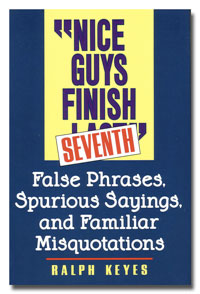
Leo Durocher is best remembered for saying, “Nice guys finish last.” He never said it. What the Brooklyn Dodgers’ manager did say, before a 1946 game with the New York Giants, was: “The nice guys are all over there. In seventh place.” Durocher’s words lacked pizzazz. Sportswriters perked them up, and gave America one of its most familiar misquotations.
Many of our best known sayings, phrases and quotations are inaccurate, misattributed, or both. “Nice Guys Finish Seventh” reveals that:
- “Any man who hates dogs and children can’t be all bad,” was said about W.C. Fields, not by him.
- “Winning isn’t everything, it’s the only thing,” was the slogan of UCLA coach Red Sanders, not Vince Lombardi.
- “The opera ain’t over ’til the fat lady sings,” came from an older saying: “Church ain’t out ’til the fat lady sings.”
- Winston Churchill did not originate the phrase “iron curtain,” and never said, “blood, sweat and tears.”
Hundreds of such examples illustrate Keyes’s Immutable Law of Misquotation: Misquotes drive out real quotes. “Certain things demand to be said,” he writes, “said in a certain way, and by the right person. Whether such comments are accurate is beside the point.”
Keyes confirms that William Tecumseh Sherman didn’t say “War is hell.” Nor did he vow, “If nominated, I will not run. If elected I will not serve.” According to Keyes such words voice observations we want made. Freud may never have said “Sometimes a cigar is just a cigar,” for example, but we certainly wish he had.
For a misquote to become familiar it must come from a well-known mouth. Take “You can’t trust anyone over 30.” Abbie Hoffman, right? Or was it Jerry Rubin? Mario Savio? Mark Rudd? All have been given credit for this 60s catch-phrase. Keyes discovered that its real originator was a student named Jack Weinberg. Remember him? Few do. That’s why Weinberg’s words were assigned to better known mouths.
Keyes calls this “the flypaper effect.” Orphan quotes or comments by unknowns routinely gravitate to a Churchill, a Lincoln, or a Twain. Other syndromes Keyes discusses include bumper stickering (condensing a long comment to make it more quotable), lip syncing (mouthing someone else’s words as if they were your own), and retro-quoting (putting words in the mouths of famous dead people). Separate chapters focus on misquotes in history, politics, show business, sports, literature and academia.
“Nice Guys Finish Seventh” is a fascinating, eye-opening book. It’s both fun to read and a reliable work of reference. By exhaustively researching the actual origins of famous remarks, Ralph Keyes has produced a provocative, authoritative guide to who actually said what.
“Nice Guys Finish Seventh” was
• excerpted in Reader’s Digest, People Weekly, Chicago Tribune Magazine
• featured in Parade
• author interviewed on NPR’s All Things Considered
Where to buy
Contents
Acknowledgments
Author’s Note
1. Why We Misquote
2. The Rules of Misquotation
3. Spurious Sayings
- Ralph Waldo Emerson
- Elbert Hubbard
- Carl Sandburg
- The Sixties and Seventies
- The Eighties
4. Let Them Eat Brioche
- From Corsica to Waterloo
- The Killing Fields of Waterloo
- Blood and Iron
- Dizzy
- Clemenceau
- Churchill
5. Founding False Phrases
- A Brand-New Country
- The War Between the Statements
- Word Wars
- Post-Wars
6. All Politics is Vocal
- The Misquote Tradition in Politics
- May We Quote You?
- Aides
7. All the President’s Misquotes
- Thomas Jefferson
- Andrew Jackson
- Abraham Lincoln
- Theodore Roosevelt
- Calvin Coolidge
- Herbert Hoover
- Franklin D. Roosevelt
- Ronald Reagan
- George Bush
8. The Twain Syndrome
- Wilson Mizner
- Alexander Woollcott
- Dorothy Parker
- Will Rogers
- Groucho Marx
9. Say it Again, Sam
- Cinema
- Mis-Remembered Lines
- Borrowed Lines
- Signature Lines
10. Say it Ain’t So!
- Boxing
- Baseball
- Football
11. The Literary Lift
- Oscar Wilde
- George Bernard Shaw
- Book Titles
12. Misquote U.
- Psychology
- Natural Sciences
- Political Science
- Fine Arts
- Creative Writing
- Economics
- Marxist Studies
- Theology
- Gender Studies
13. Could You Look it Up?
- Bibliography and Notes
Index
Excerpt
Quotation: The act of repeating erroneously the words of another. The words erroneously repeated.
Ambrose Bierce
Perish the man who said our good things before us.
Donatus
1: Why We Misquote
W. C. Fields’s best remembered saying is “Any man who hates dogs and children can’t be all bad.” Fields didn’t say it. These words were said about Fields, by Leo Rosten, as he introduced the comedian at a 1939 Masquers banquet in Los Angeles. Rosten, then a young sociologist studying the movie industry, found himself seated on the dais. After the meal he was invited to say a few words about the guest of honor. Unable to think of anything else, Rosten blurted out, “The only thing I can say about Mr. W. C. Fields, whom I have admired since the day he advanced upon Baby LeRoy with an icepick, is this: Any man who hates babies and dogs can’t be all bad.” According to Rosten his quip brought down the house. He later called it “one of those happy ‘ad libs’ God sends you.” Two weeks later Rosten’s line was mentioned in Time . At the time few people had heard of Leo Rosten. As a result, it didn’t take long for Rosten’s words to get put in a better-known mouth: that of Fields himself. It’s stayed there ever since.
But Rosten deserves credit for this line, right? Well, not exactly. In November, 1937 — nearly two years before the Masquers banquet — Harper’s Monthly ran a column by Cedric Worth about a New York cocktail party which took place in 1930. This party was dominated by a man who had a case against dogs. After leaving, Worth found himself in an elevator with a New York Times reporter. As the elevator made its way to the ground the reporter observed, “No man who hates dogs and children can be all bad.”
To be accurate, therefore, reference books should attribute “No man who hates dogs and children can be all bad,” to the Times reporter. His name was Byron Darnton. Byron who? That’s just the point. Who’s heard of Byron Darnton? Yet most of us know the name W.C. Fields. This is why Fields routinely gets credit for someone else’s words. He probably always will.
The case of W.C. Fields is surprisingly common. Even our most hallowed phrases are routinely misremembered. Many of our best known quotes have been inaccurately recorded, attributed to the wrong person, or both. In the course of this project I’ve discovered hundreds of examples of misquotation which I’ll discuss in chapters to come. For example:
- “Winning isn’t everything, it’s the only thing” was the slogan of UCLA football coach Red Sanders, not Vince Lombardi.
- “The opera ain’t over till the fat lady sings” was adapted from an older saying: “Church ain’t out till the fat lady sings.”
- “Elementary, my dear Watson,” does not appear in any of Arthur Conan Doyle’s books about Sherlock Holmes.
- Calvin Coolidge didn’t say, “The business of America is business.”
Leo Durocher never said “Nice guys finish last.”
As long as there have been quotes there have been misquotes. As a general rule: Misquotes drive out real quotes. This is the Immutable Law of Misquotation. Misquotation takes three basic forms: 1) putting the wrong words in the right mouth; 2) putting the right words in the wrong mouth; and, 3) Putting the wrong words in the wrong mouth.
During the hearings about Clarence Thomas’s Supreme Court nomination, Senate Judiciary Committee Chairman Joseph Biden quoted Shakespeare as saying, “Hell hath no fury like a woman scorned.” Senator Alan Simpson of Wyoming pointed out (correctly) that it was actually playwright William Congreve who wrote:
Heaven has no rage, like love to hatred turned,
Nor hell a fury like a woman scorned.
In the same play — The Mourning Bride — Congreve also wrote, “Music has charms to soothe a savage breast” (not “beast”).
In his 1713 play Cato, Joseph Addison wrote “The woman that deliberates is lost.” Reflecting our changing values, history first revised this to, “She who hesitates is lost,” then, “He who hesitates is lost.”
Many of our most cherished sayings have been re-worded by our memories. In the process many are improved. “When in Rome do as the Romans do”, for example, is a terser, more pointed version of what St. Ambrose was said to have advised St. Augustine in 387 A.D.: “If you are at Rome, live after the Roman fashion; if you are elsewhere, live as they do there.”
Misquotations often improve on the original. Like pebbles polished by ocean waves, common usage tends to edit, smooth and update original versions of popular sayings.
| **Common** Don’t look a gift horse the mouth. There is safety in numbers. Necessity is the mother of invention. If the shoe fits, wear it. You can’t have your cake and eat it too. To gild the lily. | **Original**Never inspect the teeth of a gift horse. In the multitude of counselors there is safety …the true creator is necessity, who is the mother of our invention If anyone fool finds the Cap fit him, let him wear it. Would both eat your cake and have your cake? To gild refined gold, to paint the lilly… |
The latter is from Shakespeare’s King John. Shakespeare could be history’s most misquoted figure. He wrote so many quotable lines that it’s easy to attribute all manner of orphan comment to him; anything that “sounds” Shakespearean. Anyone quoted as often as the Bard is bound to be misquoted. For example:
| **Popular** Discretion is the better part of valor. There’s method in his madness. Alas! poor Yorick. I knew him well. | **Actual**The better part of valor is discretion… (Henry IV) Though this be madness, yet there is method in’t. (Hamlet) Alas! poor Yorick! I knew him, Horatio. (Hamlet) |
The reason we misquote Shakespeare so routinely is that we generally consult our memory for quotations. Memory alone is a notoriously undependable work of reference. Novelist Evan Hunter discovered this when he wrote in the New York Times Book Review, “I believe it was Joseph Conrad who told us, “Never trust the teller, only trust the tale.” In fact, as a reader pointed out, it was D. H. Lawrence who wrote, “Never trust the artist. Trust the tale.” Hunter’s version actually improved the original. And Conrad wasn’t a bad guess; just not an accurate one. Evan Hunter let his memory be his guide and came up with a two-fer misquote.
Quoting from memory is like playing “Telephone,” the game in which a comment passed from mouth to ear along a line of children ends up totally distorted by the end. This process can be seen at work in one of the most re-quoted sayings of our times: Andy Warhol’s remark that in the future we all would be famous for 15 minutes. Warhol’s actual words, in the catalog of a 1968 exhibition, were, “In the future everybody will be world famous for 15 minutes.” Along the way something often got lost in transmission. Dozens of variations I’ve seen on this theme include:
“Now that everyone seems to have been famous for five minutes, as Andy Warhol predicted.”
“You know what Warhol said about everybody in America being famous for ten minutes….”
“What did Andy Warhol say — that everyone gets 15 seconds of fame?”
…Andy Warhol’s prediction — that everyone will be a celebrity for 15 seconds — has come true with a vengeance.”
“In art, everyone should be famous for 15 minutes.”
“Everybody is famous for 15 minutes.”
“‘In the future,’ the artist-seer Andy Warhol has promised, ‘there won’t be any more stars. TV will be so accessible that everybody will be a star for 15 minutes.'”
Warhol’s famous phrase is cited and mis-cited so often that it suffers double-trouble: garbling the words, and their source as well. As his memory fades we tend to talk about “15 minutes of fame” and skip attribution altogether. That’s how the pros do it. An axiom among public speakers is this: the first time you use a quote, introduce it by saying, “As Joe Doe once said….” The second time, “It’s been said that…” The third time, “As I’ve often said….”
Think of this as Three-Stage Quote Acquisition. Harry Truman was a master of the art. To explain his decision not to run for re-election in 1952, Truman quoted his old friend Harry Vaughan: “If you can’t stand the heat, get out of the kitchen.” A few months later Truman said in a speech, “The President gets a lot of hot potatoes from every direction and a man who can’t handle them has no business on the job. That makes me think of a saying that I used to hear from my old friend and colleague on the Jackson County Court. He said, ‘Harry, if you can’t stand the heat you better get out of the kitchen.” Eight years later Truman wrote in his autobiography, “I used to have a saying that applies here and I note that some people have picked it up: ‘If you can’t stand the heat, get out of the kitchen.”
By now Harry Truman is generally considered the author of this familiar saying. He has also been credited with such quips as “I don’t care what they say about me as long as they spell my name right,” and “It’s a recession when your neighbor loses his job; it’s a depression when you lose your own.” Both are old saws that were hardly original to Truman if he ever said them at all. But because they “sound like” him, and he is well known to us, Truman’s name has routinely been attached to words that weren’t his. This is a common fate of public figures. For years I quoted Lincoln’s apology for writing a long letter: he hadn’t the time to write a short one. After undertaking this project I learned that French philosopher Blaise Pascal made that observation three centuries ago. I also learned that Mark Twain never said the coldest winter he ever spent was a summer in San Francisco as I’d always believed (and often said).
This is how misquotes get born and perpetuated: Someone — ourself, say — wants to make a point during a conversation, a speech, or in a piece of writing. That person recalls a quotation which illustrates the point perfectly. Not being sure of the exact wording, the quoter uses the closest remembered version. He or she may also not be sure exactly who said the words in question, but — because they sound like Truman or Twain or Lincoln or Churchill — the quoter puts the quote in the mouth of a plausible noted figure; the one it most “sounds like.”
While reviewing Mikhail Gorbachev’s years in power, ABC-TV’s Ted Koppel concluded, “All in all, Gorbachev personified John F. Kennedy’s definition of courage: a man who showed grace under pressure.” You can see what the writer of Koppel’s line must have been thinking. Courage; John Kennedy wrote a book on courage; the classic definition of that quality must have been his. It wasn’t. Ernest Hemingway defined “guts” as “grace under pressure” in 1929, when John Kennedy was 12 years old.
This is the “sounds like” syndrome. Sayings of uncertain origin are routinely put in the mouth of the best known person they most sound like. Comments having to do with shady showmanship, for example, are routinely attributed to P.T. Barnum. “There’s a sucker born every minute,” is so commonly credited to him that it’s entered the category of “everybody knows Barnum said it.” He didn’t. Barnum Museum curator Richard Pelton calls this “one of the few things he didn’t say.” No modern biographer of Barnum takes this common attribution seriously. Among other things, the word “sucker” was not that common during the flamboyant showman’s heyday. “Humbug” was. Barnum used this word frequently, once saying “the people like to be humbugged.” Another early American term for a gullible hick was “jay.” A popular nineteenth century song included the line, “There’s a new jay born every day.” This could have inspired the modern version so commonly attributed to P.T. Barnum.
In his own search for the origins of “there’s a sucker born every minute,” Barnum biographer Arthur H. Saxon came up with two other possibilities. One was in an unpublished manuscript by Joseph McCaddon, the brother-in-law of James Bailey (of “Barnum & Bailey”), and no friend of Barnum’s. Dismissing any thought that Barnum ever said a sucker was born every minute, this manuscript attributed that sentiment to a notorious con man of the early 1880s named Joseph Bessimer. According to McCaddon, a New York police inspector said Bessimer told him, “There is a sucker born every minute, but none of them die.” This was the first time that the inspector had heard the expression. Alternatively, Barnum’s rival Adam Forepaugh reportedly observed that a sucker was born every minute during a newspaper interview. Asked if he might be quoted, Forepaugh replied, “Just say it’s one of Barnum’s slogans which I am borrowing for the occasion. It sounds more like him than it does me, anyway.”
All of these leads probably include elements of the truth. “There’s a sucker born every minute,” most likely grew out of the earlier “jay born every day” saying. The new version undoubtedly was popular among late nineteenth-century con men. After it showed up in newspapers, the saying made its way to P.T. Barnum’s lips, helped along by those who wished to imply he was a con. Not that help was needed. These words just sounded so much like Barnum that we naturally assumed he’d said them. We still do.
“Never give a sucker an even break,” is sometimes attributed to Barnum too, but no more accurately. “I don’t care what they say about me as long as they spell my name right,” also gets credited to the spiritual father of modern public relations, but with no more evidence than the sucker statements. This p.r. commonplace has also been attributed to turn-of-century Tammany Boss Timothy “Big Tim” Sullivan, Boston Mayor James Curley, fight promoter Chris Dundee, showman George M. Cohan and movie mogul Samuel Goldwyn as well as Harry Truman. It’s one of those nostrums which has been around as long as there was publicity to be garnered, and whose original author will probably never be known. But because it “sounds like” Barnum/Sullivan/Cohan/Goldwyn, “just spell the name right” gets pinned on one of them whenever we feel the need for a likely suspect as the source of that comment.
No source of modern quotations is cited more often, and more erroneously, than Winston Churchill. An Englishwoman I know once observed that “England and America are two countries divided by the same language.” Her American husband added, “Yes. Churchill.” Good guess. This certainly sounds like Churchill. In fact, however, that line is an orphan which is most often credited to George Bernard Shaw.
After filling his chest with air, a Philadelphia radio announcer intoned, “As Winston Churchill always said, ‘Luck is the residue of design.'” Baseball mogul Branch Rickey would have been surprised to hear his credo attributed to the British Prime Minister. But lots of orphan quotes end up in Churchill’s mouth. Churchill himself once apologized for misattributing a quote by saying, “I am reminded of the professor who in his declining hours was asked by his devoted pupils for his final counsel. He replied, ‘Verify your quotations.'” This pithy anecdote made Churchill’s point perfectly. The only problem was that it was apocryphal. Oxford professor Martin Joseph Routh was once asked what advice he’d give young scholars. “You will find it a very good practice always to verify your references, sir!” said Routh (who was still far from his deathbed). Churchill might have borrowed his garbled version of Routh’s advice from an 1897 speech by the Earl of Rosebery, who referred to “the advice given by one aged sage to somebody who sought his guidance in life, namely, ‘Always wind up your watch and verify your quotations.'”
We seldom need to do the former any more, and rarely do the latter. Among other things, it’s not possible to verify quotations completely. Short of owning tape recordings of original quotations made at the time they were uttered, one can only make educated guesses about what’s actually been said, and by whom. You would think that in an era of videotape, audio tape and databanks that misquotation would decline. It hasn’t. Even where accurate quotes are available — of movie lines on film, comments made on taped tv shows, or quotes taken from original pieces of writing — misquotes remain as common as ever. This is because our ability to find the exact wording and source of familiar quotations is beside the point. The point is to have things that need saying said by someone we’ve heard of. Accuracy is secondary. A pithy, pertinent misquote is preferred to one which is correct but tortured. Famous comments such as “Say it ain’t so, Joe,” or “Don’t trust anyone over 30,” gain widespread currency because they express so well a thought already on many minds. Whether such words were actually said, or by the person we thought said them, is beside the point.
When Muhammad Ali refused induction into the Army, he was widely quoted as saying, “No Viet Cong ever called me nigger.” This was a perfect marriage of anti-war and anti-racist sentiment. Better yet, it came straight from the mouth of a mega-celebrity thought to possess primitive folk wisdom. The only problem is that Ali never made this comment. “It’s wasn’t really his mind-set to say something in that way,” explained Ali biographer Thomas Hauser. “The companion thought of that comment is ‘people call me nigger in this country every day.’ I never heard Ali say ‘white people in this country call me nigger.’ He would attack racism. But he wouldn’t personalize it.” Despite extensive searching by himself and others, Hauser has never found the source of “no Viet Cong ever called me nigger.” He concluded that it was just one of those things that got picked up and passed around in the 60s. It was a comment we wanted Ali to make so badly that we made it for him.
A few years earlier, a similar fate befell General Motors President Charles E. Wilson. The comment for which we best remember Wilson is “What’s good for General Motors is good for the country.” That observation captured perfectly the smug arrogance of corporate titans. During General Motors’s downsizing in the early 1990s, this famous, fatuous remark was dusted off by commentators who wanted to portray GM’s attitude in a sound bite. But this is not what Wilson said. While testifying about his nomination as Secretary of Defense before the Senate Committee on Armed Services on January 15, 1953, Wilson was asked whether he could make a decision on behalf of the government which would adversely affect General Motors. “Yes, sir,” Wilson replied, “I could. I cannot conceive of one because for years I thought what was good for our country was good for General Motors, and vice versa.” This is similar to the more popular version, but not the same at all. We prefer the misquote, however, so that is the version which has stuck in the public mind.
Footnote: in the 1939 movie Stagecoach, a corrupt banker said: “And remember this: what’s good for the bank is good for the country.”
Wilson’s familiar misquotation is a good test of quote collections. Many still include the classic version. Others give varying reports of what they think Wilson said, and a range of dates and settings. Through its 15th edition in 1980, the venerable Bartlett’s Familiar Quotations not only got Wilson’s words wrong, but the year in which he said them (they thought it was 1952) and the setting too (Bartlett’s reported that Wilson testified before the “Senate Armed Forces Committee.” There is no such group). Their misreporting of his words — “What is good for the country is good for General Motors, and what’s good for General Motors is good for the Country.” — first appeared in Bartlett’s 1955 edition, duplicating the version in Clifton Fadiman’s An American Treasury which came out the year before. The Harper Book of American Quotations repeated Fadiman’s and Bartlett’s errors in 1988. Other quote collections are all over the board on what they think Wilson said, when, and where.
Relying on quote collections for accurate wording and citation is problematic. Their compilers have so many thousands of entries to include that they can’t possibly verify each one. In addition, quote compilers are promiscuous borrowers. As a result, errors wend their way from one collection to another. In one amusing example, the Oxford Dictionary of Quotations quoted Ulysses S. Grant as saying “I purpose to fight it out on this line if it takes all summer.” (emphasis added) A few years later the Macmillan Dictionary of Quotations had Grant purposing to do the same thing. So did The Bully Pulpit, a compendium of quotes by American presidents.
No book of quotations — including this one — can hope to be 100% accurate. The best one can hope for is to minimize errors. Quote collectors are humble people. They have to be. We usually start out planning to tease every entry back to its original source. It doesn’t take long to realize that this is an impossible dream. While producing a quote collection for the Library of Congress, Suzy Platt said of verifying its contents, “it really opened my eyes to the fact that you can’t be totally sure.”
New York Times columnist William Safire devotes more effort than the average quotemonger to determining who actually said what. He too has concluded that one can never be sure. In his columns and books, Safire takes pains to point out that any attribution of a quote must be considered tentative. Among other reasons, the readers Safire calls his “gotcha gang” love nothing better than calling gaffes to his attention. Safire’s British counterpart, Nigel Rees — host of a BBC radio program called “Quote … Unquote” — says his golden rule is this: “it is very dangerous ever to say that a particular person coined a phrase or that it came about in a definite way. There is almost always an example of earlier use. The furthest it is safe to go is to say that a certain person has popularized the phrase at a certain time.”
Consider “You can never be too rich or too thin.” This maxim is associated with any number of wealthy, skinny women. It has been attributed to Rose Kennedy, Diana Vreeland, the Duchess of Windsor and Babe Paley. (The last two most often.) In the early 1970s the Duchess of Windsor, had it inscribed on a throw pillow. No matter how rich and thin she may have been, the Duchess was not particularly clever and is unlikely to have coined this phrase. Babe Paley is a more promising candidate. The comely wife of CBS founder William Paley was known for her tart tongue. But no credible evidence exists that she coined this remark. The most likely candidate of all is one to whom the maxim is seldom attributed: Truman Capote. According to quote maven Alec Lewis, Capote said he observed you can’t be too rich or thin on “The David Susskind Show” in the late 1950s (probably 1959). Since kinescopes of Susskind’s shows are tied up in litigation, this cannot be confirmed. Capote’s biographer Gerald Clarke told me he has no evidence that the writer originated this phrase, but that he very well might have. Capote was close to Babe Paley and could have fed her the line.
As you can see, teasing quotes back to their original source is no easy task. But it’s fun, and illuminating to try. That’s what this book is: a literary detective game. It’s something I’ve been engaged in for the past two decades. That quest has taken me to the Library of Congress, New York Public Library, many smaller libraries, the Museum of Broadcasting, Theater Collections in New York and Philadelphia, movie studios, correspondence collections and various archives. Whenever possible I’ve written, called, and interviewed principals in person.
The fruits of my quest are gathered in this book. In it I’ve tried to take a fresh, skeptical look at many of our best known phrases, sayings and quotations. Are we sure that the words are accurate? Why? What is their source? Is that source primary or secondary? If the words are accurate, who said them? How do we know? What was the context? By trying to answer such questions, my hope has been to produce a book which is interesting to read and useful as a work of reference. In the process I’ve discovered that even well-known quotes are routinely mis-worded, misattributed and mis-cited in existing works of reference. This is why in the Source Notes I only give an original source as my reference when I’ve actually examined it. (Otherwise the citee is cited.)
The hardest task of all is to ascertain how a real quote became a misquote. Confirming that one person borrowed someone else’s remark doesn’t tell you whether that comment was original in the first place. It’s also far easier to prove who didn’t say something than to say who did. “There are a surprisingly large number of Americanisms which never passed the lips of those to whom they are attributed,” noted Suzy Platt of the Library of Congress. “How this manages to occur is always slightly inexplicable. The words do indeed strike a chord of truth with many of their audiences (regardless of who said them first), but without the cachet of the national figure, lose some of their impact in the dialogue.”
Take “You can’t trust anyone over 30.” Abbie Hoffman, right? Or was it Jerry Rubin? Mario Savio? Mark Rudd? All of them have been given credit for this clarion call of the 1960s’ student revolt. None actually said it, at least not first. The man who first publicly advised his peers not to trust anyone over 30 was Jack Weinberg. Remember him? Hardly anyone does. That’s why we so routinely put Weinberg’s words in better known mouths.
Here is how his motto became part of the national discourse: As student protests heated up at the University of California in 1964, a San Francisco Chronicle reporter named James Benet went to Berkeley to do a feature story on this new phenomenon. Jack Weinberg, then 24, was one of the dissidents Benet interviewed. Weinberg got the impression that the reporter was trying to bait him; to get him to admit that revolt was part of a Communist conspiracy. To get under Benet’s skin, he said, “We have a saying in the movement that you can’t trust anybody over 30.” Twenty-six years later, now long past 30 himself, Weinberg told me that those words just occurred to him on the spot. He thought they were original to him. Calling them a “movement saying” was his way of trying to give them more zing. Weinberg succeeded in getting a far bigger rise than he’d intended. After appearing in Benet’s article, his comment was repeated by Chronicle columnist Ralph Gleason. Soon it was buzzing all over the Bay Area, then around the country as a whole. Weinberg’s generational red-lining touched a nerve among over-30s. It confirmed their worst fears about how they were perceived by their children. When student activists realized how much this motto bugged their elders, many began to repeat “don’t trust anyone over 30” in earnest. Before long this became the defining slogan of an era when surly youth were seen as rudely elbowing their parents aside. In Weinberg’s words, “The phrase just resonated.”
Among the few 60s rebels to stay active in social causes (Greenpeace, most recently), Weinberg was chagrined that his most lasting to fame is this puerile remark. “It’s a bit disappointing,” he has observed, “that the one event that puts me in the history books — the one thing people ask me to comment on — is an off-the-wall put down I once made to a reporter.” To make matters worse, the reporter he was trying to put down as a reactionary turned out to be a veteran of progressive causes himself.
Once Weinberg’s slogan caught on, more prominent movement members began to get credit for it. Weinberg thought that Abbie Hoffman encouraged this process, but doesn’t think Jerry Rubin did. (In his book Growing (Up) at 37 Rubin refers to himself as “someone who had helped popularize the slogan “Don’t Trust Anyone Over 30.'”) How did he feel about so seldom getting credit for his own catch-phrase, juvenile as it might be?
“Amused?” said Weinberg.
“It’s certainly nothing I felt real possessive about,” he added. “I felt some of the people who claimed it deserved it more. It was more meaningful to their lives. At the same time there’s a certain sense of wanting to set the record straight. Even though it’s not something that’s central to my life, I guess there’s some need to be remembered for something.”
There are reasons that misquotation is so common. Certain things need to be said at certain times, and said by someone we’ve heard of. This is not a random process. Two axioms govern the process of misquotation. These axioms are:
1) Any quotation which can be altered will be.
2) Famous quotes need famous mouths.
Reviews
January 26, 2011
Up All Night Reader
Reference value aside, it’s the bumper harvest of good quotes that make the book so pleasurable.
January 26, 2011
RQ
Keyes’s book, which I would recommend to reference departments, is a fascinating compilation of well-known sayings, phrases and quotations that are inaccurate, misattributed, or both.
January 26, 2011
Parade
An interesting compendium.
January 26, 2011
Wilson Library Bulletin
Quotation collector and corrector Keyes traces the origins and restores the originals of several hundred familiar sayings from the worlds of sports, politics, entertainment, and literature. … [Source] notes document…
January 26, 2011
Montreal Gazette
Keyes points out that the prevalence of misquotes has not abated, notwithstanding the greater ability of technology to help record things accurately. Misquotes occur because we hear what and by whom we want to hear…
January 26, 2011
Minneapolis Star Tribune
You can tell what Keyes is up to from the title: He takes quotations we’re all familiar with and shows how and why they are really misquotes, and searches out the origin of phrases that have become almost part of the…
January 26, 2011
Louisville Courier-Journal
A book my friend Gene Shalit sent me the other day [is] called appropriately enough “ Nice Guys Finish Seventh.” … If you want to know more of who didn’t say what — including a whole list of things that Mark Twain never…
January 26, 2011
Tampa Tribune
Keyes has condensed 20 years of research into a newly released myth-buster called “ Nice Guys Finish Seventh”.
January 26, 2011
Booklist
Keyes’s research unearths interesting, often surprising facts about who said what when — as well as enough errors in standard references to suggest his volume deserves a place in most quotation collections.
January 26, 2011
Seattle Times
Lively, informed…Reading this is great fun.
Press
January 26, 2011
New York Times Magazine
The only thing necessary for the triumph of evil is that good men do nothing.” If you want to find out how some of us have broken our heads to find the coiner of that, get “Nice Guys Finish Seventh”: False Phrases…
January 26, 2011
New York Times Magazine
Icon-busting. William Safire
January 26, 2011
New York Times
I am indebted to Ralph Keyes’s new quotation corrector. Edmund Morris
January 26, 2011
All Things Considered
Ralph Keyes has come up with what he calls an immutable law of misquotation. Here it is: “Misquotes drive out real quotes.” And he’s researched and put together a book to prove it. Noah Adams
January 26, 2011
All Things Considered
Often pithy sayings we’ve always attributed to various famous figures, such as Winston Churchill, didn’t really come from their mouths. Ralph Keyes calls this “the flypaper effect.” Robert Siegel
On the internet
January 26, 2011
Internet
If you have Ralph Keyes’s book “Nice Guys Finish Seventh,” he has a great chapter on “The Rules of Misquotation that interpret the whole phenomenon of misquotations and misattributions very nicely. This book is a must…
January 26, 2011
Internet
See Bartlett’s Quotations … or, better still, Ralph Keyes, “Nice Guys Finish Seventh.”
January 26, 2011
Internet
An amusing popular book about misattributed quotations is “Nice Guys Finish Seventh” by Ralph Keyes, which is chock full of meticulous information on dozens of spurious quotations, many of which I used to quote…
January 26, 2011
Internet
I particularly like “Nice Guys Finish Seventh” by Ralph Keyes …
January 26, 2011
Internet
A definitive answer arose in the wonderful book “Nice Guys Finish Seventh”: False Phrases, Spurious Sayings, and Familiar Misquotations.
January 26, 2011
Internet
I found my reference: a marvelous little book by Ralph Keyes titled “Nice Guys Finish Seventh”.
What colleagues say
The correction of communication is one of the most fascinating and amusing of all intellectual pastimes. Almost all “standard quotations” are wrong and the stories of their rectification, so well told here by Ralph Keyes, give us great insight into human foibles and cultural biases.
Stephen Jay Gould
I have had occasion to study your great book, Nice Guys Finish Seventh, and consider it to have the best research of any quotation book ever published. I have always thought of your work as an inspiration and model.
Fred Shapiro, The Yale Book of Quotations
“Nice Guys Finish Seventh” is a delightful book. As another quotations collector, I enjoyed it very much.
Rosalie Maggio, The New Beacon Book of Quotations by Women
If you haven’t discovered this entertaining (and well researched) book, I encourage you to find a copy. It’s a delight to every quote sleuth who’s ever been involved in a fruitless search for a source.
Lynn M. Fox, University of Northern Colorado Library
Writer Ralph Keyes, who has carefully researched quotation origins in a book engagingly titled Nice Guys Finish Seventh…
Edward Gross, Embarrassment in Everyday Life
What readers say
Nice Guys Finish Seventh is deliriously wonderful. I ate it off the page. It’s exactly the kind of book I dote on and you have done a stupendous job. I didn’t find any errors and I love the thoroughness of the research. Yes, it probably was Truman Capote who said “too rich or too thin.” It’s the the kind of book that should sell forever and it’s also an important scholarly contribution.
Killington, VT
It’s a fun book that sets the record straight on a lot of sayings that have been altered and miscredited over the years, even in sources like Bartlett’s. … Good stuff.
Los Angeles, CA
Thoroughly enjoyed your Nice Guys Finish Seventh. Now going back to read some of your other works.
Oro Valley, AZ
I bought several copies to send to my children.
Baltimore, MD
I refuse to read it cover to cover, because then I’d be finished, and I’m having too much fun.
Columbus, OH
No sooner had I started your wonderful book Nice Guys Finish Seventh than I became aware of a misquote that appeared in an editorial of the Wall Street Journal.
Houston, TX
Thanks so much for writing (and doing the research for) Nice Guys Finish Seventh. You did a great job! It’s the best “misquotation” book I’ve seen. I not only enjoyed reading it, but learned a lot and have put some of it to good use in a project of my own.
San Francisco, CA
Ever since a friend gave me your nice book Nice Guys Finish Seventh last Christmas (forcing me to take back to the bookstore the copy I had already special-ordered for myself!), I have been meaning to write you. I like the whole idea of the book, and had for twenty years been compiling my own small list of phantom quotes …
Santa Cruz, CA
I am enjoying, and learning from your Nice Guys Finish Seventh . The category is not my only dish, but among those I relish.
Wellington, KS
I read, and enjoyed, your Nice Guys Finish Seventh, and your description of the incident with Durocher fits perfectly with the stories I heard of the incident, from Frank Graham and others. … As you indicated, most of the Yogi [Berra] stuff was dreamt up by others and attributed to him.
(former sportswriter) Teaneck, NJ
I thoroughly enjoyed your book Nice Guys Finish Seventh which I read just a few days ago. I always enjoy having Everything I Believe To Be True overturned every once in a while. You succeeded with this book.
Olympia, WA
I enjoyed very much reading your Nice Guys Finish Seventh. Like you, I am a collector of quotations and like you I am particular about the origin and authenticity of the quote. Your book was a great help.
Boulogne, France
I thoroughly enjoyed your insightful and entertaining book, Nice Guys Finish Seventh.
San Francisco, CA
You have a relaxed style and you found a good way to link the quotations and commentaries.
Toronto, Canada
Last night, I took “Nice Guys” to read on the train on my way to a dinner party with some literate friends. Your book caused a stir.
Chicago, IL
You can have no idea how much fun we’ve been having with your book around this house. I have a son who collects quotes, who has been quite challenged by it. And I read aloud from it from time to time to my wife..
Iowa City, IA
I was so interested by your work that I went to the D.C. Public Library to see if I could find the book. When I read it, I wanted to own a copy.
Washington, D.C.
My husband loved your book. He sat down and read it in two days right after Christmas (he’s a fast reader). Then he gave it to me with full of post-it notes marking things he thought I might enjoy. Last week I overheard him quoting you on something while “talking” (I call it arguing) with his brother.
Chicago, IL
Quiz
TEST YOUR QUOTE QUOTIENT
1) Who originally said, “Any man who hates dogs and children can’t be all bad”?
a) Leo Rosten c) Byron Darnton
b) W.C. Fields d) Don Rickles
2) “Winning isn’t everything, it’s the only thing” was the credo of:
a) Vince Lombardi c) Leo Durocher
b) Red Sanders d) all of the above
3) Who came up with the slogan, “Don’t trust anyone over 30”?
a) Mario Savio c) Jerry Rubin
b) Abbie Hoffman d) Jack Weinberg
4) “If men could get pregnant, abortion would be a sacrament” was coined by
a) Gloria Steinem c) a Boston cabdriver
b) Florynce Kennedy d) Betty Friedan
5) According to Woody Allen, what percentage of success is “just showing up”?
a) 90 c) 70
b) 80 d) 60
6) Andy Warhol said we would all be famous for 15
a) seconds c) days
b) minutes d) weeks
7) Liberace told his critics that all the way to the bank he
a) cried b) laughed
8) According to Jack Garner the vice-presidency wasn’t worth a pitcher of warm
a) spit b) piss
9) Charles E. Wilson said, “What’s good for General Motors is good for the country.”
True False
10) The Right Stuff was the title of a novel published in 1908.
True False
11) Winston Churchill first applied the term “iron curtain” to the Soviet Union.
True False
12) During the Battle of the Bulge, General Anthony McAuliffe’s response to a surrender demand was “Nuts!”
True False
13) Richard Nixon said he had “a secret plan” to end the Vietnam war.
True False
14) “Beam me up, Scotty,” was a common refrain in the original Star Trek.
True False
15) Andy Rooney often introduces his 60 Minutes commentary by saying, “Did you ever wonder why?”
True False
16) Which of the following Berraisms are considered authentic by Yogi Berra watchers?
a) It ain’t over till it’s over.
b) It’s deja vu all over again.
c) Baseball is 90% mental. The other half is physical.
d) You can observe a lot by watching.
17) Which of the following Goldwynisms are considered authentic by Samuel Goldwyn experts?
a) I can answer you in two words: “Im possible.”
b) I read part of it all the way through.
c) A verbal contract isn’t worth the paper it’s written on.
d) Include me out.
18) William Tecumseh Sherman is known to have said
a) War is hell.
b) War is cruelty and you cannot refine it.
c) Hold the fort! I am coming!
d) If nominated, I will not run. If elected, I will not serve.
19) Which American official first said he saw light at the end of the tunnel in Vietnam?
a) Dean Rusk c) William Westmoreland
b) Robert McNamara d) John F. Kennedy
20) Whom among the following used the words, “kinder, gentler”
before George Bush did?
a) Mario Cuomo c) Charlie Chaplin
b) Roy Orbison d) all of the above
Answers: 1-c; 2-b; 3-d; 4-c; 5-b; 6-b; 7-a; 8-b; 9-F; 10-T; 11-F;
12-T; 13-F; 14-F; 15-F; 16-a, d; 17-d; 18-b; 19-d; 20-d.
End notes
These notes indicate my sources of information and suggest leads for anyone interested in pursuing further the origins of specific quotations. I’ve tried in all cases to give the most obvious reference to text material for which sources are cited: the first few words of quotations, the names of key parties, or other identifying information.
In general, I’ve cited only the most pertinent sources (avoiding, for example, citing repeated illustrations of the same misquotation). Original sources of quotations are referred to only if they were actually examined. Otherwise, such citations are referred to along with the secondary source in which they’ve been reported. “Letter” refers to a letter to the author. “Interview” refers to an interview with a source by the author, in person or by telephone.
Sources listed in the bibliography are referred to by last name of author (or first name of title for publications without an author), and date of publication for authors with more than one entry. Publications cited frequently are referred to in the source notes by the following abbreviations:
Bartlett’s—Bartlett’s Familiar Quotations, fifteenth edition (1980) except where indicated.
CODP—The Concise Oxford Dictionary of Proverbs (1982).
Harper—The Harper Book of American Quotations (1988).
Home Book—The Home Book of Quotations, Classical and Modern, tenth edition (1964*).*
Hoyt’s—Hoyt’s New Cyclopedia of Practical Quotations (1922*).*
Macmillan—The Macmillan Dictionary of Quotations (New York*:* Macmillan, 1987, 1989).
MPMFP—The Macmillan Book of Proverbs, Maxims, and Famous Phrases (1948).
Morrow—The Morrow Book of Quotations in American History (1984).
ODEP—The Oxford Dictionary of English Proverbs, third edition (1970*).*
Oxford—The Oxford Dictionary of Quotations, third edition (1979, 1980*)* except where indicated.
Oxford Modern—The Oxford Dictionary of Modern Quotations (1991).
Reader’s Digest Treasury—The Reader’s Digest Treasury of Modern Quotations (1975).
Newspapers cited frequently are referred to by the following abbreviations:
BC*‑Boston Globe*
CT—Chicago Tribune
DDN—Dayton Daily News
NYDN—New York Daily News
NYT—New York Times
PDN—Philadelphia Daily News
PI—Philadelphia Inquirer
USAT—USA Today
WSJ—Wall Street Journal
WP—Washington Post
CHAPTER 1: WHY MISQUOTES DRIVE OUT REAL QUOTES
Bierce: The Devil’s Dictionary, New York: Dover, 1958, 106.
Donatus: Bent, iv.
Rosten: Saturday Review, June 12, 1976, 12; Leo Rosten, The Power of Positive Nonsense (New York: McGraw‑Hill, 1977), 113‑7; Safire 1989, 142; Morris, 21; Los Angeles Evening Herald and Express, February 17, 1939; Time, February 27, 1939, 30; H. Allen Smith, Lost in the Horse Latitudes (Garden City, NY: Doubleday, Doran, 1944), 191‑2.
Worth: Harper’s Monthly, November, 1937, 663; Will Fowler letter to LAT Calendar, March 30, 1986.
Darnton: Meyer Berger, The Story of The New York Times, 1851‑1951 (New York: Simon & Schuster, 1951), 460‑2.
Biden‑Simpson: Senate Judiciary Hearings on the Confirmation of Clarence Thomas, October 13, 1991.
Congreve, The Mourning Bride, 1697, III:1; I:1.
Addison, Cato, 1713, IV:1.
“Don’t look a gift horse,” MPMFP, 1182; CODP, 91.
“There is safety,” CODP, 196.
“Necessity,” Magill, 679‑80.
“If the shoe fits,” CODP, 31; King, 92.
“You can’t have,” (Heywood, 1546) MPMFP, 274; CODP, 109; Stimpson 1946, 163.
“gild,” William Shakespeare, King John, 1596‑7, IV:2.
“Discretion,” Henry IV, Part I, 1597, V:4.
“There’s method,” Hamlet, 1600, 11:2.
“Alas!” Ibid., V:1.
Warhol: catalog to exhibit of Andy Warhol photographs, Moderna Museet, Stockholm, February‑March 1968; Bob Colacello, Holy Terror: Andy Warhol Close Up (New York: HarperCollins, 1990), 1; NYT, July 7, 1987.
Dozens of variations: “Now that”: Robert Taylor, BG, October 1, 1977; “You know”: Roger Simon, Wild Turkey, 1974 (New York: Warner, 1986), 134; “What did”: Christine Kraft, Channel 39 (Philadelphia, PA), August 15, 1983; “Andy Warhol’s”: George Vecsey, NYT, August 15, 1982; “In the future”: Jack Hicks, TV Guide, August 2, 1980, 18; “In art”: wall display, Swarthmore-Rutledge K‑8 School, Swarthmore, PA, September 20, 1989; “Everybody is”: Dayton Journal Herald, August 31, 1977.
Truman: “If you can’t,” Time, April 28, 1952, 19; Public Papers, 1952, 1085‑1086; Mr. Citizen (New York: Bernard Geis Associates, 1960), 229.
“I don’t care,” John J. O’Grady, Creative Computing, July 1980, 64.
“It’s a recession,” (London) Observer, April 13, 1958, in Oxford Modern, 218.
Pascal: Blaise Pascal Pensees, The Provincial Letters, provincial letter 16, 571 (1941), in Platt, 389; King, 151.
Koppel: ABC‑TV. December 26, 1991.
Hemingway: Dorothy Parker, The New Yorker, November 30, 1929, 31.
Barnum: Pelton, interview, December 17, 19, 1991; Robert Edmund Sherwood, Here We Are Again: Recollections of an Old Circus Clown (Indianapolis: Bobbs‑Merrill, 1926), 192‑3; Stimpson 1946, 2‑3; A. H. Saxon, P. T. Barnum: The Legend and the Man (New York: Columbia University Press, 1989), 334‑7.
“Elementary”: Oxford Modern, 69; Partridge 1977, 56; “The Crooked Man,” in Sir Arthur Conan Doyle, The Memoirs of Sherlock Holmes (London: John Murray, 1893, 1974), 147; review of The Return of Sherlock Holmes, NYT, October 19, 1929; Rees 1984, 92‑3; Rees 1991, 53.
Ali: Thomas Hauser, Muhammad Ali: His Life and Times (New York: Simon & Schuster, 1991); interview, December 7, 1991.
Wilson: Platt, 71; NYT, January 23, 1953; Bartlett’s, 817; Fadiman, 194; Harper, 116.
Oxford, 233; Macmillan, 153; Bully Pulpit, Frost, 36.
Platt: interview, December 5, 1990.
Safire 1978, xii‑xiii; Rees 1989, 2.
“You can never be”: Duchess of Windsor: Esquire, August, 1973, 93; Ralph C. Martin, The Woman He Loved (New York: Simon & Schuster, 1973, 1974), 505; NYT, May 4, 1980; People, December 27, 1983‑January 3, 1984, 55. Paley: Philadelphia Magazine, October, 1978, 6; People, May 31, 1982, 58; Harvey A. Levenstein, Revolution at the Table (New York: Oxford, 1988), 205. Capote: Lewis, vii, 23; Clarke, interview, December 10, 1990.
Platt: xiii-xiv.
Weinberg: San Francisco Chronicle, November 15, 1964; interview, December 5, 1990; Gleason, San Francisco Chronicle, November 18, 1964; Washington Post, March 23, 1970; Bill of Rights Journal, Winter 1988, 15. Rubin, Growing (Up) at 37 (New York: M. Evans, 1976), 7.
CHAPTER 2: THE RULES OF MISQUOTATION
Sherman: Harper’s Weekly, June 24, 1871; William Tecumseh Sherman, Memoirs of Gen. W. T. Sherman, Written by Himself (New York: Charles L. Webster, 1891), 466; Lloyd Lewis, Sherman: Fighting Prophet (New York: Harcourt, Brace and Company, 1932), 631.
Pogo: Kelly, Mrs. Walt and Bill Crouch, Jr., ed., The Best of Pogo (New York: Simon & Schuster, 1982), 156, 224; Platt, 102.
Ford: CT, May 25, 1916; Allan Nevins and Frank Ernest Hill*, Ford: Expansion and Challenge* (New York: Scribner’s, 1957), 129‑42; Walter Karp, “Henry Ford’s Village,” in A Sense of History (New York: American Heritage, 1985), 659‑62.
De Gaulle: Ernest Mignon, Les Mots du General (Paris: Librairie Artheme Fayard, 1962), 57; Newsweek, October 1, 1962, 34; Oxford, 173; Lewis, x. Over 400 French cheeses, CT, December 1, 1991.
Longworth: Newsweek, February 11, 1974, 52; Ringo, 219; NYDN, February 14, 1933; Fleeson, Joseph P. Lash, Eleanor and Franklin (New York: Norton, 1971; Signet, 1973), 802; NYT, February 21, 1980. Longworth denial, Lash, 802. Lowell: A Fable for Critics (Freeport, NY: Books for Libraries Press, 1890, 1972), 78.
Armstrong: NYT, July 21, 1969, July 31, 1969; WP (Reuters), July 20, 1989; Clark DeLeon, PI, July 19, 1989, July 26, 1989. William Poundstone, Big Secrets (New York: Quill/Morrow, 1983), 183‑4.
Stein: “Sacred Emily,” in William Harmon, ed., The Oxford Book of American Light Verse (New York: Oxford University Press, 1979), 293; Rees 1979, 40; Rees 1984, 90; Rees 1991, 28; Green,725; Janet Hobhouse, Everybody Who Was Anybody: A Biography of Gertrud1e Stein (New York: Putnam’s 1975, 1976), 73, 139, 175, 185, 205.
Sutton: Willie Sutton with Edward Linn, Where the Money Was (New York: Viking, 1976), 120.
Lansky: Robert Lacey, Little Man: Meyer Lansky and the Gangster Life (Boston: Little, Brown, 1991), 284‑5, 315, 423. NYT, January 16, 1983.
Stengel: Robert Creamer, Stengel: His Life and Times (New York: Simon & Schuster, 1984), 299. Jarvis: Norman Lear letter to Newsweek, November 6, 1978, 8‑9.
Kissinger: Fallaci, The New Republic, December 16, 1972, 21; Mike Wallace letter to Playboy, December 1982, 16; Esquire, June 1975, 104; Henry Kissinger, The White House Years (Boston: Little, Brown, 1979), 1410.
Seattle: Susan Jeffers, Brother Eagle, Sister Sky: A Message from Chief Seattle (New York: Dial, 1991); Joseph Campbell, with Bill Moyers, The Power of Myth (New York: Doubleday, 1988) 34‑5; National Public Radio, Weekend Edition, June 8, 1991; Newsweek, May 4, 1992, 68.
Hitler: Beatty, Saturday Review, May 17, 1969, 10, December 20, 1969, 12; Esquire, November 1970,44; Platt, 33‑4; William O. Douglas, Points of Rebellion (New York: Vintage Books, 1969, 1970), 58; Parade, April 26, 1970; Boller and George, 45‑6.
Socrates: Forbes, April 15, 1966, 5, 85.
Zack: Paul Tsongas, Heading Home (New York: Knopf, 1984), 160.
“If men could get”: Ms., March, 1973, 89; Gloria Steinem, Outrageous Acts and Everyday Rebellions (New York: Holt, Rinehart and Winston, 1983), 8.
“the little man”: Safire 1978, 401‑2; Safire, NYT Book Review, December 24, 1978; Safire, NYT, March 22, 1980.
“weaned on a pickle”: Alice Roosevelt Longworth, Crowded Hours (New York: Charles Scribner’s, 1933; Arno Press, 1980), 337.
“a vast wasteland”: NYT, May 10, 1961; NYT, May 4, 1986; John Bartlow Martin, It Seems Like Only Yesterday (New York: Morrow, 1986), 203.
“chewing gum”: Simpson 1957, 233; Simpson 1964, 400; Simpson 1988, 377.
Wright: Fadiman, 838; Sullivan: Lippincott’s, March 1896, in Bartlett’s, 681; NYT, April 9, 1959 in Reader’s Digest Treasury; Oliver Wendell Holmes, The Autocrat of the Breakfast Table (New York: A. L. Burt, 1858, 1900), 121.
Anderson: RQ, Spring 1987, 291.
Wicker: NYT, January 1, 1982; NYT, July 27, 1963; Public Papers, John F. Kennedy, July 26, 1963, 603; NYT, July 27, 1963; Platt, 239; Herman Kahn, On Thermonuclear War (Princeton: Princeton University Press, 1961) 20, 40.
Colson: WSJ, October 15, 1971; Charles W. Colson, Born Again (Old Tappan, NJ: Fleming H. Revell, 1976), 57. Colson letter, March 17, 1992.
Tweed: Albert Bigelow Paine, Thomas Nast: His Period and His Pictures (New York: Chelsea House, 1980), 164, 197; Leo Hershkowitz, Tweed’s New York: Another Look (Garden City, NY: Anchor Press/Doubleday, 1978), xviii.
F.P.A.: Robert MacKenzie, TV Guide, March 11, 1978, 36; Levant, 163; Robert E. Drennan, ed., The Algonquin Wits (New York: Citadel Press, 1968), 36. Bevin: Macmillan, 433; Oxford Modern, 33; Rees 1984, 233; Sir Roderick Barclay, Ernest Bevin and the Foreign Office 1932‑1969 (London: Sir Roderick Barclay, 1975), 78.
Holmes: Jack Smith, Chicago Sun‑Times, February 14, 1977; Anthony and Sally Sampson, ed., The Oxford Book of Ages (Oxford: Oxford, 1985, 1988), 174; Fadiman, 783. Clemenceau: Macmillan, 400. von Wrangel: Smith, Chicago Sun‑Times, February 14, 1977.
“If people don’t want to come”: Berra: Phil Pepe, The Wit and Wisdom of Yogi Berra (New York: St. Martin’s, 1988), 151. Hurok: Time, October 1, 1979, 83. “I don’t care”: Goldwyn: Ezra Goodman, Bogey: The Good‑Bad Guy (New York: Lyle Stuart, 1965), 112. Cohan*:* John McCabe*, George M. Cohan: The Man Who Owned Broadway* (Garden City: Doubleday, 1973), 196; Fadiman, 833. Barnum: Garson Kanin, Hollywood (New York: Viking, 1974), 296. Truman: John J. O’Grady, Creative Computing, July 1980, 64. Curley: Vic Gold, P.R. as in President (Garden City: Doubleday, 1977), in Dickinson 1978, 34. Sullivan: Ringo, 159; Safire 1978, 574; Rees 1984, 60; Rees 1991, 11.
Longworth: Platt, 376; Miller, 103‑4; Carol Feisenthal, Alice Roosevelt Longworth (New York: G. P. Putnam’s, 1988), 161. Connelly: James R. Gaines, Wit’s End (New York: Harcourt, Brace, Jovanovich, 1977), 30; Howard Teichmann, Smart Aleck: The Wit, World and Life of Alexander Woollcott (New York: Morrow, 1976), 112; Malcolm Goldstein George S. Kaufman (Oxford: Oxford, 1979), 67.
Weiss: Sugar, 116. Duchess: Rees 1989, 229; Partridge 1977, 103. Duke‑Ewing: D. L. Stewart, DDN, October 1, 1991; Macmillan, 208.
Gorbachev aide: BG, August 22, 1991; Acheson: Macmillan, 3; Talleyrand, et al.: King, 388; Home Book, 337; Baker, 75.
“Living well”: Calvin Tomkins, Living Well is the Best Revenge (New York: Viking, 1962), 126; Herbert: Herbert, #524; Lyly: ODEP, 476.
Courter: Gay Courter, Flowers in the Blood (New York: Dutton, 1990), 553; interview, December 7, 1991; Walter Bagehot, Literary Studies, Volume One (New York: Dutton, 1879, 1911, 1951), 152.
Barnard: Printer’s Ink, December 8, 1921, 96; March 10, 1927, 114; Bartlett’s 12th, 1213; Rees 1991, 27; Macmillan, 409.
CHAPTER 3: POOR RICHARD’S PLAGIARISM
Canetti: Macmillan, 500.
Franklin: Esmond Wright, Franklin of Philadelphia (Cambridge: Belknap/Harvard, 1986), 53‑5; Carl Van Doren, Benjamin Franklin (New York: Viking, 1938), 110‑3, 266‑8; Carl Van Doren, in Meet Dr. Franklin (Philadelphia: The Franklin Institute, 1943), 232‑4. Theodore Hornberger, Benjamin Franklin (Minneapolis: University of Minnesota Press, 1962), 11‑2, 23‑6; Stuart A. Gallacher*,* “Franklin’s Way to Wealth; a Florilegium of Proverbs and Wise Sayings,” Journal of English and Germanic Philology, 48: 229‑51, April 1949; Charles W. Meister, “Franklin as a Proverb Stylist,” American Literature, 24: 157‑66, May, 1952; Robert H. Newcomb, “The Sources of Benjamin Franklin’s Sayings of Poor Richard,” Ph.D. diss., University of Maryland, 1957.
“An ounce of prevention”: Meister, 164.
“There are no gains”: MPMFP, 924; Newcomb, 292.
“A word to the wise”: MPMFP, 261; CODP, 250; King, 66; Meister, 161.
Newcomb: interview, December 26, 1991; Newcomb, 12, 50, 81, 228, 240, 367.
“Success has ruined”: Newcomb, 138, 351.
“A man in a passion”: Newcomb, 77, 313.
“For want of a nail”: Newcomb, 361; Herbert, Outlandish Proverbs #499.
“Love your neighbor”: Newcomb, 327; Herbert, #141.
“Marry your sons”: Newcomb, 88, 38; Herbert, #149.
“Nothing dries”: Newcomb, 328; Herbert, #659.
“At 20 years”: Newcomb, 110.
“Don’t throw stones”: Newcomb, 351; Herbert, #196; Howell: Newcomb, 351.
Newcomb: Newcomb, 16, 143, 158, 240; interview.
Fuller: Newcomb, 100.
“We do not inherit”: RQ, Fall 1990, 26; Celestial Seasonings Chamomile tea, box copy © 1987; RQ, Summer 1991, 474; Robert Keller, “Haida Indian Land Claims and South Moresby National Park,” The American Review of Canadian Studies, 20: 7‑30, Spring, 1990, 7; Newsweek, July 11, 1988, 24.
“A man is known”: RQ, Spring 1979, 285; Fall 1990, 25; William Law, Christian Perfection, A Contemporary Version by Marvin D. Hinten (Wheaton, IL: Tyndale House, 1986), 75; William Law, A Practical Treatise Upon Christian Perfection (London: William and John Innys, 1726; J. J. Trebeck, 1902), 269‑70.
“A foolish consistency”: “Self‑Reliance,” The Heart of Emerson’s Essays: Selections from His Complete Works (Boston: Houghton Mifflin, 1933), 103.
Emerson‑Thoreau: Platt, 286‑7; Shenkman 1991, 85‑6.
“Build a better mousetrap”: Stimpson 1948, 338‑9; Seldes 1987, 128. “If a man has good corn”: Journals of Ralph Waldo Emerson (Boston: Houghton Mifflin, 1912), vol. 8, p. 528.
The Fra, November 1908 in Freeman Champney, Art and Glory: The Story of Elbert Hubbard (New York: Crown, 1968), 204. Hubbard’s claim of quote: Champney, 204‑6; Kenneth Dirlam and Ernest E. Simmons, Sinners, This is East Aurora (New York: Vantage Press, 1964), 193‑200; Burton Stevenson, “The Mouse Trap,” The Colophon, December 1934, pages unnumbered; “More About the Mouse‑Trap,” The Colophon, Summer 1935, 71‑85; Home Book, 630‑1, 2275; “after Emerson students failed to find it,” Stevenson, The Colophon, 1934, sixth page; Elbert Hubbard, A Thousand & One Epigrams (Englewood Cliffs: Prentice‑Hall, 1911, 1973), 167; “Mr. Hubbard has a habit,” H. T. Morgan in The Philistine, July 1912, fifth page (pages unnumbered); “Always credited to Emerson,” Ibid.
Borrowings: A Collection of Helpful and Beautiful Thoughts (New York: Dodge Publishing, 1889), 52; Stevenson, The Colophon, 1934, 1935. “The fact that,” Stevenson, The Colophon, 1935, 85; “one can only wonder,” Ibid.
Champney, 205.
on Hubbard: Champney, Art and Glory, op. cit.; Dirlam and Simmons, Sinners, This is East Aurora, op. cit.; Charles F. Hamilton, As Bees in Honey Drown: Elbert Hubbard and the Roycrofters (South Brunswick: A. S. Barnes, 1973); Paul McKenna, A History and Bibliography of the Roycroft Printing Shop (North Tonawanda, NY: Tona Graphics, 1986); Bruce A. White, Elbert Hubbard’s The Philistine: A Periodical of Protest (1895‑1915) (Lanham, MD: University Press of America, 1989).
Hubbard colleague: Champney 202; Armstrong, Plain Truth, January 1982, 1; Edison, MPMFP, 283.
“Too many people”: Hubbard, A Thousand and One Epigrams, op. cit., 159; Hubbard, Roycroft Dictionary and Book of Epigrams (East Aurora, NY: Roycrofters, 1923), 154; Elbert Hubbard’s Scrap Book (New York: Wm. H. Wise & Co., 1923), 83; Oscar Wilde, The Picture of Dorian Gray (New York: Brentano’s, 1890, 1906), 67; Lady Windermere’s Fan, 1892, III.
“Never explain”: MPMFP, 728; Platt, 136; Hamilton, As Bees in Honey Drown, op. cit., 184; see Disraeli, Chapter four.
“Folks who can”: Hubbard, A Thousand and One Epigrams, op. cit., 64; Shaw, Maxims for Revolutionists in Man and Superman (London: Constable, 1931), 213.
“The reward of”: A Thousand and One Epigrams, op. cit., 82; Emerson, Essays, Second Series: New England Reformers, in Stevenson, The Colophon, 1934, fifth page.
“Anything that has charms”: Hubbard, Roycroft Dictionary and Book of Epigrams, op. cit., 41.
“Life is”: Hubbard, Ibid., 141; A Thousand and One Epigrams, op. cit., 136; O’Malley, The Literary Digest, November 5, 1932, 39.
Sandburg: “When the future generations”: Penelope Niven, Carl Sandburg: A Biography (New York: Scribner’s, 1991), 68; “As a poseur”: Harry Golden, Carl Sandburg (Cleveland: World, 1961), 59. See also North Callahan, Carl Sandburg: His Life and Works (University Park, PA: Pennsylvania State University Press, 1987).
Sandburg: Carl Sandburg, Good Morning, America (New York: Harcourt, Brace, 1928); The People, Yes (New York: Harcourt, Brace, 1936).
Sandburg, The People, Yes, op. cit., 43.
James A. Newman letter reprinted in newsletter of Polaris Action, New London, CT, November 1961.
McCall’s, October 1966, 26.
“Suppose they gave a war . . .”: Guthrie: Jonathan Green, The Book of Rock Quotes (New York: Omnibus Press, 1977), 65; Ginsberg: Oxford Modern, 90.
“Do your own thing.”: Safire, NYT Magazine, February 15, 1981, March 15, 1981, April 12, 1981; Safire 1984, 118‑9; Chaucer, Canterbury Tales (New York: Holt, 1928), “The Clerkes Tale,” 342, line 652.
“Today is”: Dederich: Platt, 343; Macmillan, 139; RQ, Summer, 1975, 337; RQ, Winter, 1978, 184; RQ, Winter, 1979, 110.
“Keep on truckin’ “: Thomas Marema, “Who is this Crumb?,” NYT Magazine, October 1, 1972; Green, 706; Rees 1991, 41; Flexner, 312, 382.
“You’re either part”: Cleaver, Robert Scheer introduction to Eldridge Cleaver: Post‑Prison Writings and Speeches (Random House, 1969), xxxii; Newsweek, September 16, 1968, 30; Gallagher, Reader’s Digest Treasury, 236.
“We are the people”: Von Hoffman, We Are the People Our Parents Warned Us Against (New York: Quadrangle, 1967); Rees 1989, 157‑8.
“Life is what happens”: Macmillan, 325; Harper, 344; Rees 1989,124; Rees, 91, 23. La Mance: Peter, 305; Barnes & Noble, 210. Saunders: Reader’s Digest, January 1957, 32. Talmadge: Rowes, 106.
Motta: PDN, May 8, 1978; Philadelphia Bulletin, May 8, 1978; WP, May 8, 1978, June 11, 1978; Sugar, 37; CODP, 171; Platt, 341.
Cook: RQ, Winter 1985, 173; CODP, 171; Safire, NYT Magazine, February 15, 1987.
Cook in quote collections: Macmillan, 403; Rees 1984, 58; Oxford Modern, 60; Platt, 341.
Fabia Rue Smith and Charles Rayford Smith, Southern Words and Sayings (Jackson, MS: Office Supply Company, 1976), 6.
Bethard: interview, May 11, 1992.
Holcomb: interview, October 1, 1991.
Inman, Ingraham: interviews, December 14, 1991.
CHAPTER 4: LET THEM EAT BRIOCHE
Strunsky: Simeon Strunsky, No Mean City (New York: Dutton, 1944), 274.
Rousseau: Jean Jacques Rousseau, Confessions, Book 6, 254; Bergen Evans, The Spoor of Spooks (New York: Knopf, 1954), 63; Home Book, 1571; MPMFP, 274‑5. Duchess of Tuscany: Alphonse Karr, Les Guepes (1843), in Burnam 1975, 139; Fabulous Fallacies, 150. Marie Therese: Louis XVIII, Relation d’un Voyage a Bruxelles et a Coblentz en 1791 (Paris, 1823) in Oxford, 329; Platt, 253‑4; Nesta M. Weber letter to Times, April 29, 1959. John Peckham: John Ward letter to Times, April 30, 1959.
Louis XIV: Bent, 338‑42; King, 178‑9; Walsh, 627; Voltaire, The Age of Louis X1V (New York: Dutton, 1751, 1926, 1961), 257‑8; Olivier Bernier, Louis XIV (New York: Doubleday, 1987), 97.
“I disapprove”: S. G. Tallentyre, The Friends of Voltaire (London: John Murray, 1906), 199; Reader’s Digest, June 1934, 50. Hall, “I did not intend”: NYT Book Review, September 1, 1935, 19.
“two o’clock”: from Las Cases, Memorial de Ste‑Helene (1823) in Bartlett’s, 421; MPMFP, 436. Thoreau: Henry David Thoreau, Walden (New York: Holt, Rinehart and Winston, 1854, 1948), 97. Theroux: Paul Theroux, Mosquito Coast (Boston: Houghton Mifflin, 1982), 10, 97.
“From the sublime”: Bartlett’s, 420; Home Book, 1725; MPMFP, 1987; Walsh, 1038; King, 78. Paine: Thomas Paine, The Age of Reason (New York: Putnam’s, 1795, 1890), 107.
“The English are a nation”: Walsh, 1007; CODP, 65‑6; Stimpson 1946, 339‑40; Bent, 406. Adam Smith, An Inquiry into the Nature and Causes of the Wealth of Nations (Edinburgh: Adam and Charles Black, 1838, 1853), 276.
“An army travels”: Christopher Hibbert, Waterloo: Napoleon’s Last Campaign (New York: Mentor, 1969), 36; Oxford, 359; CODP, 6. Frederick the Great: Home Book, 1863.
Cambronne: King, 159; Bartlett’s, 421; Bartlett’s 9th, 810; Oxford, 128; Home Book, 2127; MPMFP, 2251‑2; Hoyt’s, 844; Les Miserables, Book 1, Chapt. 14.
“Up, guards”: Bent, 564, 618; Hoyt’s, 859; Walsh, 434; Boller and George, 130; Sir William Fraser, Words on Wellington (London: John C. Nimmo, 1889), 96‑7.
“The battle of Waterloo”: Elizabeth Longford, Wellington: The Years of the Sword (New York: Harper & Row, 1969), 16‑17; letter to Times: Rees 1989, 218; Seldes 1960, xiv; Count Charles de Montalembert*, De L’Avenir Politique de l’Angleterre,* 1856, in Longford, Wellington, op*.* cit., 16; Rees 1989, 218. Fraser, Words on Wellington, op*.* cit., 138.
“Blood and iron”: Frederic B. M, Hollyday, ed., Bismarck (Englewood Cliffs, NJ: Prentice‑Hall, 1970), 16‑7; Emil Ludwig, Bismarck: The Story of a Fighter (Boston: Little, Brown, 1927), 26‑7; Louis L. Snyder, The Blood and Iron Chancellor (Princeton, NJ: Van Nostrand, 1967) 126‑7; Latham, 197; Walsh, 559‑60; MPMFP, 2449.
“If you like laws and sausage”: Platt, 190. Talmadge: The Reader, November 25, 1977, in Baker, 196. Jim Buchy, DDN, September 8, 1991.
“one who has missed”: Robert Manning, NYT, June 8, 1983; Latham, 208; Mencken, 617.
“peace with honor”: Rees 1989, 155; Safire, 1978, 522‑4; Bent, 47‑8; Latham, 50; Walsh, 879‑80; Bartlett’s, 727; Coriolanus, III: 2.
“That depends”: Cerf, 256; Harris, 16; Warren Clements, Toronto Globe & Mail, July 30, 1991; Platt, 74; Sir Charles Petrie, The Four Georges (Boston: Houghton Mifflin, 1936), 132‑3.
Disraeli plagiarism: Robert Blake, Disraeli (New York: St. Martin’s, 1967), 146, 335.
“I only wish”: Ringo, 200; Oxford, 336. “Everything comes”: MPMFP, 2440; Pearson, 30. “Yes, I am a Jew”: MPMFP, 1269; Home Book, 1011; Harris, 67, 220. “Exhausted volcanoes”: Bent, 46‑7; Safire, NYT Magazine, February 3, 1985; Safire 1990, 161.
“lies, damned lies”: Mark Twain, Mark Twain’s Own Autobiography (Madison, WI: University of Wisconsin Press, 1924, 1990), 185; Tripp, 185, 612; Orrin Riley, “Lies, Damn Lies, and Disguises,” STATS, Fall 1991, 8; Home Book, 1112; MPMFP, 802; Bibby, Quotes, Damned Quotes, And . . . . (Edinburgh: John Bibby, 1983, 1986), 29, 50; Journal of the Royal Statistical Society, 59: 38‑118, 1896, 87; Platt, 333.
“Never complain”: John Morley, The Life of William Ewart Gladstone (New York: Macmillan, 1903, Scholarly Press, St. Clair Shores, MI, 1972), 123. Baldwin: Harold Nicolson, The War Years, 1939‑1945: Volume II of Diaries and Letters (New York: Atheneum, 1967), 307. Royal Navy: Partridge 1977, 152; John Wayne: Fennell, 90. Henry Ford II: Robert Lacey, Ford (Boston: Little, Brown, 1986), 591; Elmore Leonard, The Switch (New York: Bantam, 1978), 204.
“The good Lord”: J. Hampden Jackson, Clemenceau and the Third Republic (New York: Macmillan, 1948), 183; Oxford, 152; Ringo, 229.
“I accuse”: Rees 1989, 8.
“War is too important”: Jackson, Clemenceau, op. cit., 228; Georges Suarez, La Vie Orgueilleuse de Clemenceau (Paris: Editions de France, 1930), 172; Platt, 365; John Bailey, Letters and Diaries (London: John Murray, 1935), 176; Samuel, 226.
“America is the only nation”: Esquire, January 1980, 7; The Penguin Dictionary of Modern Humorous Quotations (New York: Viking, 1986, Penguin, 1987), 14. Bendix, Saturday Review of Literature, December 1, 1945, 9.
“Any man”: Cerf, 258; Seldes 1985, 157; Benham, 751; RQ, Winter 1977, 164.
“And you madam”: Macmillan, 478; Harris, 173; William Manchester, The Last Lion (Boston: Little, Brown, 1983), 810; Fields: Wallace Markfield, NYT Magazine, April 24, 1966, 116; Richard J. Anobile, ed., Drat!: W. C. Fields in His Own Words (New York: Signet, 1969), 43.
“If I were your husband”: Manchester, 34; Elizabeth Langhorne, Nancy Astor and Her Friends (New York: Praeger, 1974), 57; Consuelo Vanderbilt Balsan, Glitter and Gold (New York: Harper & Brothers, 1952), 204‑5. Thayer: April 27, 1971. Lloyd George: Harris 131. Dizzy Dean, Cerf, 305.
“There but for the grace of God”: Harris, 174; Rees 1984, 106; Ringo, 194, 279; Boller and George, 96‑7.
“Atlee is a very modest man”: Udall, xiii; Ringo, 183. “A sheep”: Harris, 164; Rees 1984, 106; Safire 1978, 643; Safire, NYT Book Review, December 24, 1978.
Churchill on Bartlett’s: Winston S. Churchill, A Roving Commission (New York: Scribner’s, 1930, 1949), 116.
“it has been said”: Oxford Modern, 55; Platt, 83.
“blood, sweat and tears”: John Donne, An Anatomie of the World, The Complete Poetry of John Donne (New York: New York University Press), 1968, 284; Lord Byron, The Age of Bronze, The Works of Lord Byron (New York: Scribner’s, 1901), 571; Lord Alfred Douglas, The Collected Poems of Lord Alfred Douglas (London: Martin Secker, 1919), 121, 57; Boller and George, 13; Henry James, The Bostonians (New York: Modern Library, 1886, 1956), 186; Winston S. Churchill, The Unknown War (New York: Scribner’s, 1931), 1.
“iron curtain”: Safire 1978, 340; Ignace Feuerlicht, “A New Look at the Iron Curtain,” American Speech, 30:186‑9, 1955. Englishman: Ibid., 186. Abbé de Pradt: Friedrich Henn, Encounter, January 1966, 89. Wells: H. G. Wells, The Food of the Gods (New York: Dover, 1904), 789. Belgian Queen: Emile Hinzel in Historie Illustrée de la Guerre du Droit, vol. II, 407, in Henn, Encounter, 89; Bartlett’s, 746; Seldes 1985, 123 (citing Bernard Baruch as source). Crile: George Crile, A Mechanistic View of War and Peace (New York: Macmillan, 1915), 69. Rozanov: V. V. Rozanov, Solitairia, The Apocalypse of Our Times, translated by S. S. Kotelyiansky (New York: Boni & Liveright, 1918, 1927), 148. Snowden: Ethel Snowden, Through Bolshevik Russia (London: Cassell, 1920), 32. American magazine article: P. Mohr, Information About Eastern Questions, 1921, in Henn, Encounter, 89. Goebbels: Das Rech, February 23, 1945, in Seldes 1985, 79; Reuters, February 23, 1945, in Allan Fotheringham, MacLean’s, June 6, 1983, 56. von Koosigk: Times of London May 3, 1945. Churchill cable (May 12, 1945): Winston S. Churchill, Triumph and Tragedy (Boston: Houghton Mifflin, 1953), 573. Sunday Empire News (October 21, 1945), St. Vincent Troubridge, in American Speech, 26: 49‑50, 1951.
CHAPTER 5: FOUNDING FALSE PHRASES
Henry: William Wirt, Sketches of the Life and Times of Patrick Henry (Freeport, New York: Books for Libraries Press, 1817, 1836, 1970), 74‑85.
French journal: “Journal of a French Traveller in the Colonies, 1765, I,” American Historical Review, 26:726‑47, 1921, 745. Freeman: Douglas Southall Freeman, George Washington: A Biography (New York: Scribner’s, 1951), vol. 3, 136.
“give me liberty”: Wirt, 132‑43; Freeman, George Washington, op. cit., 404.
Boorstin: Daniel Boorstin, The Americans: The National Experience (New York: Random House, 1965), 309, 308.
“Taxation without representation”: Boorstin, Ibid., 309; Edward Channing, A History of the United States (New York: Macmillan, 1924), 4‑5; Samuel Eliot Morison in Dictionary of American Biography (New York: Scribner’s, 1934), vol. 14, 102.
“Where there is liberty”: Otis: Bartlett’s, 367. Franklin: Mencken, 682; Platt, 201. Paine: Alfred Owen Aldridge, Man of Reason: The Life of Thomas Paine (Philadelphia: Lippincott, 1959), 169.
“Eternal vigilance”: Platt, 200; Bartlett’s, 397; Stimpson 1946, 5‑6; Home Book, 1106; MPMFP, 1388.
“Don’t fire”: Richard Frothingham, History of the Siege of Boston and of the Battles of Lexington, Concord and Bunker Hill (Boston: Little, Brown, 1849, 1903), 140; Bartlett’s, 368, 358; Harper, 65; Burnam 1975, 69‑70.
“There, I guess”: William M. Fowler, Jr., The Baron of Beacon Hill: A Biography of John Hancock (Boston: Houghton Mifflin, 1980), 213; Barrett Williams, BG, January 21, 1962.
“We must all hang together”: P.M. Zall, ed., Ben Franklin Laughing: Anecdotes from Original Sources by and About Ben Franklin (Berkeley: University of California Press, 1980), 153‑4; Carl Van Doren, Benjamin Franklin, op. cit., 551‑2; Freeman Hunt, American Anecdotes (Boston: Putnam & Hunt, 1830), vol. 1, 97; The American Joe Miller (Philadelphia: Carey and Hart, 1839), 181; Jared Sparks, The Works of Benjamin Franklin (Boston: Hilliard Gray, 1840), 408.
“I only regret”: Burnam 1975, 104; Ringo, 315; Lewis, x; Allentown (PA) Call‑Chronicle, September 15, 1976; George Dudley Seymour, Captain Nathan Hale, Major John Palsgrave Wyllys, A Digressive History (New Haven: George Dudley Seymour, 1933), 28; George Dudley Seymour, Documentary Life of Nathan Hale (New Haven: George Dudley Seymour, 1941), xxxii; 85‑7, 292, 376‑82, 402, 409‑10, 452‑4; Judith Ann Schiff, “Old Yale: Nathan Hale’s Many Faces,” Yale, Summer 1988, 16; Campbell, Maria (Hull), Revolutionary Services and Civil Life of General William Hull: Prepared from His Manuscripts, by His Daughter (New York: Appleton, 1848), 38; Addison, Cato, IV:4.
“I have not yet”: Platt, 305; Samuel Eliot Morison, John Paul Jones: A Sailor’s Biography (Boston: Little, Brown, 1959), 236, 240‑2; Rush, The Autobiography of Benjamin Rush (Princeton: Princeton University Press, 1948), 157; Morison, Ibid., 236.
“Millions for defense”: The South Carolina Historical and Genealogical Magazine, vol. 1, 1901, 100‑3, 178‑9; Bombaugh, 131; Spinrad, 103; Platt, 156; State Papers and Publick Documents of the United States (Boston: T. B. Wait and Sons, 1817), vol. 3, 492; Albert J. Beveridge, The Life of John Marshall (Boston: Houghton Mifflin, 1916), 349‑50.
“Don’t give up”: Harry L. Coles, The War of 1812 (Chicago: University of Chicago Press, 1965), 86; Bombaugh, 388‑9; Home Book, 62; MPMFP, 2091; John White Chadwick, “Mugford’s Victory,” in Burton Stevenson, Poems of American History (Boston: Houghton Mifflin, 1936), 174‑5; Motor‑Boating, October 1965, 72; Dictionary of American History (New York: Scribner’s, 1940, 1976), vol. 2, 364; Walsh, 1004‑5; Platt, 189.
“Damn the torpedoes”: A. T. Mahan, Admiral Farragut (New York: Greenwood Press, 1895, 1968), 278; Christopher Martin, Damn the Torpedoes! (New York: Abelard‑Schuman, 1970), 258.
“Shoot if you must”: Samuel T. Pickard, Life and Letters of John Greenleaf Whittier (Boston: Houghton Mifflin, 1894), vol. 2, 454‑60; Boller and George, 28‑9; Shenkman, 1991, 95‑6.
“Hold the Fort”: Woods, 153; Lloyd Lewis, Sherman: Fighting Prophet (New York: Harcourt, Brace, 1932), 426; Home Book, 65; MPMFP, 869; Rees 1989, 84; Rees 1991, 109‑10; Oxford, 88.
“War is hell”: Sherman, Memoirs, op. cit., vol. 2, 126; Basil Liddell Hart, Sherman: Soldier, Realist, American (New York: Praeger, 1958), 310; James Merrill, William Tecumseh Sherman (New York: Rand McNally, 1971), 238, 259, 298, 379‑80; Lloyd Lewis, op. cit., 635‑7; Ohio State Journal, August 12, 1880.
Forrest: “I always”: James Harrison Wilson, Under the Old Flag (New York: Appleton & Co., 1912), 184; “I just took”: Basil W. Duke, Reminiscences of General Basil W. Duke, C.S.A., (Garden City, NY: Doubleday, 1911), 345‑6; “I got there”: Richard Taylor, Destruction and Reconstruction: Personal Experiences of the Late War (New York: Longmans, Green, 1955), 244. See also, Donn Piatt, General George H. Thomas (Cincinnati: Robert Clarke, 1893), 599, and John Watson Morton, The Artillery of Nathan Bedford Forrest’s Cavalry (Kennesaw, GA: Continental, 1909, 1962), 198. Memphis Commercial Appeal, May 14, 1905. Ralph Selph Henry*, “First With the Most” Forrest* (Indianapolis: Bobbs‑Merrill, 1944), 18‑9. Confederate General’s memoir: Taylor, Destruction and Reconstruction, op. cit., 244. “The mostest”: Oxford English Dictionary, second edition, vol. 9, 1117; Rees 1989, 82‑3; Rees 1991, 109; New York Tribune, May 27, 1918; NYT, May 28, 1918. Foote, PBS, September 25, 1990. Bartlett’s, 583.
“The only good Indian”: Edward Sylvester Ellis, The History of our Country (Cincinnati: Jones Brothers, 1900), 1483; Michael V. Sheridan, Personal Memoirs of Philip Henry Sheridan (New York: Appleton, 1902), 464‑5. “If I owned Texas”: Stimpson 1946, 398‑9; Fadiman, 85; Harper, 231; Morrow, 264. Paul Hutton, Phil Sheridan and His Army (Lincoln, NE: University of Nebraska Press, 1985), 180. Cavanaugh: The Congressional Globe, May 28, 1868, 2638. “the proverb”: Ellis Paxson Oberholtzer, A History of the United States Since the Civil War (New York: Macmillan, 1926), 357.
“You furnish the pictures”: William Randolph Hearst, Jr., with Jack Casserly, The Hearsts: Father and Son (New York: Roberts Rinehart, 1991), 38; W. A. Swanberg, Citizen Hearst (New York: Scribner’s, 1961), 107‑8; John K. Winkler, William Randolph Hearst: A New Appraisal (New York: Hastings House, 1955), 95‑6; James Creelman, On the Great Highway (Boston Lothrop, 1901), 177‑178; Joyce Milton, The Yellow Kids: Foreign Correspondents in the Heyday of Yellow Journalism (New York: Harper & Row, 1989), xii‑xiii; Pauline Kael, The Citizen Kane Book (Boston: Little, Brown, 1971, Bantam, 1974), 94; The New Yorker, February 27, 1971, 62.
“war to end all wars”: H. G. Wells, The War That Will End War (London: F. & C. Palmer, 1914). Wells discussed claim: Liberty, December 29, 1934, 4‑7.
“Lafayette”: John J. Pershing, My Experience in the World War (New York: Frederick A. Stokes, 1931), 93. Bartlett’s 14th, 856, 15th, 693.
“Only those”: Home Book, 2298d; MPMFP, 1419; Representative Speeches of General of the Army Douglas MacArthur (Washington, D.C.: U.S. Government Printing Office, 1964), 3; Theodore Roosevelt, The Great Adventures (vol. 19 of The Works of Theodore Roosevelt, 1926), 243, in Platt, 214.
“I shall return”: Representative Speeches, op. cit., vi; William Manchester, American Caesar (Boston: Little, Brown, 1978; Dell, 1979), 311‑3; Michael Schaller, Douglas MacArthur (Oxford: Oxford 1989), 62.
“In war”: Representative Speeches, op. cit., 19; Dwight D. Eisenhower, Letters to Mamie, John S. D. Eisenhower, ed. (Garden City, NY: Doubleday, 1978), 203; Harper, 578.
“Old soldiers never die”: Representative Speeches, op. cit., 20; Home Book, 2298h; CODP, 168; Oxford Modern, 82; Platt, 324‑5; Rees 1984, 70‑1; Rees 1991, 26. Safire: Safire 1978, 482.
“eyeball to eyeball,” Rusk, Saturday Evening Post, December 8, 1962, 16; Safire, NYT Magazine, October 21, 1979. “light”: Kennedy, December 12, 1962, in Public Papers, December 12, 1962, 870. Navarre: Time, September 28, 1953, 22; RQ, Fall 1981, 20; A Supplement to the Oxford English Dictionary, 1986, 1015; Rees, 1984, 212; Rees 1991, 226‑7.
“A secret plan”: Safire, NYT Magazine, September 9, 1984; Safire 1988, 219‑21; John Chancellor and Walter R. Mears, The News Business (New York: Harper & Row, 1983), 30‑31; Richard M. Nixon, RN: The Memoirs of Richard Nixon (New York: Grossett & Dunlap, 1978), 298.
“Guns and butter”: Oxford, 229; Home Book, 2298d; Baker, 330; Rees 1984, 228‑9; Safire 1978, 282.
Give ulcers: Frost, 137. “Hold it”: Bill Adler, ed., The Johnson Humor (New York: Simon and Schuster, 1965), 80; Bill Moyers, interview, June 15, 1977.
CHAPTER 6: LIP‑SYNC POLITICS
Safire 1978, xii.
Schroeder: Patricia Schroeder, interview, February 17, 1992; Dan Buck, interview, December 7, 1990; Congressional Record, August 2, 1983; NYT, August 9, 1983; People, August 22, 1983, 88; “Teflon candidate,” Public Opinion, April/May 1984, 17; “Teflon coated,” NYT (editorial), March 1, 1987; Bush: Denver Post, Rocky Mountain News, May 5, 1984.
Schroeder comment, interview, February 17, 1992.
“It’s not what he doesn’t know”: NYT, October 13, 1984, October 18, 1984. Copelands, 779. The Complete Works of Artemus Ward (Charles Farrar Browne) (New York: G. W. Dillingham, 1901), 25; The Complete Works of Josh Billings (Henry W. Shaw) (New York: G. W. Dillingham, 1876); Home Book 1964, 1055. Hubbard: NYT, October 18, 1984.
“Where’s the beef?”: Clifford Freeman: NYT, February 11, 1984; Beckel-Mondale, Peter Goldman and Tony Fuller, The Quest for the Presidency 1984 (New York: Bantam, 1984), 152. Kerrey‑Hart: New York Newsday, October 8, 1991.
Shaffer: Samuel Shaffer, On and Off the Floor (New York: Newsweek Books, 1980), 14‑5.
Dirksen: Ibid., 18.
Stevenson: John Kenneth Galbraith, A Life in Our Times (Boston: Houghton Mifflin, 1981), 288, 290; John Bartlow Martin, Adlai Stevenson and the World (Garden City, NY: Doubleday, 1977), 22.
Harris, 242‑4.
“If they will stop”: Porter McKeever, Adlai Stevenson: His Life and Legacy (New York: Morrow, 1989), 251. Hearst: John K. Winkler, William Randolph Hearst, op. cit., 150. Depew: Platt, 261; Harris, 244.
“There are no gains”: Spinrad, 20; Baker, 87; Platt, 19. Franklin: Newcomb, 292.
“An editor”: Reston, NYT Book Review, September 25, 1977; Harris, 238; Laurence J. Peter, Human Behavior, May 1978, 68. Kihss: Sidney Schanberg, NYT, January 1, 1985; Hubbard, 1001 Epigrams, op. cit., 21.
“A politician”: Rees 1989, 161. “Brinkmanship”: Morris, 88.
“Quality of life”: Safire 1978, 584‑5.
“would rather light”: Miller, 278‑9; Platt, 89; Morris, 57‑58.
“No woman has ever”: Luce: Lewis, ix; Ringo, 218; Ringo, 218. Dooley: Winkler, William Randolph Hearst, op. cit., 12. Mencken, 852.
Biden: NYT, September 12, 1987. Disraeli: Robert Blake, Disraeli, op. cit., 146, 335.
Kinnock: Rees 1989, 163‑4, citing Time, December 28, 1987, about Johnson, Sunday Today, May 5, 1987, about Kinnock, Observer Magazine, March 20, 1988, about Tutu.
Udall: DDN, April 20,1991; Udall, 191‑2.
Truman: Simpson 1988, 42; Simpson 1957, 180; Saturday Evening Post, November 4, 1899, 356. Saxbe: Current Biography, 1974, 347.
Kennedy: Bill Adler, The Robert F. Kennedy Wit (New York: Berkeley, 1968), 104. Darrow: Clarence Darrow, The Story of My Life (New York: Scribner’s, 1932), 13.
Burford: Platt, 368.
Buchanan‑Leno: The Tonight Show February 19, 1992; DDN, February 21, 1992; Newsweek, February 24, 1992, 21. Leno‑Quayle: The Tonight Show, June 23, 1992; DDN, June 25, 1992.
Babbitt: Newsweek, June 13, 1988, 30; Judith Daniels letter to Newsweek, July 11, 1988, 10; O’Reilly, GQ, November 1984, 298.
Richards: Ann Richards with Peter Knobler, Straight From the Heart (New York: Simon and Schuster, 1989), 26. Booth: NYT, July 3, 1988, July 26, 1988; Morris: NYT, April 19, 1960, April 1, 1966.
“Ginger Rogers”: Richards, Straight from the Heart, op. cit., 24. Whittlesey: Anne W. Schaef, Meditations for Women Who Do Too Much (San Francisco: Harper & Row, 1990), May 2.
Solarz: NYT January 23, 1982; Richard W. Wallach letter, NYT, February 2, 1992. Johnson: James Boswell, The Life of Samuel Johnson (London: Navarre Society, 1924), 403. Gray aide: PI, December 2, 1990. Kennedy‑Dante: Platt, 230.
“Every man”: Latham, 14‑5; Stimpson, 1948, 261‑2; Home Book, 1605; MPMFP, 1878; CODP, 68.
“Your people”: Clinton Rossiter, Alexander Hamilton and the Constitution (New York: Harcourt, Brace and World, 1964), 162. Tuchman: Morris, 574. Theophilus Parsons, Jr., Memoir of Theophilus Parsons (Boston: Ticknor & Fields, 1859, Da Capo Press, 1970), 110; Shenkman 1989, 172; William Ander Smith, “Henry Adams, Alexander Hamilton, and the American People as a ‘Great Beast,’ ” The New England Quarterly, June 1975, 216‑30. Henry Adams, History of the United States of America During the First Administration of Thomas Jefferson (New York: Scribner’s, 1891), 85, 109. Machiavelli‑Pope, et al.: Bartlett’s, 108, 154, 339; Mencken, 901‑2; Home Book, 1484; MPMFP, 1775; Adams letter, Smith, New England Quarterly, op. cit., 230.
“Rum, Romanism”: Woods, 57; Matthew Josephson, The Politicos (New York: Harcourt, Brace and World, 1938), 369; Oberholtzer, A History of the United States, op. cit., 206.
“Public office”: William C. Hudson, Random Recollections of an Old Political Reporter (New York: Cupples & Leon, 1911), 175‑83. Clay, Calhoun: Home Book, 1550. Johnson: Harnsberger, 263.
“Smoke‑filled room”: Woods, 100; Washington Evening Star, June 14, 1920; Mark Sullivan, Our Times (New York: Scribner’s, 1935), vol. 6, 37‑8. “I found him sunning”: Jonathan Daniels, The Time Between the Wars (Garden City, NY: Doubleday, 1966), 63. Sullivan, Our Times, op. cit., 38. See also: Wesley M. Bagby, The Road to Normalcy: The Presidential Campaign and Election of 1920 (Baltimore: Johns Hopkins Press, 1962), 87‑89; Ray Baker Harris, Warren G. Harding: An Account of his Nomination for the Presidency by the Republican Convention of 1920 (Washington, D.C., 1957), 16‑7; Francis Russell, The Shadow of Blooming Grove (New York: McGraw‑Hill, 1968), 341‑2.
“Are you aware”: Time, April 17, 1950, 27‑8; NYT, February 24, 1983; Ringo, 152; Eric Burns, TV Guide, March 19, 1988, 30‑2; Shaffer, On and Off the Floor, op. cit., 108; Michael Dorman, Dirty Politics (New York: Delacorte, 1979), 73. Buckley, et al.: NYT, February 24, 1983.
“Where fraternities”: Edwin McDowell, Barry Goldwater: Portrait of an Arizonan (Chicago: Henry Regnery, 1964), 160. See also Boller, 357.
“The Vice‑Presidency”: Time, February 1, 1963, 17; Sidey interview, January 3, 1977; O. C. Fisher, Cactus Jack (Waco, TX: Texian Press, 1982), 118.
“Jerry Ford”: Richard Reeves, A Ford, Not a Lincoln (New York: Harcourt Brace Jovanovich, 1975), 25; Shaffer, On and Off the Floor, op. cit., 265.
“Inoperative”: NYT, April 18, 1973; Safire, 1978, 331‑2; Carl Bernstein and Bob Woodward, All the President’s Men (New York: Simon and Schuster, 1974), 290‑2.
“If you’ve got them”: Morrow, 72; Shenkman and Reiger, 1982, 242; Colson letter, March 17, 1992; Steven Brill, The Teamsters (New York: Simon & Schuster, 1978), 393‑4; Rivers: Udall, 167.
“The Big Enchilada”: Safire 1978, 48; Steve Allen letter, Newsweek, December 11, 1978, 11. “When the going gets tough”: see Knute Rockne, Chapter 10. “Deep six”: Safire 1978, 161.
“Extremism”: Hess: Playboy, July 1976, 60. Goldwater: Platt, 114. Paine: Thomas Paine, Rights of Man, 1791, in Seldes 1987, 166, and Bartlett’s, 385.
Keating: Morrow, 169; Udall, 236; Harris, 228; Lance Morrow, The Chief (New York: Random House, 1984), 11‑2.
Darrow: Irving Stone, Clarence Darrow for the Defense (Garden City, NY: Doubleday, Doran, 1941), 169. Ford: Richard Reeves, A Ford, Not a Lincoln, op. cit., 120. Barry: Dave Barry, Dave Barry Turns 40 (New York: Crown, 1990), dedication.
Buck: interview, December 7, 1990; February 13, 1992.
CHAPTER 7: ALL THE PRESIDENT’S MISQUOTES
“The only thing necessary”: RQ, Fall 1980, 16, Spring 1981, 237, Spring 1987, 291; Seldes 1985, 60; Seldes 1960, 329; Bartlett’s 14th, 454; Bartlett’s 15th, ix; Safire, NYT Magazine, March 9, 1980, April 5, 1981; Safire 1980, 224‑6; Seldes 1985, 60; Platt, 109. Ted Kennedy: PI, October 20, 1979.
“I’ll hitch my wagon”: Theodore C. Sorensen, Kennedy (New York: Harper & Row, 1965, Bantam, 1966), 71.
“The new frontier”: Harnsberger, 105; David Wise in Lester Tanzer, ed., The Kennedy Circle (Washington, D.C.: Luce, 1961), 41. Alf Landon, America at the Crossroads (New York: Dodge Publishing, 1936), 13; Henry Wallace, New Frontiers (New York: Reynal & Hitchcock, 1934); Safire 1978, 456‑7.
“Ask not”: Harnsberger, 66. Holmes: May 30, 1884 speech, Keene, NH, before John Sedgwick Post No. 4, Grand Army of the Republic, in Speeches by Oliver Wendell Holmes (Boston: Little, Brown, 1900), 2‑3. Harding: Ohio February 1989, 11; Morris, 28. Sorensen, op. cit., 240; Arthur Schlesinger, Jr., A Thousand Days (Boston: Houghton Mifflin, 1965), 4.
“Victory has a hundred fathers”: Schlesinger, A Thousand Days, op. cit., 289‑90. The Desert Fox: Paul Hoffman to Safire 1978, 764. Ciano: Count Galeazzo Ciano, The Ciano Diaries (Garden City, NY: Garden City Publishing, 1947), 521. Inflationary spiral: Macmillan, 550; Safire 1978, 764, NYT Magazine, April 1, 1990; Frost, 56; Jeff Greenfield, NYT Book Review, May 1, 1977; Newsweek, March 11, 1991, 42. Parade, August 18, 1991.
“Washington is a city”: William Manchester, Portrait of a President (Boston: Little, Brown, 1967), 200; Arthur Schlesinger, Jr., A Thousand Days, op. cit., 673. 1961 speech: “Remarks to the Trustees and Advisory Committee of the National Cultural Center,” November 14, 1961, Public Papers of the Presidents of the United States, John F. Kennedy, 1961, 719.
“You see things”: John F. Kennedy Public Papers, 1963, 537; Shaw, “Back to Methuselah,” 1922, part 1, act 1. Edward Kennedy on Robert Kennedy: NYT, June 9, 1968; W. P. Kinsella, Shoeless Joe (Boston: Houghton Mifflin, 1982, Ballantine, 1983), frontispiece.
“Peace, commerce”: Harnsberger, 90; Platt, 121; Safire 1978, 204; Woods, 16.
“That government”: Boller and George, 56, citing Buckley column of November 11, 1987. Henry David Thoreau, “Civil Disobedience,” The Portable Thoreau (New York: Viking, 1947, 1975), 109.
O’Sullivan: The United States Magazine and Democratic Review, October 1837, 6; Oxford, 365; Platt, 146; Bartlett’s, 552.
“Few die,” Bailey, 43; Thoas V. DiBcco, WSJ, January 17,1989; MPMFP, 1714; Walsh, 366.
“John Marshall”: Marquis James, Andrew Jackson: Portrait of a President (Indianapolis: Bobbs‑Merrill, 1937), 304‑5; Robert V. Remini, Andrew Jackson and the Course of American Freedom (New York: Harper & Row, 1981), 276‑7; Horace Greeley, The American Conflict (Hartford, CT: O. D. Case, 1864), vol. 1, 106.
“One man”: NYT, October 11, 1987. Kennedy: Platt, 172. Knox, et al.: Oxford, 305; Macmillan, 234; Bailey, 92; Hoyt’s 319; Home Book, 1236; MPMFP, 1505; Platt, 217.
“Elevate”: Macmillan, 292. “E pluribus”: Shenkman 1988, 33‑4; John William Ward, Andrew Jackson: Symbol for an Age (New York: Oxford, 1955), 84‑6.
Lincoln: Boller and George, 77‑91; Shenkman 1988, 173; Reinhard H. Luthin, The Real Abraham Lincoln (Englewood Cliffs, NJ: Prentice‑Hall, 1960), 400‑401; Fred Kerner, ed., A Treasury of Lincoln Quotations (Garden City, NY: Doubleday, 1965), vii‑viii; David Donald, Lincoln Reconsidered (New York: Knopf, 1972); Albert A. Woldman*,* “Lincoln Never Said That,” Harper’s, May 1950, 70‑4; DDN, September 12, 1991. Lincoln estimates half spurious: David Homer Bates, Lincoln Stories (New York: William Edwin Rudge, 1926), 12; Harris, 94.
“You can fool”: Clinton: Time, December 27, 1976, 26; Oxford 314; Harper 351. Bloomington: Home Book, 421; MPMFP, 534; Emanuel Hertz, Lincoln Talks (New York: Viking, 1939), 138. 1862: Mencken, 902. 1863: Evans, 159. Roy P. Basler, ed., The Collected Works of Abraham Lincoln (New Brunswick, NJ: Rutgers University Press, 1953), 81; Woldman, op. cit., 74. Alexander K. McClure, Abe Lincoln’s Yarns and Stories (Chicago: Thompson and Thomas, 1901), 184.
“Tell me what brand”: Burnam 1975, 98; Bates, Lincoln Stories, op. cit., 50 Oxford, 223.
“You cannot”: Platt, xiv; Tiffany’s, Newsweek, March 8, 1976; Woldman, 70‑71; Congressional Record, March 18, 1964, 5579‑80; Lee Metcalf and Vic Reinemer, Overcharge (New York: David McKay, 1967), 121‑2; Morris Kominsky, The Hoaxers (Boston: Branden Press, 1970), 18‑26; Woldman, Harper’s, op. cit., 702. Time, January 30, 1950, 58.
“Government of the people”: Woods, 41; Bent, 609‑10; Walsh, 425‑6; Bombaugh, 176‑7; Spinrad, 118‑9; Seldes 1987, 245; Home Book, 431; MPMFP, 549; William H. Herndon and Jesse W. Weik, Abraham Lincoln (New York: Appleton, 1892), vol. 2, 65; Robert E. Collins, Theodore Parker: American Transcendentalist (Metuchen, NJ Scarecrow Press, 1973), 2‑3.
“With malice”: Bent, 610; MPMFP, 1506.
“He reminds me”: Home Book, 1028; George Homer, ed., The Great Americana Scrap Book (New York: Crown, 1985), 172. Barkley: Udall, 236. Taft, Liberty, Summer, 1971, 12, 55. Rosten: Leo Rosten, Hooray for Yiddish (New York: Simon & Schuster, 1982), 85. Ward: Harper, 307; The Complete Works of Artemus Ward, op. cit., 115‑6; Gerald R. Ford, Humor and the Presidency (New York: Arbor House, 1987), 119.
“I remember a good story”: Harris, 94.
“Here I stand”: Safire, NYT Magazine, August 6, 1988; Safire 1991, 132‑5. “A statesman thinks,” Clarke: Newsweek, September 19, 1977, 47. “last best hope”: Harnsberger, 136; Safire, NYT Magazine, March 15, 1981; Safire 1982, 207‑8; November 27, 1988.
Roosevelt: Safire 1988, 268; Gamaliel Bradford, The Quick and the Dead (Boston: Houghton‑Mifflin, 1931), 31. “Weasel word”: Frost, 59; Stewart Chaplin, “The Stained Glass Political Platform,” Century, June 1900 in Evans, 742. “Muckraker”: Baker, 70; Safire 1978, 434; Ringo, 175; Mathews, vol. 2, 1094.
spinal similes: Max Lerner, ed., The Mind and Faith of Justice Holmes (Boston: Little, Brown, 1943), xxxii; Edmund Morris, The Rise of Theodore Roosevelt (Coward, McCann & Geoghegan, 1979; Ballantine, 1980), 610; Harry Thurston Peck, Twenty Years of the Republic (New York: Dodd, Mead, 1907), 642. Grant‑Garfield: Frost, 93.
“Square deal,” Woods, 239; Mathews, vol. 2, 1624; Mark Twain, Life on the Mississippi (New York: Heritage, 1944), 301.
“Speak softly”: Minneapolis Tribune, September 3, 1901. Chicago: Presidential Addresses and State Papers, I, 265‑6, in Albert Bushnell Hart and Herbert Ronald Ferleger, ed., Theodore Roosevelt Cyclopedia (Oyster Bay, NY: Theodore Roosevelt Association, 1989), 42; Platt, 123; NYT, April 4, 1903 in Oxford Modern, 183. Letter to friend: Henry F. Pringle, Theodore Roosevelt: A Biography (New York: Harcourt, Brace, 1931), 214. Sandburg, The People, Yes, op. cit., 17.
Coolidge: John Hiram McKee, Coolidge Wit and Wisdom (New York: Frederick A. Stokes, 1933); Claude M. Fuess, Calvin Coolidge: The Man From Vermont (Hamden, CT: Archon Books, 1939, 1965), 475‑8; Ashley Montagu and Edward Darling, The Prevalence of Nonsense (New York: Harper & Row, 1967), 212‑3; Donald R. McCoy, The Quiet President (Lawrence, KS: University Press of Kansas, 1967, 1988), 295‑6; Shenkman 1988, 44.
“The business of America”: Oxford, 162; NYT, January 18, 1925; Fuess, Calvin Coolidge, op. cit., 358; Bartlett’s, 736.
“They hired the money”: Woods, 246; Fuess, Calvin Coolidge, op. cit., 333; Jules Abels, In the Time of Silent Cal (New York: Putnam’s, 1969), 40‑1.
“You lose”: Udall, 9; Ishbel Ross, Grace Coolidge and Her Era (New York: Dodd, Mead, 1962), 67; Edward Connery Lathem, ed., Meet Calvin Coolidge: The Man Behind the Myth (Brattleboro, VT: Stephen Greene, 1960), 159.
“He was against it”: Harper, 509; Lathem, Meet Calvin Coolidge, op. cit., 151.
“Tell Mrs. Coolidge”: Michael S. Gazzaniga, Mind Matters (Boston: Houghton Mifflin, 1988), 171.
“When more and more people”: Fadiman, 214; Baker, 57; Shenkman 1988, 43; Edward Bennett Williams introduction to Ford, Humor and the Presidency, op. cit., 7; Stanley Walker, City Editor (New York: Frederick A. Stokes, 1934), 131. Thurber: William L. Shirer, 20th Century Journey (New York: Simon & Schuster, 1976), 224‑5.
“Rugged individualism”: Herbert Hoover, The Challenge to Liberty (New York: Scribner’s, 1934), 54; Bartlett’s, 750; MPMFP, 1238; Harper, 295.
“A noble experiment”: Herbert Hoover, The Memoirs of Herbert Hoover: The Cabinet and the Presidency, 1920‑1933 (New York: Macmillan, 1952), 201‑2; Eugene Lyons, Herbert Hoover: A Biography (Garden City, NY: Doubleday, 1948, 1964), 181; Woods, 248; MPMFP, 728; Shenkman 1991, 125.
“A chicken”: Woods, 104‑5; Bailey, 376; Safire 1978, 110; Seldes 1960, 142; Latham, 125.
“Prosperity”: MPMFP, 1902; Richard Norton Smith, An Uncommon Man: The Triumph of Herbert Hoover (New York: Simon & Schuster, 1984), 126; Boller and George, 48; Edward Angly, Oh Yeah? (New York: Viking, 1932), 17.
“A New Deal”: Safire 1978, 100, 449‑51; Safire, NYT Magazine, October 7, 1984; Safire 1988, 209; Safire 1990, 54; Raymond Moley, After Seven Years (New York: Harper & Brothers, 1939), 23‑7; Samuel I. Rosenman, Working With Roosevelt (London: Rupert Hart‑Davis, 1952), 77‑8; MPMFP, 498; Home Book, 2298‑8a.
“The only thing”: Home Book, 655; MPMFP, 783‑4; Bartlett’s, 164, 179, 421; Morris, 416; Safire 1978, 471‑2; Rosenman, Working With Roosevelt, op. cit., 93‑5.
“I see”: Harnsberger, 255; Safire 1978, 489; Leo Rosten, The Power of Positive Nonsense (New York: McGraw‑Hill, 1977), 110‑11; Wells, In the Days of the Comet (New York Airmont, 1966), 7.
“Rather die”: NYT, June 20, 1941; Harnsberger, 101. Ibarruri: Dolores Ibarruri, They Shall Not Pass: The Autobiography of La Pasionaria (New York: International Publishers, 1966), 195; Seldes 1960, xlviii; Seldes, 1985, 199. Zapata: Bartlett’s, 759; John Gunther, Inside Latin America (New York: Harper & Brothers, 1941), 63; Leigh White, The Long Balkan Night (New York: Scribner’s, 1944), 390. Ford: Public Papers, July 4, 1976, 645.
Reagan: Elizabeth Drew, The New Yorker, October 29, 1984, 140, 143; NYT, September 9, 1985; Paul D. Erickson, Reagan Speaks (New York: New York University Press, 1985), 38‑50; Michael Paul Rogin, Ronald Reagan: The Movie (Berkeley, CA: University of California Press, 1987), 7‑9, 14‑7, 33; Lou Cannon, President Reagan: The Role of a Lifetime (New York: Simon & Schuster, 1991), 123, 129.
“I paid”: Drew*, The New Yorker,* October 29, 1984, 140, 143; Rogin, Ronald Reagan, op. cit., 7; Cannon, President Reagan, op. cit., 67‑8, 123, “Nightline,” ABC‑TV, May 27, 1992.
“A recession”: Reagan: Harper, 203; NYT, October 2, 1986. Truman: Morrow, 292; Macmillan, 583‑4; Beck: Simpson 1957, 26.
“If not us”: Reagan: Alcoa ad, NYT, October 22, 1981; Hillel: two letters to Safire 1990, 71; R. Travers Herford, ed., The Ethics of the Talmud: Sayings of the Fathers (New York: Schocken Books, 1962), 34.
“There is no greater happiness:” Newsweek, December 21, 1981, 26; Rogin, Ronald Reagan, op. cit., 33; Rowes, 50; Lorraine L. Koeppen letter to People, December 8, 1980, 6.
“Honey, I forgot to duck”: Reagan: Time, April 13, 1981, 30. Dempsey: Cerf, 314; Sugar, 55; Oxford Modern, 67; Red Smith, NYT, April 1, 1981.
“Go ahead”: Reagan: NYT, March 14, 1985. Eastwood: Playboy, May 1984, 145; Fennel, 210.
“Where do we find such men?”: Erickson, Reagan Speaks, op. cit., 38; Rogin, Ronald Reagan, op. cit., 7; Rees 1989, 136; Rees 1991, 240.
“There is nothing better”: Time, December 28, 1987, 52; January 18, 1988, 7; CODP, 165; Home Book, 929; MPMFP, 1988; Boller and George, 108.
“A thousand points”: Peggy Noonan, What I Saw at the Revolution (New York: Random House, 1990), 312‑3; People, February 26, 1990, 84; Lewis, The Magician’s Nephew (New York: Macmillan, 1955, Collier, 1970), 99; Wolfe, The Web and the Rock (New York: Grosset & Dunlap, 1939), 169, 45, 169; Noonan, What I Saw at the Revolution, op. cit., 313.
“A kinder, gentler”: Noonan, What I Saw at the Revolution, op. cit., 304; Darrow, The Story of My Life, op. cit., 68; Safire, NYT Magazine, March 12, 1989. Chaplin: videotape of The Great Dictator; Gregory Najarian letter to NYT, May 1, 1989; Crews, A Childhood: The Biography of a Place (New York: Harper & Row, 1978), 49. Cuomo, Orbison, Presley: WSJ, January 19, 1989.
“Read my lips”: NYT, November 22, 1988. “Opera,” Michael Kramer, New York, April 7, 1980, 13. “Ninety percent”: Safire, NYT Magazine, August 13, 1989; Thomas Peters and Robert Waterman, In Search of Excellence (New York: Harper & Row, 1982), 119; DDN, January 12, 1992; Lax, interview, November 13, 1991; Allen‑Safire, NYT Magazine, August 13, 1989.
CHAPTER 8: THE TWAIN SYNDROME
Cerf, x.
Twain: LAT, August 6, 1991; DDN, August 6,1991; ABC World News Tonight, October 22, 1991; Hirst interview, December 16, 1991; January 29, 1992.
“So I became a newspaperman”: Platt, 237. “The only way for a newspaperman”: Bill Adler, ed., The Washington Wits (New York: Macmillan, 1967), 166; Mencken, 939. “For every problem”: Studds: ABC World News Tonight, September 26,1991; H. L. Mencken, A Mencken Chrestomathy (New York: Knopf, 1944), 443; Platt, 326‑7.
Bradley: Mark Crispin Miller, Boxed In (Chicago: Northwestern University Press, 1988), 112‑3; Safire: Safire 1991, xi; Quayle: NYT, June 18, 1992.
Hirst: ABC World News Tonight, October 22, 1991.
“To cease smoking”: Reader’s Digest, December 1945, 26; Hirst, op. cit.
“When I was a boy”: Reader’s Digest, September 1937, 22; Platt, interview, December 5, 1990; Platt, xiv.
“The coldest winter”: Caen, NYT, September 26, 1975; RQ, Winter 1988, 148; Robert Pack Browning, Bancroftiana, November 1981, 10.
“The man who does not read”: New York Post, April 6, 1990; RQ, Summer 1978, 340.
“The reports of my death”: Hirst, interviews, op. cit.; Hirst letter, January 30, 1992; Frank Marshall White, “Mark Twain as a Newspaper Reporter,” Outlook, December 24, 1910, 966‑7; New York Journal, June 2, 1897; Twain typescript, April 3, 1906, in Mark Twain Papers; revision, undated, ibid.; Mark Twain, “Chapters from My Autobiography,” North American Review, September 21, 1906, 460. Longhand note: Outlook, op. cit., 965; The Rotarian, August, 1945; Mark Twain Quarterly, Spring‑Summer 1947, cover.
“The finest Congress”: Platt, 57.
“Whenever I feel”: ABC World News Tonight, October 22, 1991; Newsweek, November 17, 1989, 77; Reader’s Digest, January 1938, 80; Ashmore, Unseasonable Truths: The Life of Robert Maynard Hutchins (Boston: Little, Brown, 1989), 114.
“Wagner’s music”: Mark Twain, Mark Twain’s Autobiography (New York: Harper & Brothers, 1924), 338.
Hirst: interview, December 20, 1992.
“Even paranoids”: People, September 11, 1989, 99; Udall, 224. “I’m not afraid of dying”: Peter, 234; Gerald Gardner, I Coulda Been a Contender (New York: Warner, 1992), 169, back jacket.
Mizner: Addison Mizner, The Many Mizners (New York: Sears, 1932); Edward Dean Sullivan, The Fabulous Wilson Mizner (New York: Henkle, 1935); Jim Tully, Esquire, July 1938, 45,176‑7,179; Alva Johnston, The Legendary Mizners (New York: Farrar, Straus and Young, 1953); Sidney Phillips, Diners’ Club, December 1963, 56‑7, 60; John Burke, Rogue’s Progress (New York: Putnam’s, 1975).
Mencken: Burke, Ibid., viii; Loos, A Girl Like I (New York: Viking, 1966), 22; Burke, Rogue’s Progress, op. cit., 281.
Mizner comments: Bartlett’s, 757; Fadiman, 994‑5; Green, 561; Morris, 389; Sullivan, The Fabulous Wilson Mizner, op. cit., 53, 268‑9; Johnston, The Legendary Mizners, op. cit., 66‑7; Tully, Esquire, op. cit., 176.
Mizner on suckers: Burke, Rogue’s Progress, op. cit., 124‑5; Johnston, The Legendary Mizners, op. cit., 208‑9.
“Hello, sucker!”: Sullivan, The Fabulous Wilson Mizner, op. cit., 144; Glenn Shirley, Hello, Sucker!: The Story of Texas Guinan (Austin, TX: Eakin Press, 1989), 47.
“Never give a sucker”: Mizner: Tully, Esquire, op. cit., 45; Johnston, The Legendary Mizners, op. cit., 209; The New Yorker, January 25, 1947, 19; Fields: Nicholas Yanni, W. C. Fields (New York: Pyramid, 1974), 113; Oxford Modern, 79; Collier’s, November 28, 1925, 26; Helen Hayes, Collier’s, September 22, 1951, 80. Albee: Bartlett’s 14th, 842; Bartlett’s 15th, 683; Fadiman, 833; Joe Laurie, Jr., Vaudeville: From the Honky‑Tonks to the Palace (New York: Henry Holt, 1953), 342.
Addison Mizner: Addison Mizner, The Many Mizners, op. cit., 265.
“just some mouse”: Gary Nuhn, DDN, October 23, 1991; Steve Gietschier, Sporting News, April 2, 1992.
“if you steal”: Allan Fotheringham, MacLean’s, June 6, 1983, 56; Burke, Rogue’s Progress, op. cit., 127; Cerf, 232.
“Be nice to people”: Winchell: Larry Fields, PDN, May 21, 1979. Durante, Rowes, 22; Fadiman, 995. Mizner: Bartlett’s, 75; Partridge and Beale, 10.
“Living in Hollywood”: Loos, A Girl Like I, op. cit., 21. Walker: Fadiman, 240; Macmillan, 128; Johnston, The Legendary Mizners, op. cit., 67.
“Life’s a tough proposition”: Harper, 346; Hendrickson, 333; S. J. Perelman, NYT Magazine, April 23, 1978.
Sullivan, The Fabulous Wilson Mizner, op. cit., 143; Tully, Esquire, 45, 176.
“The only difference”: Liberace: Rowes, 50. Brothers: Bennett Cerf, The Sound of Laughter (Garden City*,* NY: Doubleday, 1970), in Dickson 1980, 20. Franklin: Home Book, 33; Newcomb, 265.
“There’s more old drunkards”: Van Doren, Benjamin Franklin, op. cit., 110; MPMFP, 596‑7. Willie Nelson: “I Gotta Get Drunk,” words and music by Willie Nelson, © 1983, Tree Publishing.
Allen: Steve Allen, Mark It and Strike It: An Autobiography (New York: Holt, Rinehart and Winston, 1960), 341. Punch editor: Bates, Lincoln Stories, op. cit., 12. Berle: Fadiman, 835.
“I may vomit,” Johnston, The Legendary Mizners, op. cit., 67.
Woollcott: Samuel Hopkins Adams, A. Woollcott: His Life and His World (New York: Reynal & Hitchcock, 1945); Edwin P. Hoyt, Alexander Woollcott: The Man Who Came to Dinner (New York: Abelard‑Schuman, 1968); Howard Teichmann, Smart Aleck (New York: Morrow, 1976). Hoyt, Alexander Woollcott, op. cit., 196.
“This is the way”: Woollcott: David A. France letter to People, February 28, 1977. Kaufman: People, February 7, 1977, 32. Gibbs: Cerf, 27; Fadiman, 903. Case: Fadiman, 903. Shaw: Wagner, 85. Fleming: Macmillan, 585.
“All the things”: Teichmann, Smart Aleck, op. cit., 221; Reader’s Digest, December 1933, 109; Platt, 163. Fields: Tony Vellela, Circus, March 16, 1978, 45; Schieffer, TV Guide, August 17, 1991, 24.
“Let’s get out”: Woollcott: Fadiman, 255; Hendrickson, 182; Macmillan, 15; Bartlett’s 14th, 999; Bartlett’s 15th, 812. Teichmann, Smart Aleck, op. cit., 107. Cerf, 132. Nathaniel Benchley: Robert Benchley (New York: McGraw‑Hill, 1955), 146; Teichmann, Smart Aleck, op. cit., 107. Benchley film: Fennell, 67. Smith: LAT, August 21, 1985. Oxford Modern, 225.
“There is less”: NYT, January 4, 1922; Lee Israel, Miss Tallulah Bankhead (New York: Putnam’s, 1972, Dell, 1973), 63; Tallulah Bankhead, Tallulah: My Autobiography (New York: Harper & Brothers, 1952), 82.
Parker: Jim Murray, LAT, September 23, 1973. Kaufman: Scott Meredith, George S. Kaufman and His Friends (Garden City, NY: Doubleday, 1974), 139.
Parker denial: Hubbard Keavey, Dallas Morning News, December 7, 1941.
“Pearls before swine”: Robert E. Drennan, ed., The Algonquin Wits (New York: Citadel, 1968), 113; DDN, July 12, 1990; Donald J. Quigley letter to NYT, February 4, 1989; John Keats: You Might as Well Live (New York: Simon & Schuster, 1970), 48‑9. Woollcott story: Hoyt, Alexander Woollcott, op. cit., 42.
Alexander Woollcott, While Rome Burns (New York: Viking, 1935), 142‑52; Dorothy Parker, “A Valentine for Mr. Woollcott,” Cleveland Amory and Frederic Bradlee, ed., Vanity Fair: Selections from America’s Most Memorable Magazine (New York: Viking, 1960), 290‑1.
“MEN”: Woollcott, While Rome Burns, op. cit., 144; Parker denial: Saul Pett, New York Herald Tribune, October 13, 1963; Parker letter, Nathaniel Benchley, Robert Benchley, op. cit., 145.
“Runs the gamut”: Woollcott, While Rome Burns, op. cit., 147; Katharine Hepburn, Me: Stories of My Life (Knopf/Random House Large Print, 1991), 231; Garry Carey, Katharine Hepburn (Thorndike, Maine: Thorndike Press, 1983), 103.
“Excuse my dust”: Woollcott, While Rome Burns, op. cit., 146; Vanity Fair, June 1925, 51. Ephron: Nora Ephron, Crazy Salad (New York: Knopf, 1975, Bantam, 1976), 141.
“How can they tell?”: Cerf, 261; Fadiman, 1004; Udall, 9. Tully, Esquire, op. cit., 175; Alva Johnston, The Legendary Mizners, op. cit., 65; Ringo, 193.
Rogers: Homer Croy, Our Will Rogers (New York: Duell, Sloan and Pearce, 1953); Paula McSpadden Love, ed., The Will Rogers Book (Indianapolis: Bobbs‑Merrill, 1961); Donald Day, Will Rogers: A Biography (New York: David McKay, 1962); Richard M. Ketchum, Will Rogers: His Life and Times (New York: American Heritage, 1973); Peter C. Rollins, Will Rogers: A Bio-Bibliography (Westport, CT: Greenwood Press, 1984).
“Buy land”: New York, June 13, 1977, 109. “There is nothing”: Love, The Will Rogers Book, op. cit., 67.
“I’ve never met”: Croy, Our Will Rogers, op. cit., 286‑8; Saturday Evening Post, November 6, 1926, 231; Day, Will Rogers, op. cit., 189‑90; Rollins*, Will Rogers,* op. cit., 52; BG, June 16, 1930. Croy: Croy, Our Will Rogers, op. cit., Foreword.
Marx‑Kaufman: NYT, April 16, 1988; Malcolm Goldstein, George S. Kaufman: His Life, His Theater (New York: Oxford, 1979), 109.
“I don’t want to belong”: Arthur Marx, Life with Groucho (New York: Simon & Schuster, 1954), 45. Zeppo: Rees 1984, 24; Sheekman: introduction to Groucho Marx, The Groucho Letters (New York: Simon & Schuster, 1967), 8. Groucho: Groucho Marx, Groucho and Me (Bernard Geis, 1959, Dell, 1960), 239‑40; Rees 1984, 24.
“Time wounds all heels”: Groucho: Macmillan, 572; Green, 526. Cerf: Fadiman, 1009. Ace: Goodman Ace, The Fine Art of Hypochondria (Garden City, NY: Doubleday, 1966), 63. Fields: Morris, 576. Brecher: Oxford Modern, 38. Case: Frank Case, Tales of a Wayward Inn (New York: Frederick A. Stokes, 1938), 232.
“I’ve been around”: Max Wilk, The Wit and Wisdom of Hollywood (New York: Atheneum, 1971), 51; Levant: Oscar Levant, The Memoirs of an Amnesiac (New York: Putnam’s, 1965), 192. Harris: Jules Witcover, Marathon (New York: Viking, 1977), 146.
CHAPTER 9: SAY IT AGAIN, SAM
Goldwyn: Alva Johnston, The Great Goldwyn (New York: Random House, 1937, Arno Press, 1978); Arthur Marx, Goldwyn: A Biography of the Man Behind the Myth (New York: Norton, 1976); Carol Easton, The Search for Sam Goldwyn (New York: Morrow, 1976); A. Scott Berg, Goldwyn: A Biography (New York: Knopf, 1989); Arthur Mayer, Merely Colossal (New York: Simon & Schuster, 1953), 9‑15, 170, 249; Norman Zierold, The Moguls (New York: Coward‑McCann, 1969), 119‑29; Wagner, 106‑14.
Random House Dictionary (New York: Random House, 1967), 608.
Goldwyn‑reporter, Earl Sparling, New York Post, July 25, 1939. Staffers: Carl Rollyson, Lillian Hellman: Her Legend and Her Legacy (New York: St. Martin’s, 1988), 77; Philip French, The Movie Moguls (Chicago: Henry Regnery, 1969), 46; Marx, Goldwyn, op. cit., 9‑10.
“blanket check”: Marx, ibid., 298. “mucus of a good picture”: Mayer, Merely Colossal, op. cit., 10.
Goldwyn embarrassed: Reader’s Digest incident: Marx, Goldwyn, op. cit., 296‑8. Grumbled: Loudon Wainwright, Life, February 16, 1959, 116. Wife concurred: Toronto Globe & Mail, September 24, 1959.
“Include me out”: Variety, February 6, 1974, 6; New York Post, April 23, 1976; Marx, Goldwyn, op. cit., 9. Own epitaph: Wagner, 107.
“A verbal contract”: Kanin, Hollywood, op. cit., 299; Zierold, The Moguls, op. cit., 128.
“I can answer”: Zierold, Ibid., 127; Johnston, The Great Goldwyn, op. cit., 27‑8. Chaplin: Kanin, Hollywood, op. cit., 298.
“I read part”: Johnston, The Great Goldwyn, op. cit., 28. “Anyone who sees”: Hellman: Kanin, Hollywood, op. cit., 299; Marilyn and Hy Gardner, Glad You Asked That! (New York: Ace, 1976), 53. See psychiatrist: New York Post, November 22, 1946; Reader’s Digest, December 1948, 122.
“We’ll make her”: Mayer, Merely Colossal, op. cit., 9; NYT, October 30, 1986. Marx, Goldwyn*,* op. cit., 210.
“Too blood and thirsty”: Marx, ibid., 322. Thurber: see chapter 6.
“What won’t they”: Berg, Goldwyn, op. cit., 396; Marx, Goldwyn, op. cit., 112. Johnston, The Great Goldwyn, op. cit., 28.
People, November 23, 1981, 140; April 29, 1985, 130.
“If you have a message”: Goldwyn: NYT, March 25, 1982; Mother Jones, September‑October 1977, 61; Melinda Corey and George Ochoa, The Man in Lincoln’s Nose (New York: Simon & Schuster, 1990), 169. Warner: Rees 1981, 60. Cohn: Colombo, 113. Bogart: Boller and Davis, 339. Brando: Rowes, 220. Kaufman: James R. Gaines, Wit’s End (New York: Harcourt Brace Jovanovich, 1977), 47. Hemingway: Rowes, 307. Shaw: Rex Reed, People are Crazy Here (New York: Delacorte, 1974; Dell, 1975), 257.
“Never let that bastard”: Goldwyn, Warner, Zukor: Rowes, 228. Cohan: Johnston, The Great Goldwyn, op. cit., 29; Cerf 38; vaudeville: Tanzer, The Kennedy Circle, op. cit., xv.
“I don’t have ulcers”: Goldwyn: Jonathon Green, Morrow’s International Dictionary of Contemporary Quotations (New York: Morrow, 1982), 309. Cohn: Ringo, 266; Macmillan 272; French, The Movie Moguls, op. cit., 40. Sarnoff: “Empire of the Air,” PBS, January 29, 1992; Newsweek, January 27, 1992, 61. Koch: NYT January 20, 1984 in Simpson 1987, 31. Lombardi: Tom Weir, USA Today, August 16, 1990. Fitch: Sports Illustrated, They Said It (New York: Oxmoor House, 1990), 60. Novelty sign: Spinrad, 94.
“I have a foolproof device”: Cohn: Newsweek, October 27, 1980, 123; Colombo, 113; French, The Movie Moguls, op. cit., 57. Hewitt: NYT, April 25, 1989, April 29, 1989.
“It only proves”: Skelton: Bob Thomas, King Cohn (New York: Putnam’s, 1967, Bantam, 1968), xvii; PI, September 28, 1989; Boller and Davis, Hollywood Anecdotes, op. cit., 69; French, The Movie Moguls, op. cit., 1; Wagner, op. cit., 114. Lahr: John Lahr, Notes on a Cowardly Lion (New York: Knopf, 1969, Ballantine, 1970), 210; Ringo, 275. “The reason so many people”: Macmillan, 285; Ringo, 266.
“I’ve been rich”: Tucker: Bartlett’s, 789; Morris, 465; NYDN, February 10, 1966. Lewis: Rowes, 21; Edwin McDowell, NYT Book Review, June 27, 1982; Patrick O’Connor, interview, July 7, 1990. Tucker‑Lewis performance ads, Joe E. Lewis archives, Lincoln Center Theater Collection.
“From birth”: NYDN, August 5, 1979; Bartlett’s, 788‑9. Norris: Gee, 116.
“Life begins”: Macmillan, 11; CODP, 132; Rees 1984, 55‑6; Rees 1991, 22‑3.
“Just know your lines”: People, July 17, 1978, 118; Harper, 550; Macmillan, 3; Rees 1984, 18. Coward: Ibid.
“Toto, I have a feeling”: videotape of The Wizard of Oz.
“What we’ve got here”: videotape of Cool Hand Luke; Haun, 95.
“Me Tarzan, you Jane”: Weissmuller: Photoplay, June 1932, 119; exact words: Burroughs v. Metro‑Goldwyn‑Mayer 683 F.2d 610, (2nd Cit. 1982); Safire, NYT Magazine, April 28, 1985.
“The poor people”: Grizzard, If I Ever Go Back to Georgia I’m Gonna Nail My Feet to the Ground (New York: Villard, 1990), 96.
Rocky V: WNYW‑Channel 5 news (New York City), December 14, 1990; DDN, December 18, 1990.
“To be on the wire”: videotape of All That Jazz; Fennell 192. Wallenda: PI, October 27, 1987. Caracciola: Car and Driver, November 1985, 127.
“Dying is easy”: Time, September 27, 1982, 71; Kean: NYT, November 14, 1982. Gwenn: Time, January 30, 1984, 79; NYT, November 14, 1982. See also Dale Thomajan, Film Comment, March‑April, 1990, 68.
“He has every characteristic”: Fennell, 143; Harris, 60,
“Are we having fun yet?” Fennell, 206; Bill Griffith, Zippy Stories (Berkeley, CA: And/Or Press, 1981), cover; Justin Kaplan letter, July 24, 1990.
“I want to be alone”: Haun, 7; PDN, April 16, 1990; USA Today, April 16, 1990; People, April 30, 1990, 93; Alexander Walker, Sex in the Movies (Baltimore: Penguin, 1966), 99‑100. Told friend: John Bainbridge, Life, January 24, 1955, 113; Fennell, 19.
“Come with me”: Harry Purvis, TV Guide, December 30, 1978; The Morning Call (Allentown, PA), August 29, 1978; Time, September 4, 1978, 71; NBC Nightly News, August 27, 1978; Burnam 1980, 47; Larry Swindell, Charles Boyer (Garden City, NY: Doubleday, 1983), 108.
“Why don’t you come up”: videotape of She Done Him Wrong; George Eells and Stanley Musgrove, Mae West: A Biography (New York: Morrow, 1982), 112.
“No man who hates”: see Chapter 1.
“Never give a sucker”: Fields‑sucker: Donald Deschner, The Films of W. C. Fields (New York: Citadel Press, 1966), 158.
“On the whole”: actual words on vault, PI, January 29, 1979; Burnam, 123. More popular version, Cleveland Amory and Frederic Bradlee, ed., Vanity Fair, June 1925, 51.
Hired ghosts: Florabel Muir, NYDN, January 12, 1970. Cerf, 179.
“It’s not a fit night”: Fields’s denial: Ronald J. Fields, ed., W. C. Fields by Himself (Englewood Cliffs, NJ: Prentice‑Hall, 1973, Warner, 1974), 94.
Robinson: Sight and Sound, Summer 1967, 128.
“Judy!”: Purvis, TV Guide, op. cit., 28‑9; Grant comment: Hy Gardner, Philadelphia Evening Bulletin, August 24, 1969.
“Old Gary Grant fine”: Geoffrey Wansell, Haunted Idol: The Story of the Real Cary Grant (New York: Morrow, 1984), 310.
“You dirty rat!”: PI, March 15, 1974; PI TV Week, March 17, 1974, 3; Michael Freedland, Cagney (New York: Stein & Day, 1975), 240‑1. Blonde Crazy: Macmillan, 284; Rees 1991, 67.
“All right, you guys!”: James Cagney, Cagney by Cagney (Garden City, NY: Doubleday, 1976), 74. Keyes: PI TV Week, March 17, 1974, 3. To Gorshin: Doug Warren with James Cagney, Cagney (New York: St. Martin’s, 1983), 198.
“Drop the gun”: Burnam 1975, 255; Ezra Goodman, Bogey: The Good‑Bad Guy (New York: Lyle Stuart, 1965), 31; Safire, NYT Magazine, July 1, 1990; Rees 1984, 178; Rees 1991, 119.
“Tennis anyone?”: Burnam 1975, 255; Goodman, Bogey, op. cit., 31; Safire, NYT Magazine, July 1, 1990. Bartlett’s 14th, 1046; Bartlett’s 15th, 843. Oxford, 199.
“Play it again”: Howard Koch, Casablanca: Script and Legend (Woodstock, NY: Overlook Press, 1973), 87, 95; Rees 1984, 184; Safire 1980, 231; Koch, Casablanca, op. cit., 17. “The Spoilers”: Purvis, TV Guide, op. cit., 28; Allen, Life, March 21, 169, 65.
“Did you ever wonder”: CBS News, 60 Minutes, September 13, 1989, transcript, vol. XXI, #52, 6.
“Beam me up”: Oxford Modern, 182; Rees 1991, 149.
“I laughed all the way”: Joseph Laffan Morse, ed., The Unicorn Book of 1954 (New York: Unicorn Books, 1955), 306; Simpson 1988, 212; Morris, 344. Perdue: People, August 30, 1982, 71. Tavern owner: Newsweek, January 7, 1980, 70.
“WIOU”: DDN TV Week, January 6, 1991, 4. Anderson fable: People, June 20, 1988, 21.
CHAPTER 10: SAY IT AIN’T SO!
“Nice guys”: Frank Graham, New York Journal‑American, July 16, 1946; Red Barber interview, February 14, 1992; Baseball Digest, September 1946, 59‑60. See also: Frank Graham, Jr., A Farewell to Heroes (New York: Viking, 1981), 207‑9.
Durocher denies: Marilyn and Hy Gardner, Glad You Asked That! op. cit., 20. Durocher assents: Leo Durocher, Nice Guys Finish Last (New York: Simon & Schuster, 1975), 14. Late 1970s: NYT, May 21, 1978. English collection: Green, 268.
Fullerton, New York Evening World, September 30, 1920.
Oliver Gramling, AP: The Story of the News (New York: Farrar and Rinehart, 1940), 292. Chicago Herald, September 29, 1920.
Jackson denial: Donald S. Gropman, Say it Ain’t So, Joe! (Boston: Little, Brown, 1979), 191‑2.
“Win one”: Jerry Brondfield, Rockne (New York: Random House, 1976), 97, 219‑223; NYDN, November 12, 1928, in Francis Wallace, Knute Rockne (Garden City, NY: Doubleday, 1960), 212‑7. Rockne magazine article: Collier’s, November 22, 1930, 64.
Knute Rockne, All‑American, 1940, NYT, October 27, 1980; Rees 1991, 242; Fennell, 57.
Philadelphia lawyer: PI Today, October 1, 1978.
“When the going gets tough”: Martin Gross, Nostalgia Quiz Book #3 (New York: Bonanza Books, 1975), 104, 274; CODP, 96; Oxford Modern, 120; Safire 1978, 575; Brondfield interview, June 10, 1977.
“Show me a good loser”: Brondfield, Rockne, op. cit., 102; June 10, 1977 interview. Nixon: RN, op. cit., 19‑20; Carter: David Broder, Morning Call (Allentown, PA), October 27, 1976. Jimmy Carter Why Not the Best? (Nashville, TN: Broadman Press, 1975), 112.
“The bigger they are”: Sullivan: Albert Pason Terhune, American Magazine, June*,* 1926, 19. Corbett: MPMFP, 749; Maria Leach, ed., Funk & Wagnalls Standard Dictionary of Folklore, Mythology and Legend (New York: Harper & Row, 1949, 1972), 916. Fitzsimmons: Oxford Modern, 81; Ringo, 46; Lee Green, Sportswit (New York: Harper & Row, 1984), 57; Spinrad, 215; Fadiman, 271; Morris, 61. Fitzsimmons popularized: Brooklyn Daily Eagle, August 11, 1900. Terhune, American Magazine, op. cit.; English proverb: CODP, 18.
“We was robbed!” Bartlett’s, 836. Gunboat Smith: Peter Heller, “In This Corner . . . !” (New York: Simon & Schuster, 1973) 44‑5. Jacobs obituary: NYT, April 25, 1940. New York newspapers, Daily Mirror, June 22, 1932; Times, June 22, 1932; Evening Post, June 22, 1932; American, June 22, 1932.
“I should of stood”: Lardner: Strong Cigars and Lovely Women (New York: Funk & Wagnalls, 1951), 60; Bartlett’s 12th, 1001; Bartlett’s 13th, 975. Morris, 524. Bruccoli to Safire 1988, 43. Murray‑Smith, LAT, November 9, 1989.
Lardner, Strong Cigars and Lovely Women, op. cit., 61.
“We’ll win”: Roger Wilkins, NYT, November 13, 1977, George J. Friedman letter, November 27, 1977, Arthur J. Susskind letter, December 11, 1977; Joe Louis with Edna and Art Rust, Jr., Joe Louis: My Life (New York: Harcourt Brace Jovanovich, 1978), 174; Barney Nagler, Brown Bomber (New York: World Publishing, 1972), 130‑1; Joe Louis Barrow, Jr., and Barbara Munder, Joe Louis (New York: McGraw‑Hill, 1988), 139; Chris Mead, Champion (New York: Scribner’s, 1985), 218; Gerald Astor, And a Credit to His Race (New York: Saturday Review Press, 1974), 219. Lincoln: MPMFP, 983.
“I am the greatest”: Ali comments: Colman McCarthy, PI, September 22, 1978. See also Lee Green, Sportswit, op. cit., 64‑65; Rees 1984, 221‑2. Hauser interview, December 7, 1991. Wilfrid Sheed, Muhammad Ali (New York: New American Library, 1976), 70, 72; Lewis, vii.
“Float like a butterfly”: Sheed, Muhammad Ali, op. cit., 57; Lewis, vii; Harper, 533; Time, February 27, 1978, 74; Hauser interview, December 7, 1991.
“Don’t look back”: Collier’s, June 13, 1953, 55. “Someone”: Morris, 187. “They”: Ford, Humor and the Presidency, op. cit., 9, 146. “Like they say”: USAT, October 11, 1990. “If you look back”: Sporting News, April 6, 1992.
“You could”: Saturday Evening Post, April 5, 1941, 9, 114; Dickson 1991, 427; Lee Green, Sportswit, op. cit., 65; Safire, NYT Magazine, March 2, 1986.
“I’d like to thank”: Joe Garagiola, It’s Anybody’s Ballgame (Chicago: Contemporary, 1988, Jove, 1989), 191; Powers in Dickson 1991, 43.
“How the hell”: Dickson 191, 44.
“I really didn’t say”: Sports Illustrated, March 17, 1986, 18. Garagiola: It’s Anybody’s Ballgame, op. cit., 190; Rosenthal, NYT Magazine, September 15, 1991.
“It ain’t over”: Yogi Berra with Tom Horton, Yogi: It Ain’t Over . . . (New York: McGraw‑Hill, 1989), 5.
“You can observe”: NYT, October 25, 1963; Berra, Yogi, op. cit., 76.
“It’s déja vu”: Berra, Yogi, op. cit., 15; to Safire, NYT Magazine, February 15, 1989.
“A wrong mistake”: Berra, Yogi, op. cit., 8; Pepe, The Wit and Wisdom of Yogi Berra, op. cit., 40, xv.
“Baseball is 90 percent mental”: David Ring letter to Sports Illustrated, May 14, 1979, 114. Ozark: Sugar, 3. Wohlford: Sporting News, October 1, 1977, 4; Sports Illustrated, October 24, 1977, 16. Berra, Yogi, op. cit., 7.
“Always go”: Berra denial: Yogi, op. cit., 15‑16; to Safire, NYT Magazine, February 15, 1989. Day: Clarence Day, Life With Father (New York: Washington Square Press, 1935, 1962), 164.
“Nobody ever goes there”: Murray Chass, NYT, February 13, 1984; Roy Blount, Sports Illustrated, April 2, 1984, 92; Carmen Berra, Safire, NYT Magazine, February 15, 1987; Roy Blount, Sports Illustrated, op. cit., 92; Pepe, Wit and Wisdom, op. cit., 37; Garagiola, It’s Anybody’s Ballgame, op. cit., 190. Parker: Blount, Sports Illustrated, op. cit., 92. John McNulty, New Yorker, February 10, 1943, 13.
“The future”: Jon Talton, DDN, November 11, 1990; Schwarzkopf in Rosenthal, NYT Magazine, op. cit. Clarke: Paul Dickson, The Future File (New York: Rawson, 1977), vii.
Dr. Zhivago: Dickson 1991, 42.
“When you reach”: Murray Chass, NYT, June 24, 1990.
“Football isn’t”: Lombardi: James Michener, Sports in America (New York: Random House, 1976, Fawcett Crest, 1977), 520. Daugherty: Sugar, 80; Sports Illustrated, They Said It, op. cit., 56. Ditka: Melvin Durslag, TV Guide, November 8, 1986, 45.
“Winning isn’t everything”: Sanders: Joel Sayre, Sports Illustrated, December 26, 1955, 29; Platt, 373. Kuharich: NYT, January 29, 1981. Tatum: Stephen D. Ward in Ralph Slovenko and James A. Knight, ed., Motivations in Play, Games and Sports (Springfield, IL: Charles Thomas, 17), 312. Veeck: NYT Magazine, October 18, 1964, 28; Simpson 1964, 467.
Lombardi profile: Marshall Smith, Life, December 7, 1962,52; Jerry Kramer Instant Replay (New York: New American Library, 1968; Signet, 1969), 50. Former player: Joe Murphy letter to NYT, January 9, 1977; “the will to win: Ibid.; Robert Riger, Esquire, November 1962, 178. “I have been quoted”: Vince Lombardi on Football (New York: Van Nostrand Reinhold, 1973, 1981), 4.
Algren: H. E. F. Donahue, Conversations with Algren (New York: Hill and Wang, 1964), 154.
CHAPTER 11: THE LITERARY LIFT
“Immature poets”: T. S. Eliot, “Philip Massinger,” in Sacred Wood (New York: Barnes & Noble, 1920), 125.
“A good composer”: Igor Stravinsky in Peter Yates, Twentieth Century Music (New York: Minerva Press, 1967), 41.
“Never play cards”: Nelson Algren, A Walk on the Wild Side (New York: Farrar, Straus and Giroux, 1956, Fawcett Crest, 1968), 243. Subsequent interview: H. E. F. Donahue, Conversations with Algren, op. cit., viii. Bettina Drew, Nelson Algren: A Life on the Wild Side (New York: Putnam’s, 1989). Drew interview, December 4, 1991. Peltz interview, December 12, 1991.
Byron: Stephens, 100.
Fitzgerald‑Hemingway: “The Rich Boy,” in F. Scott Fitzgerald, Babylon Revisited and Other Stories (New York: Scribner’s, 1960), 152. Hemingway, “The Snows of Kilamanjaro,” Esquire, August 1936, 200. F. Scott Fitzgerald, The Crack‑Up, Edmund Wilson, ed. (New York: New Directions, 1945), 125. Hemingway‑Perkins‑Colum: Matthew J. Bruccoli, Some Sort of Epic Grandeur: The Life of F. Scott Fitzgerald (New York: Harcourt Brace Jovanovich, 1981), 411‑13; John Kuehl and Jackson R. Bryer, ed., Dear Scott/Dear Max (New York: Scribner’s, 1971), 230‑2. Hemingway, The Snows of Kilamanjaro (New York: Scribner’s, 1927, 1936), 23. King: Larry L. King, None but a Blockhead (New York: Viking, 1985), 242.
“You are a lost generation”: James R. Mellow, A Charmed Circle, (New York: Praeger, 1974), 273‑4; Hemingway, A Moveable Feast (New York: Scribner’s, 1964), 29‑30; Gertrude Stein, Everybody’s Autobiography (New York: Cooper Square, 1937, 1971), 52‑3.
“rather have her room”: Morris, 87; MPMFP, 386.
“Mad, bad”: Bartlett’s, 454; Macmillan, 89; Ringo, 61. Waugh: Time, February 12, 1979, 96. Richler: Mordecai Richler, Joshua Then and Now (New York: Knopf, 1980), 241, 376‑7; Time, February 16, 1980, 81.
“You pays your money”: Huckleberry Finn (New York: Harper & Row, 1965), 170. Punch cartoon: CODP, 175; Safire 1991, 359.
“Mean streets”: Scorsese, 1973; Chandler, “The Simple Art of Murder,” Atlantic Monthly, December 1944, 59. Morrison: Arthur Morrison, Tales of Mean Streets (London: Methuen, 1894), in Rees 1989, 136, Rees 1991, 57.
“there’s a thin man”: Coming Up for Air (New York: Harcourt, Brace, 1939, 1950), 23; Connolly, The Unquiet Grave (New York: Viking, 1945, 1957), 61.
“At 50”: People, June 16, 1980, 78. Orwell: In Front of Your Nose 1945‑1950: The Collected Essays, Journalism and Letters of George Orwell (New York: Harcourt, Brace & World, 1968), vol. 4, 515. Lincoln: Fadiman, 688; Daniel Goleman and Jonathan Freedman, What Psychology Knows That Everyone Should (Lexington, MA: Lewis, 1981), 50; Schlesinger, Saturday Review, December 1980, 67. Stanton: W. H. Auden and Louis Kronenberger, The Viking Book of Aphorisms (New York: Viking, 1962), 391. West: Joseph Weintraub, ed., The Wit and Wisdom of Mae West (New York: Putnam’s, 1967), 85. Chanel: Ladies’ Home Journal, September 1956, 69. Camus: Albert Camus, The Fall (New York: Vintage, 1956), 57. Just: Ward Just, The American Ambassador (Boston: Houghton Mifflin, 1987), 52.
Wilde: Robert H. Sherard, Oscar Wilde (New York: Haskell House, 1905, 1970); Leonard Cresswell Ingleby, Oscar Wilde (New York: D. Appleton, 1908); Hesketh Pearson, Lives of the Wits (New York: Harper & Row, 1962); Alvin Redman, The Wit and Humor of Oscar Wilde (New York: Dover, 1952, 1959); Richard Ellmann, Oscar Wilde (New York: Knopf, 1988).
Frost: John Savage letter to Playboy, July 1978, 16; “Life is never fair”: An Ideal Husband in Redman, Wit and Humor, op. cit., 65. “Beautiful people”: John Lennon and Paul McCartney, “Baby You’re a Rich Man,” 1967. Wilde-Boulton: Bartlett’s, 914.
Whistler‑Wilde: Redman, Wit and Humor, op. cit., 52; Hesketh Pearson, The Man Whistler (New York: Harper & Brothers, 1952), 162‑70.
“Good Americans”: Platt, 17; MPMFP, 1745; Richard Hanser, NYT Magazine, August 10, 1980; Wilde, The Picture of Dorian Gray (London: Bodley Head, 1925), 44; A Woman of No Importance, Act I, in The Complete Works of Oscar Wilde (London: Hamlyn, 1963).
“Please don’t shoot”: “Impressions of America” (1882), in The Works of Oscar Wilde (New York: Lamb, 1909), 259; Lloyd Lewis and Henry Justin Smith, Oscar Wilde Discovers America (New York: Harcourt, Brace, 1936), 316; Ellman, Oscar Wilde, op. cit., 204; MPMFP, 1788; Oxford, 7.
“I can resist everything”: Lady Windermere’s Fan, Act I, Oscar Wilde’s Plays, Prose Writings and Poems (New York: Dutton, 1930, 1966); attributed to others: Peter, ix.
“Experience”: The Picture of Dorian Gray (New York: Brentano’s, 1906), 85; Lady Windermere’s Fan, Act III. Other attributions: Leo Rosten, The Power of Positive Nonsense, op. cit., 108‑9; J. Chalmers Da Costa, The Trials and Triumphs of the Surgeon (Philadelphia: Dorrance, 1944), 42; Macmillan, 369.
“Nowadays people know”: Wilde, The Picture of Dorian Gray, op. cit., 67; Lady Windermere’s Fan, Act III. Hubbard: Elbert Hubbard, A Thousand and One Epigrams, op. cit., 159; Roycroft Dictionary and Book of Epigrams, op. cit., 154.
“In this world”: Lady Windermere’s Fan, Act III. Shaw, Man and Superman, Act IV; Hubbard, Roycroft Dictionary, op. cit., 157. Kristol: George Will, Newsweek, November 28, 1977, 132. Huxley: Thomas Huxley, “Address on University Education,” September 26, 1876, Essays (New York: Macmillan, 1929), 283; Platt, 127. Smith: Oxford Modern, 202. Wilde: An Ideal Husband, in Redman, Wit and Wisdom, op. cit., 69.
“We have really”: The Canterville Ghost, The Complete Works of Oscar Wilde (New York: Wm. H. Wise, 1927), 91; Rees 1989, 45‑6. “America is”: see Clemenceau, Chapter 4.
Shaw: Hesketh Pearson, G.B.S.: A Full Length Portrait (New York: Harper & Brothers, 1942); St. John Ervine, Bernard Shaw: His Life, Work and Friends (London: Constable, 1956); Michael Holyrod, Bernard Shaw (New York: Vintage, 1991).
Shaw: Man and Superman, Act II. Lincoln: Caroline Thomas Harnsberger, The Lincoln Treasury (Chicago: Wilcox and Follett, 1950), 29. Hertz, Lincoln Talks, op. cit., 596. Davis‑Shaw: MPMFP, 54. “If I find in a book”: Holyrod, Bernard Shaw, op. cit., vol. 2, 334.
“The world is a comedy”: Burnam 1975, 259; Oxford 2nd, 563; Bartlett’s, 363.
“I have defined”: Pearson, G.B.S., 366. “Oh, all Americans”: Joseph P. Lash, Helen and Teacher: The Story of Helen Keller and Anne Sullivan Macy (New York: Delacorte, 1980), 612‑4; Pearson, G.B.S., op. cit., 366; Ervine, Bernard Shaw, op. cit., 532; Holyrod, Bernard Shaw, op. cit., vol. 3, 308.
“Youth is a wonderful thing”: Lewis and Faye Copeland, 10,000 Jokes, Toasts and Stories, op. cit., 555; Reader’s Digest, April 1940, 84. Weintraub: Platt, 392.
“England and America”: Reader’s Digest, November 1942, 100. Platt, 105‑6. Wilde: The Canterville Ghost, op. cit., 91.
“But suppose”: Duncan: Copeland, 10,000 Jokes, op. cit., 560; NYT June 8, 1982; July 23, 1982; DDN, July 12, 1990. Swiss woman: Hesketh Pearson: Lives of the Wits, op. cit., 265.
“Who are we”: Cerf, 121. Woollcott: Teichmann, Smart Aleck, op. cit., 229. Pearson: Hesketh Pearson, Lives of the Wits, op. cit., 255‑6; G.B.S., op. cit., 167.
“The trouble, Mr. Goldwyn”: Zierold, The Moguls, op. cit., 128; NYT, September 27, 1936; Macmillan, 236. See also Film Comment, March‑April, 1990, 68; Cerf, 121. Dietz: Arthur Mayer, Merely Colossal, op. cit., 10; Max Wilk, The Wit and Wisdom of Hollywood, op. cit., 287.
“Messages”: Rex Reed, People are Crazy Here, op. cit., 257. Kennedys: see Chapter 7. Fraser: Shaw, Back to Methuselah, Part V; Rees 1984, 41. “All professions”: Shaw, The Doctor’s Dilemma, Act I. Boulding: Roland Marchand, Advertising the American Dream (Berkeley, CA: University of California Press, 1985), 48.
“You can’t go home”: David Herbert Donald, Look Homeward: A Life of Thomas Wolfe (Boston: Little, Brown, 1987), 434.
“Stranger in a strange land”: Bartlett’s, 9, 75; MPMFP, 2224. “For whom”: Donne, The Complete Poetry and Selected Prose (New York: Modern Library, 1952), 441; Platt, 30.
“Gone with the wind”: The Poems of Ernest Dowson (Philadelphia, PA: University of Pennsylvania Press, 1962), 58.
“The right stuff”: Ian Hay, The Right Stuff (Boston: Houghton Mifflin, 1910); Rees 1989, 187; Rees 1991, 187.
“The best and the brightest”: Elizabeth Webber and Mike Feinsilber, Grand Allusions (Washington, D.C.: Farragut, 1990), 39‑40. Heber: Wilson, 89; Dickens, Kipling: Elizabeth Weber and Mike Feinsilber, Grand Allusions, op. cit., 39‑40.
“The cold war”: Safire 1978, 127‑9; Platt, 48‑9; NYT, April 17, 1947; Bernard Baruch, The Public Years (New York: Holt, Rinehart and Winston, 1960), 388; Home Book, 2298h; Bartlett’s, 729. Bernstein: Siracusa to Safire, Safire 1986, 68. Manuel: Adda B. Bozeman, Politics and Culture in International History (Princeton, NJ: Princeton University Press, 1960), 426; Safire 1986, 69‑70.
“There’s no such thing”: Friedman There’s No Such Thing as a Free Lunch (LaSalle, IL: Open Court, 1975); Safire, NYT Magazine, March 13, 1988, September 3, 1989; Safire 1991, 229. Oxford Modern, v, 100; Heinlein, The Moon is a Harsh Mistress (New York: Putnam’s, 1966, Ace, 1987), 129. Crane, The Sophisticated Investor (New York: Simon & Schuster, 1959) in Dickson 1978, 33. Morrow: RQ, Winter 1976, 163. History of free lunch: John Lardner, The World of John Lardner (New York: Simon & Schuster, 1961), 196, 213‑4; Flexner: Safire 1978, 245; RQ, Fall 1981, 20. San Francisco publication: Mathews, 659; Lloyd Lewis and Henry Justin Smith, op. cit., 187; The Philistine, July 1895, 46‑51. Hessen: John Eatwell, Murray Milgate and Peter Newman, ed., The New Palgrave Dictionary of Economics (London: Macmillan, 1987), vol. 2, 420‑1.
CHAPTER 12: MISQUOTE U.
Mark Hopkins”: Carroll A. Wilson, The Colophon, Spring 1938, 194‑208.
“Sometimes a cigar”: Peter Gay, Freud: A Life For Our Time (New York: Norton, 1988), 169‑70; Elisabeth Young‑Bruehl, Anna Freud (New York: Summit, 1988). Alan Elms interview, December 14, 1991.
“Love and work”: Erikson, Childhood and Society (New York: Norton, 1950, 1963), 265. Seldes 1960, 620. Macmillan, 385; Reader’s Digest Treasury, 188; Simpson 1964, 1988, 135. Theodore Reik, Of Love and Lust (New York: Farrar, Straus and Cudahy, 1957), 194. Platt, 163. Tolstoy: Henri Troyat (Garden City, NY: Doubleday, 1965, 1967), 158; Cindy Hazen and Philip R. Shaver, “Love and Work: An Attachment‑Theoretical Perspective,” Journal of Personality and Social Psychology, 59:270‑80, 1990.
“But still”: Oxford, 220; Giuseppe Baretti, The Italian Library, Containing An Account of the Lives and Works of the Most Valuable Authors of Italy (London: A. Millar, 1757), 52; Abbe Irailh, Querelles litteraires (1761), vol. 3, 49 in Bartlett’s, 183; MPMFP, 657; Morris Rosenblum, “They Never Said It,” American Mercury, April 1946, 494. See also Bent, 241‑2; King, 36; Walsh, 252; Cohn A. Ronan, Galileo (New York: Putnam’s, 1974), 220.
“If I have seen”: Robert K. Merton, On the Shoulders of Giants (New York: Free Press, 1965, Harcourt Brace Jovanovich, 1985), 3‑9, 12‑3, 32‑4, 40‑1, 73‑9, 177‑96, 200‑1, 209‑11, 218, 246‑61, 267‑9.
“Survival”: Herbert Spencer, The Principles of Biology (New York: D. Appleton, 1865, 1898), vol. 2, 444; Charles Darwin, The Origins of Species (Chicago: Britannica, 1859, 1952), 32.
“There is no hitching post”: Einstein‑Seldes 1985, 119. “God does not play dice”: Seldes 1985, 120; Oxford Modern, 72; Max Born, The Born‑Einstein Letters, Irene Born, trans. (New York: Walker, 1971), 91. See also, Banesh Hoffman, Albert Einstein: Creator and Rebel (New York: Viking, 1972), 193.
“If only I had known”: Morrow, 98; Macmillan, 180; Harper, 292; New Statesman, April 16, 1965, 601; NYT, July 2, 1979, Otto Nathan letter, July 11, 1979. Einstein letter to The Reporter, November 18, 1954, 8.
“Vote early”: Curley: Time, March 5, 1979, 6. Miles: Bartlett’s, 590; Home Book, 2278. Van Buren: James Morgan, Our Presidents (New York: Macmillan, 1924), 30; MPMFP, 2438; Bailey, 120. Billings: The Complete Works of Josh Billings, op. cit., 253.
“Nobody ever”: Macmillan, 587; Harper, 480; Bailey, 371; Time, February 16, 1970, 84; Newsweek, March 5, 1973, 46; The Bulletin (Philadelphia), December 24, 1978; Tom Fox, PI, July 19, 1979. Bartlett’s, 772; Seldes 1985, 283; CT, September 19, 1926; Oxford Modern, 150.
“If fascism comes”: Arthur Schlesinger, Jr., The Politics of Upheaval (Boston: Houghton Mifflin, 1960), 67, 664‑5; Boller and George, 94‑5; Shenkman 1988, 178.
“Less is more.”: Macmillan, 27; Reader’s Digest Treasury, 22; Peter Blake, The Master Builders (New York: Knopf, 1960), 169; Arthur Drexier, ludwig mies van der rohe (New York: George Braziller, 1960), 31; David Spaeth, Ludwig Mies van der Rohe: An Annotated Bibliography and Chronology (New York: Garland, 1979), 8. Browning, Andrea del Sarto in Browning’s Poetical Works (London: Oxford, 1940), 433; Robert W. Kent, Money Talks (New York: Pocket Books, 1981), 312; Safire 1991, 264. Franz Schulze, Mies van der Rohe: A Critical Biography (Chicago: University of Chicago, 1985); Schulze interview, April 21, 1992.
“God is in”: PI, January 13, 1980; PC Computing, November 1988, 4. Schulze, Mies van der Rohe, op., cit., 281; interview; David Spaeth, Mies van der Rohe (New York: Rizzoli, 1985); Spaeth interview, February 25, 1992.
“When I hear”: Seldes 1985, 214; Oxford Modern, 114; Rees 1984, 228; Boller and George, 36; Peter Bloch letter to NYT, April 12, 1981; Thomas Vinciguerra letter to NYT, September 17, 1987; NYT, May 28, 1933.
“Typing”: Capote‑Kerouac: Peter Lewis, The Fifties (New York: J.B. Lippincott, 1978), 175; George Will, Newsweek, July 4, 1988, 64.
“Easy writing”: Hemingway: Morris, 606. Johnson: Stephens, 29. Sheridan: Home Book, 2254; MPMFP, 2654.
“Read over”: Berger, 88‑9; Jon Winokour, Writers on Writing (Philadelphia: Running Press, 1987), 78; James Boswell, The Life of Samuel Johnson, op. cit., 74. Mark Twain, Pudd’nhead Wilson (New York: Harper & Brothers, 1894, 1922), 83.
“Writing is easy”: Smith: Peter Axthelm, Newsweek, May 17, 1976, 75; James Charlton, The Writer’s Quotation Book (Wainscott, NY: Pushcart Press, 1980), 55; Donald Mall, NYT Book Review, July 18, 1982; Time, July 16, 1982, 61. Fowler: Charlton, The Writer’s Quotation Book, op. cit., 1986, 41; Winokour, Writers on Writing, op. cit., 78; Harper, 624. Wolfe: Gene Olson, Sweet Agony (Grants Pass, OR: Windyridge Press, 1972), 18. Smith: Lady Holland, A Memoir of the Reverend Sydney Smith (London: Longman, Brown, Green and Longmans, 1855), vol. 1, 258; Ringo 141; Home Book, 2254.
“Bad money”: Raymond de Roover, Greshan on Foreign Exchange (Cambridge, MA: Harvard University Press, 1949), 91‑3.
“If you have to ask”: NYT, June 14, 1982; Block Island Times, August 3, 1991; Rees 1989, 75‑6; Frederick Lewis Allen, The Great Pierpont Morgan (New York: Harper & Brothers, 1949), 192; Edwin P. Hoyt, Jr., The House of Morgan (New York: Dodd, Mead, 1966), 271. Other wealthy men: BG, August 23, 1991. Getty: Macmillan, 605; Rees 1989, 76; Robert Lenzner*, The Great Getty* (New York: Crown, 1985), in Simpson 1988, 96; Clifton Chadwick to Dickson 1980, 68. Hunt, Harry Hurt III, Texas Rich (New York: Norton, 1981) in Publishers Weekly, April 10, 1981, 63.
“Under capitalism”: Gorbachev: DDN January 4, 1992. Galbraith: Christopher Lehmann‑Haupt review of John Kenneth Galbraith, A Life in Our Times (Boston: Houghton Mifflin, 1981), NYT, May 1, 1981.
“Religion . . . is the opium”: Safire, NYT Magazine, February 21, 1980; Safire 1991, 189.
“Workers of the world”: Bartlett’s, 205; Burnam 1980, 205.
Lenin: Kominsky, The Hoaxers, op. cit.; Boller and George, 63‑77; NYT, January 22, 1983; Abraham Brumberg, New Republic, August 29, 1960, 15‑6.
“The capitalists”: Safire, NYT Magazine, April 12, 1987; Platt, 51; Boller and George, 64. Barry Goldwater, With No Apologies (New York: Morrow, 1979), 86.
“The best way to destroy”: John Maynard Keynes, The Economic Consequences of the Peace (Harcourt, Brace and Howe, 1920), 235; Platt, 229.
“Promises”: NYT, January 22, 1983; Platt, 290; CODP, 184; Kominsky, The Hoaxers, op. cit., 27‑35.
“The United States”: RQ, Spring 1987, 292; Kominsky, The Hoaxers, op. cit., 35‑42.
“Useful idiots”: Safire, NYT Magazine, April 12, 1987; Safire 1991, 49‑51; Boller and George, 76.
“the love of money”: Burnam, 159; Magill, 599‑600.
“pride goeth”: Rees 1989, 166; Burnam 198.
“The lion shall lie down” Pearson, 20.
“Can the leopard”: Pearson, 20; MPMFP, 1673.
“Let us eat”: Pearson, 20; Bartlett’s, 27, 30, 43.
“God helps those”: 1991 survey: George Barna, What Americans Believe (Ventura, CA: Regal Books, 1991), 80; News‑Gazette (Champaign‑Urbana, IL), September 13, 1991. Aesop: Bartlett’s, 66. Howell: Newcomb, 294. Sidney: Hoyt’s, 319. Franklin: MPMFP, 979.
“Cleanliness”: The Works of John Wesley (Grand Rapids: Zondervan, 1872, 1958), vol. 7, 16; Bartlett’s, 346; Walsh, 167; Bombaugh, 177‑8; Burnam, 47; Boller and George, 7; MPMFP, 361.
“God, give us”: Platt, 276. “It may have been spooking”: RQ, Spring 1978, 290. Subsequent comment: Richard Wightman Fox, Reinhold Niebuhr: A Biography (New York: Pantheon, 1985), 291. Mowbray: RQ, Winter 1978, 183‑4.
“Go placidly . . .”: Fred D. Cavinder, “Desiderata,” TWA Ambassador, August 1973, 14‑5, in Platt xiv, 212. Rees 1984, 48. Rees 1989, 16. Court ruling: Robert Bell v. PRO ARTS, INC., 366 F. Supp. 474 (N.D. Ohio 1973).
“Burn your bra”: Rees 1984, 215; Rees 1991, 214. Judith Hole and Ellen Levine, Rebirth of Feminism (New York: Quadrangle, 1971), 123, 136, 229‑30.
“Sisterhood”: Robin Morgan, ed., sisterhood is powerful (New York: Random House, 1970), xvi‑xvii; Bartlett’s, 914; Oxford Modern, 155. Brownmiller, Amatniek: Hole and Levine, Rebirth of Feminism, op. cit., 179, 118; Colette Price letter to NYT Book Review, May 3, 1981.
“The only man”: Time, March 26, 1973, 61, December 18, 1978, 43; Golda Meir, My Life (New York: Putnam’s, 1975), 114; Meir interview, Oriana Fallaci, Ms., April 1973, 100. Flora Larsson, My Best Men are Women (New York: The Salvation Army, 1974), 73. Goldwyn: Life, February 16, 1959, 116. Barbara Castle: Macmillan, 449.
“Call me Madam”: George Martin, Madam Secretary (Boston: Houghton Mifflin, 1976, 16‑7; Eleanor Roosevelt and Lorena Hickock, Ladies of Courage (New York: Putnam’s, 1954), 190; Rees 1991, 62‑3.
“Close your eyes”: Macmillan 369; Partridge 1977, 35; Partridge and Beale, 50‑1; Rees 1984, 251‑2; Rees 1989, 42.
“Love is two minutes”: Macmillan, 516; Rees 1989, 130.
“That was the‑most fun”: Haun, 300; Rees 1991, 135; Mencken, 717; William Cole and Louis Phillips, Sex: The Most Fun You Can Have Without Laughing . . . and Other Quotations (New York: St. Martin’s, 1990).
CHAPTER 13: COULD YOU LOOK IT UP?
Bond‑Mencken: Jeff Prugh, LAT, June 16, 1978; Village Voice, July 31, 1978; Julian Bond letter to Rolling Stone, September 7, 1978.
Hirst: interview, December 16, 1991.
Johnston: Alva Johnston, The Great Goldwyn, op. cit., 28; A. Scott Berg, Goldwyn: A Biography, op. cit., 396.
H. Allen Smith, Lost in the Horse Latitudes, op. cit., 191‑2.
Darwin: Oxford 2nd, xvi‑xvii.
Ted Williams: Dan Buck interview, February 13, 1992.
Hume‑Macaulay: Mencken, 996.
Eliot: The Sacred Wood, op. cit., 123‑9.
Trilling: Robert Benton and Gloria Steinem, “The Student Prince, Or How to Seize Power Though an Undergraduate,” Esquire, September 1962, 85; James Chariton, The Writer’s Quotation Book, op. cit., 1985, 58; The Penguin Dictionary of Modern Humorous Quotations, op. cit., 192; Oxford Modern, 218; Simpson 1988, 316; Tripp, 474.
Anderson: RQ, Summer 1987, 413.
Voltaire: The Complete Works of Voltaire (Oxford: The Voltaire Foundation, 1976), vol. 120, 18; King, 61. Leo Rosten, The Power of Positive Nonsense, op. cit., 101; Seldes 1985, 434; Rees 1989, 181. Norbert Guterman*, The Anchor Book of French Quotations* (New York: Doubleday, 1963), 189.
Shadegg: Stephen Shadegg, Barry Goldwater: Freedom Is His Flight Plan (New York: McFadden, 1963), 171.
Burger: WSJ, January 31, 1986.
“The Lord prefers”: Seldes 1960, xiii; Boller, 330‑1; Boller and George, 84; Shenkman 1988, 173‑4; Oxford, 315; James Morgan, Our Presidents, op. cit., 149. John Hay, Letters of John Hay and Extracts From Diary (Washington, D.C., 1908), vol. 1, 142‑3; Platt, 252
“Everybody talks”: Hartford Courant, August 24,, 1897. Warner attribution: Hartford Daily Courant, January 5, 1945; Bartlett’s, 603; Morris, 209; Harper, 250; Richard Hanser, NYT Magazine, August 10, 1980; WSJ, January 7, 1988. Burnam, 78. Clark: Home Book, 2128. Robert Underwood Johnson, Remembered Yesterdays (Boston: Little, Brown, 1923), 322; Platt, 370‑1.
“Nuts!”: Harper, 261; Rees 1989, 148; Rees 1991, 42. Maxey interview, December 13, 1976.
Attali: Jacques Attali, Stories of Time, in Jean‑Louis Servan‑Schreiber, The Art of Time (Reading, MA: Addison‑Wesley, 1988), 130. Lewis Mumford, Technics and Civilization (New York: Harcourt, Brace, 1934), 14.
Voltaire: Barnes & Noble, xiv; Platt, 389.
Trudeau: People, July 20, 1981, 7.
Pearson: Pearson, 10.
Thurow: speech to National Press Club, May 28, 1992. “Play up!”: R. Z. Sheppard, Time, March 13, 1978, 92; Time, April 3, 1978.
“The miracle is not”: Lawrence Eisenberg, TV Guide, November 8, 1986, 19. Middle East expert: Barry Rubin, NYT, December 18, 1984; Leon Aron letter to NYT, January 1, 1985.
Fadiman: Macmillan, 467.
Bouton‑Cannon: Washington Star, November 5, 1977; Sugar, 99. Burton-Churchill: Melinda Corey and George Ochoa, The Man in Lincoln’s Nose, op. cit., 121; Bartlett’s, 743.
Leno: Jay Leno speech to National Press Club, broadcast December 12, 1991, WYSO (Yellow Springs, OH).
Rosenblum: Morris Rosenblum, American Mercury, April 1946, 493.