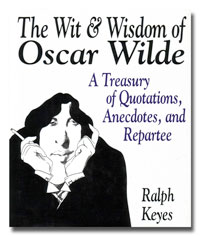
Nearly a century since his death, Oscar Wilde still intrigues us. This poet, novelist, playwright, and essayist was also his era’s leading aphorist. George Bernard Shaw called him “incomparably the greatest talker of his time — perhaps of all time.”
Wilde claimed he could discuss any subject at any time prepared or not. A companion once took him up on this claim, asking that he discourse on the subject of “The Queen.” Responded Wilde: “The queen is not a subject.”
On another occasion, Wilde told a host that he’d toiled strenuously that day. “I was working on the proof of one of my poems all the morning and took out a comma,” he said.
“And in the afternoon?” she asked.
“In the afternoon,” responded Wilde, “– well, I put it back again.”
In The Wit & Wisdom of Oscar Wilde, Ralph Keyes has captured the verbal flair that delighted Wilde’s contemporaries. This definitive compilation includes material not only from Wilde’s better known works but also his more obscure reviews, letters and appearances in friends’ memoirs. It incorporates anecdotes that illustrate Wilde’s knack for repartee. When a journalist said he never discussed subjects on which he didn’t know the facts, Wilde observed, “That must limit your conversation frightfully.”
At the heart of The Wit & Wisdom of Oscar Wilde are Wilde’s best sayings. Some are witty: “Scandal is gossip made tedious by morality.” Others are caustic: “Mr. Henry James writes fiction as if it were a painful duty.” Still more show genuine wisdom: “Anybody can sympathize with the sufferings of a friend, but it requires a very fine nature to sympathize with a friend’s success.”
Oscar Wilde is as popular with readers today as he was in his own era. The Wit & Wisdom of Oscar Wilde shows why. His words in this book remain fresh, alive, and electric. They stride off the page and demand we pay attention, not just because he was clever but because he was wise. “For all of their verbal hijinks,” Keyes writes in his introduction, “many of Wilde’s observations displayed real perception. Amid the glitter of his wit lay nuggets of insight.” By winnowing Oscar Wilde’s best work into one volume, Keyes has given us a primer of one of history’s greatest personalities and most original thinkers.
Oscarisms
Nothing worth knowing can be taught.
I can resist everything except temptation.
The truth is rarely pure and never simple.
Morality is simply the attitude we adopt towards people whom we personally dislike.
Children begin by loving their parents; after a time they judge them; rarely, if ever, do they forgive them.
The youth of America is their longest tradition. It has been going on now for three hundred years.
We have really everything in common with America nowadays, except, of course, language.
In the old days men had the rack. Now they have the Press.
All women become like their mothers. That is their tragedy. No man does. That’s his.
Talk to every woman as if you loved her, and to every man as if he bored you.
I sometimes think that God, in creating men, somewhat overestimated his ability.
A poet can survive everything but a misprint.
Only dull people are brilliant at breakfast.
Experience is the name everyone gives to their mistakes.
Where to buy
Follow the links to purchase The Wit and Wisdom of Oscar Wilde:
Contents
Acknowledgments
Author’s Note
1. The Puzzle of Oscar Wilde
2. Wilde’s Wilde
3. The Anecdotal Oscar Wilde
4. Oscariana
5. By-Play
6. May it Please the Court
Bibliography and Notes
Excerpt
If, with the literate, I am Impelled to try an epigram, I never seek to take the credit; We all assume that Oscar said it.
Dorothy Parker
He left behind, as his essential contribution to literature, a large repertoire of jokes which survive because of their sheer neatness, and because of a certain intriguing uncertainty — which extends to Wilde himself — as to whether they really mean anything.
George Orwell
1. THE PUZZLE OF OSCAR WILDE
Nearly a century since his death, what shall we make of Oscar Wilde? Was Wilde merely a bright boy in a man’s body or a thoughtful prophet cleverly wrapping profundity in dazzling giftwrap? Until his trials for “gross indecency,” this puzzle intrigued Victorian England. From the time he packed his blue china to leave Oxford for London in 1879 until his imprisonment 16 years later, Wilde’s contemporaries never knew how seriously to take him. During his two years in prison, they stopped wondering. Oscar Wilde’s books were withdrawn from circulation and his plays canceled.
It didn’t take long, however, for the fickle public to renew its interest in Oscar Wilde. A decade after his 1900 death at 46, Wilde’s bankrupt estate was flush. By World War II more Europeans read Wilde than they did any English writer except Shakespeare. Today he is the only author of his time and place who still has a following. Oscar Wilde’s writing remains fresh, alive, electric. His words stride off the page to grab us by the lapel and demand that we pay attention. “You’ve got to listen to what I’m about to tell you,” they insist. And we do; gladly. Wilde’s claim to our attention has kept The Picture of Dorian Gray continuously in print for over a century, The Importance of Being Earnest repeatedly staged, and The Happy Prince revived onto the bestseller list. “He is not one of those writers who as the centuries change lose their relevance,” observed biographer Richard Ellmann. “Wilde is one of us.”
It wasn’t just Wilde’s writing that was ahead of its time. His disdain for conventional morality and relentless pursuit of celebrity broke ground later tilled by counterparts ranging from Truman Capote to Andy Warhol. Wilde was an advance herald of existentialism, and the intellectual godfather of 60s “flower children.” As estheticism’s most prominent advocate, he helped create a climate receptive to Europe’s contemporary design revolution. For better or worse, his contention that criticism could be an art form encouraged subsequent critics to follow Wilde’s lead and impose themselves on whatever they were ostensibly criticising.
More than anything else, it is the sum of Oscar Wilde’s 46 years that commands our attention. Wilde felt that way himself. “Do you want to know the great drama of my life?” he asked Andre Gide. “It’s that I have put my genius into my life; all I’ve put into my works is my talent.” Wilde’s life was an ongoing performance starring himself. Writing was merely a vehicle propelling him toward his real goal: the dramatization of Oscar Wilde.
Men of Wilde’s size (a bulky 6’3″) typically dress down to take the edge off their imposing physical presence. Oscar dressed up. He wore knee breeches, red waistcoats, velvet jackets, and a massive fur coat. A hairdresser waved his hair daily. He chain-smoked gold-tipped cigarettes. His ring featured a large green beetle. The buttonhole of his jacket was invariably decorated with some expensive flower.
Wilde was unapologetic about his flamboyant hunger for attention. “Somehow or other I’ll be famous, and if not famous I’ll be notorious,” he told an Oxford classmate. After leaving Oxford for London, Wilde pioneered the use of mass media for self-promotion. He routinely wrote witty letters in duplicate, one for his correspondent, one for the press. By continually satirizing this easy target, Punch became Oscar Wilde’s faithful publicist. So did Gilbert and Sullivan when they featured a Wilde-like fop named Reginald Bunthorne in their comic opera Patience. Londoners laughed, but they paid attention. As would be true of Dorothy Parker in New York half a century later, retailing Oscar’s latest mot was quite the fashion in Victorian London. “Every omnibus-conductor knew his latest jokes,” said Wilde’s friend Ada Leverson.
Talking was Wilde’s vocation, writing his avocation. Those who knew him were virtually unanimous that Oscar Wilde was the best conversationalist they’d ever met. Shaw thought him “the greatest talker of his time — perhaps of all time.” Sir Max Beerbohm — who’d heard such other masters of table-talk as Henry James, Gilbert Chesterton and Hilaire Belloc — said none could compare to Wilde. “Oscar in his own way was the greatest of them all,” said Beerbohm, ” — the most spontaneous and yet the most polished, the most soothing and yet the most surprising.”
During his 1882 lecture tour of America, Wilde was invited to visit an artists’ studio in San Francisco. As a lark, the artists’ wives had dressed up a female portrait dummy, complete with gloves and a fan. This mannequin was dubbed “Miss Piffle.” While touring the studio, Wilde bumped into her. Backing up with a bow, he apologized for the mishap. Without missing a beat Wilde proceeded to give Miss Piffle his impressions of America. He related some funny anecdotes, and replied to her imagined comments with clever repartee. “It was a superb performance, a masterpiece of sparkling wit and gaiety,” marveled an onlooker. “Never before, or since, have I heard anything that compared to it.”
Unlike many a great monologist, Wilde didn’t deny others the opportunity to join him in conversation. Few dared. To engage Wilde in a dialogue would have been like playing tennis with Martina Navratilova, or dancing with Fred Astaire. Or perhaps dueling with Cyrano de Bergerac. While courtly and considerate, Wilde could also be cutting. He was a master of the veiled barb. The deftness and subtlety of Wilde’s malice made it no less malicious; the sharpness of his stiletto didn’t dull the pain of its wound. Wilde’s observation that Shaw had no enemies, but none of his friends liked him, was clever, mean, and wrong. So was his contention that an upwardly mobile acquaintance “came to London in hopes of founding a salon and succeeded in opening a saloon.” (This quip later showed up in The Picture of Dorian Gray.) The same thing could be said of Oscar Wilde that he wrote about a character in Vera : “He would stab his best friend for the sake of writing an epigram on his tombstone.”
Like Disraeli, Churchill and so many others renowned for spontaneous wit, Wilde kept carefully crafted quips in his pocket, waiting for the proper moment to launch them into conversation. He couldn’t always wait, however, and was notorious for setting conversational traps in which to spring a new epigram. Wilde once asked a friend named Coulson Kernahan about his religious convictions. Kernahan responded in all seriousness. When he had finished, Wilde said with a smile, “You are so evidently, so unmistakably sincere and most of all so truthful, that … I can’t believe a single word you say.”
Kernahan later recalled Wilde’s countenance in the aftermath of this volley:
… having discharged his missile, Wilde, no longer lolling indolently forward in his seat, pulled himself backwards, and up like a gunner taking a pace to the rear, or the side of his gun the better to see the crash of the shell upon the target, and then, if I may so word it, “smiled all over.” He was so openly, so provokingly pleased with himself and with this particular paradox that not to be a party to the gratification of such sinful vanity, instead of complimenting him, as he had expected, on its neatness, I ignored the palpable hit, and inquired:
“Where are you dining tonight, Wilde?”
“At the Duchess of So-and-So’s,” he answered.
“Precisely. Who is the guest you have marked down, upon whom — when everybody is listening — to work off that carefully prepared impromptu wheeze about ‘You are so truthful that I can’t believe a single word you say,’ which you have just fired off on me?”
Wilde sighed deeply and threw out his hands with a gesture of despair, but the ghost of a glint of a smile in the corner of his eye signaled a bull’s eye to me.
Those who’d heard Wilde talk found reading his written words disappointing; rather like drinking yesterday’s wine. The words were there, but the spirit was missing: the lilt, the sparkle, the daring leaps from one topic to the next. Some of Wilde’s best lines occurred only during conversation. “One must have a heart of stone to read the death of Little Nell without laughing,” for example — like so many of Wilde’s quips — appears nowhere in his published work. (This one was jotted down by Ada Leverson.)
By mixing the insights in some his essays with the witty dialogue in The Importance of Being Earnest, suggested his friend Adela Schuster, one could get a hint of his conversational prowess. This prowess was built on a foundation of epigrams. “One never left him without carrying away some characteristic mot ,” said the poet Richard La Gallienne, “light as thistledown, yet usually pregnant with meaning.” Oscar Wilde was the leading aphorist of his era, and among the best of all time. He was well equipped not only with the conviction but with the glibness and audacity that aphorizing calls for. The spirit of brash certainty that is aphorizing’s lifeblood can be hard to sustain. Wilde was up to the challenge. Until his final years, he seldom hesitated to be categorical. “I still recall perfect sayings of his,” said the painter Will Rothenstein, “as perfect now as on the day when he said them.”
By his own choice, Wilde’s commentary was more often witty than wise. Many of his epigrams were little more than word play. They suggest a precocious teenager showing off for bemused grownups.
Familiarity breeds consent.
Nothing succeeds like excess.
It is better to be good-looking than to be good.
I can believe anything, provided that it is quite incredible .
Did Wilde know what he was about? Of course he did. “I throw probability out of the window for the sake of a phrase,” Wilde told Arthur Conan Doyle, “and the chance of an epigram makes me desert truth.”
Because he was so smart, even Wilde’s flip remarks imply insight, as if by chewing on their husk long enough one might reach a kernel of wisdom. For all of their verbal hijinks, many of Wilde’s observations displayed real perception. Amidst the glitter of his wit lay nuggets of insight.
The reason we all like to think so well of others is that we are all afraid of ourselves. The basis of optimism is sheer terror.
We think that we are generous because we credit our neighbor with the possession of those virtues that are likely to be a benefit to us.
No man dies for what he knows to be true. Men die for what they want to be true, for what some terror in their hearts tells them is not true.
Anybody can sympathize with the sufferings of a friend, but it requires a very fine nature … to sympathize with a friend’s success.
One reason Oscar Wilde so baffled his contemporaries — as he does us — was that he freely mingled such wisdom with mere frippery. Reading his work is like touring an art gallery in which works by Red Grooms, Pablo Picasso and Charles Schulz are hung side by side. Like so many brilliant men, Wilde took for granted that his listeners and readers were as able as he was to juggle many perspectives at once. When waxing paradoxical for sheer recreation, he assumed others were in on the joke. Wilde knew that he often just played with words, toyed with ideas, struck poses. He was as charmed as anyone by the performance. “Wilde has been the life and soul of the voyage,” said a fellow passenger on his 1882 crossing to New York. “He has showered good stories and bon mots , paradoxes and epigrams upon me all the way, while he certainly has a never failing bonhomie which makes him roar with laughter at his own absurd theories and conceits.”
Oscar enjoyed amusing and amazing so much that it wasn’t always clear when he was being serious. Nor did he care to say. “To the world I seem, by intention on my part, a dilettante and dandy merely,” he once wrote a friend, ” — it is not wise to show one’s heart to the world — and as seriousness of manner is the disguise of the fool, folly … is the robe of the wise man.” As part of his outrageous persona, Wilde considered honesty an overrated virtue. He regarded any attempt to pin him down about the veracity of his views as tedious; a sure sign of a limited intellect. During his first trial, when quizzed about a saying he’d written, Wilde said airily, “I think it is an amusing paradox, an amusing play on words.” Challenged about the truth of another epigram, he responded, “I rarely think that anything I write is true.”
The writer Sir Henry Newbolt once watched Wilde discuss the virtues of some obscure Elizabethan playwrights, with frequent citation of their work. Newbolt was so impressed by Wilde’s peroration that he jotted down some of his references in order to look them up later. He could find none of the plays cited. Nor could Newbolt locate any of the “playwrights” Wilde had so learnedly discussed. They existed only in his fertile imagination. “My feeling was chiefly one of almost awed surprise at his wonderful powers,” said Newbolt, ” — the imitations were so perfect and so striking in themselves as to be worthy of the forged names he appended to them.”
Wilde loved to create verbal works of art. To him, inquiring about their truthfulness was like quizzing a painter about the validity of his reds or blues. Wilde routinely said things he didn’t mean because they sounded pretty. Did he really believe that “Men who are dandies and women who are darlings rule the world, at least they should do so”? I doubt it. More likely he was delighted by the resonance of “dandy” and “darling” in such close juxtaposition. Elsewhere, Wilde juxtaposed “kisses and blisses,” “scribblers and nibblers,” and commended a book for substituting the vice of verbosity for the stupidity of silence.”
Friends noted how often Wilde repeated the same phrases, albeit honed, sharpened, polished. Like a standup comedian, he continually recycled good lines. Wilde’s sayings moved freely from conversation to essay to fiction to drama. Sometimes they moved freely from other people’s conversation. His quip “If one had the money to go to America, one would not go,” was based on a friend’s earlier question, “Who would go to Australia if he had the money to go with?” Another famous Wildeism — “Good Americans, when they die, go to Paris” — appeared first in Oliver Wendell Holmes’s Autocrat of the Breakfast Table . So did “Give me the luxuries, and anyone can have the necessaries,” a line later attributed to Wilde.
Wilde borrowed other people’s material without apologies. “I appropriate what is already mine,” he explained, “for once a thing is published it becomes public property.” His sometime friend James Whistler rarely missed an opportunity to accuse Wilde of blatant theft on the high literary seas. After Whistler got off a good line, the painter said Wilde told him, “I wish I’d said that.”
“You will, Oscar, you will,” Whistler retorted.
Wilde, Whistler concluded, “has the courage of the opinions of others.” Wilde responded by using this aphorism without attribution in a subsequent essay.
But aphorisms are a revolving fund. Even as Wilde withdrew, he deposited far more than his share of lasting epigrams. In his play An Ideal Husband Wilde included the thought that “Life is never fair,” perhaps inspiring John F. Kennedy’s similar observation 70 years later. Wilde’s “I can resist everything except temptation,” was later attributed to Mark Twain, Mae West and W.C. Fields. In Man and Superman, Shaw wrote, “There are two tragedies in life. One is to lose your heart’s desire. The other is to gain it.” A decade earlier, in Lady Windermere’s Fan , Wilde observed, “In this world there are only two tragedies. One is not getting what one wants, and the other is getting it.”
A key problem facing any compiler of Oscar Wilde’s sayings is selecting the best from an embarrassment of riches. Harvesting aphorisms from Wilde’s canon is like fly fishing in a fish farm. Wilde put so many maxims into his writing that we have a wealth of them on the record. His play scripts were basically a bulletin board on which Wilde pinned his best remarks. The comedies in particular featured one quip after another mouthed by characters — men and women alike — who were thinly disguised depictions of the playwright’s various facets. Scene-setting, character development and plot were essentially filler. The playwright conceded that his characters did very little. Like their creator, he said, they were content to “sit in chairs and chatter.”
It may be true that authors shouldn’t be held accountable for the views of their characters. But the narcissistic Wilde was not one to create fictional figures distinct from himself. Because Wilde’s writing was largely a forum for his own observations, one is usually safe in taking his characters’ views as Wilde’s. If such views were often inconsistent and contradictory, so was their author.
Details are always vulgar.
Details are the only things that interest.
To be modern is the only thing worth being nowadays.
Nothing is so dangerous as being too modern;
one is apt to grow old-fashioned quite suddenly.
The supreme vice is shallowness.
Only the shallow know themselves.
Had such contradictions been tossed in his face, Wilde would have responded with disdain for the tosser. “Consistency is the last refuge of the unimaginative,” he said. Wilde claimed an artist’s right to propound a point of view and its obverse too. In his introduction to “The Truth of Masks,” he advised readers, “Not that I agree with everything that I have said in this essay. There is much with which I entirely disagree … For in art there is no such thing as a universal truth. A Truth in art is that whose contradictory is also true.”
There was always something of the promising undergraduate about Oscar Wilde: bright, charming, outrageous. Yet the man who could display such insight about others was no more perceptive than the average college sophomore when it came to himself. Biographer Hesketh Pearson thought that the fundamental conflict in Wilde’s nature was between his precocious intellect and his immature emotions. Even as the boy in him loved to show off, the adult stood to one side amused by the spectacle.
As part of being so young at heart, Wilde took every opportunity to expound the virtues of self-gratification. “I would go to the stake for a sensation,” he once admitted. Today we’d call him boredom-phobic. “Life was nothing to Oscar,” observed a friend, “unless it was made up of thrills and excitements.”
Oscar Wilde’s emotional life never progressed much beyond an adolescent’s. This could be seen in his lifelong preference for the company of young men. Wilde’s unrepentant homosexuality and borderline pederasty challenged the hypocrisy of Victorian sexual attitudes. In Wilde’s time and class, the implicit attitude was: do what you like, but be discreet. Don’t flaunt. Wilde flaunted. He was by nature a flaunter. So long as Oscar Wilde wasn’t too public about his dalliances, fin-de-siecle England was willing to look the other way. Only after he rubbed its nose in his passion for young men — and, incidentally, risked pulling the bedsheets off thousands more who shared that passion — did the hammer of British justice fall mercilessly on Wilde’s head.
From today’s perspective, it’s hard to picture how much horror “the love that dare not speak its name” excited in Victorian England. (Had open discussion of the issue been possible, Wilde might have speculated that this was due to the stifled libido of those who were horrified.) Today, Wilde’s homosexuality would be a mere peccadillo, no more damning of him than it would later be of Tennessee Williams or Edward Albee. Were he still alive, Wilde would be less condemned for his gayness, but perhaps taken more to task for exploitation of young men by an older celebrity.
Even as he’d reaped its rewards, Wilde eventually paid the price for being over-famous. His flamboyance and self-promotion made him a household name long before he produced work to merit such recognition. As a result, his fall at the end was that much farther, and harder, accompanied by the delighted applause of the many whom he’d offended in his ostentatious rise to fame. But Wilde didn’t take the opportunity to segue from brilliance to profundity after leaving prison. Flashes, hints of what he might have become could be seen in his epic Ballad of Reading Gaol and in De Profundis, the petulant, sad, and riveting memoir of his life leading to prison. Within De Profundis Wilde continually repeated “The supreme vice is shallowness,” as if trying to convince himself. Alas, after his release, Wilde resumed the life of a boulevardier. Now, however, he had neither the resources nor conviction to do a good job of it. Wilde ended his days as a shabby absinthe-drinker in French cafes, cadging francs off old friends and new acquaintances. He couldn’t reconceive himself as anything other than brilliantly witty. Yet the thought of returning to drawing-room drama repelled the chastened ex-convict. “I simply have no heart to write clever comedy,” he told a friend.
Although outrageous to the end — sipping champagne on his deathbed, remarking that he was dying beyond his means — in later years Wilde did temper his craving to astonish. The post-prison Wilde was in many ways more thoughtful and compassionate than he’d been before his trials. Before, Wilde thought nothing of getting off a good quip at the expense of the destitute. (“If the poor only had profiles there would be no difficulty in solving the problem of poverty.”) In prison Wilde developed enormous sympathy for the plight of his fellow convicts. He took particular interest in some rabbit-poaching children who were confined to solitary cells for 23 hours of every day. Two letters to a London newspaper denouncing such cruelty were the only pieces of writing Wilde published under his own name during three and a half years between leaving prison and dying.
It’s interesting to speculate how Wilde might have matured with age (a concept he would have loathed). But it’s hard to conceive of a gray-haired Oscar Wilde. Not the man who’d spent so many years rapping the aged across their wrinkled knuckles. (“The old should neither be seen nor heard.” “Those whom the gods hate die old.” “Those whom the gods love grow young.”) Wilde venerated youth too much. Like Byron, Capote, and Presley, his appeal was based on brashness. He was far better suited to being an enfant terrible than a sage. Oscar Wilde had a good first act and a better second one, but missed the call to his third.
And so we are left with the witty, sometimes wise output of the two productive decades of this writer-raconteur. We all should have such output. It includes not only poetry, fiction, plays and essays but stories, repartee and quips recorded by contemporaries who heard Wilde talk. The challenge facing anyone who compiles Oscar Wilde’s work is to try to convey in print the conversational pyrotechnics that captivated his peers. That’s the goal of The Wit and Wisdom of Oscar Wilde . Because he was such a master of conversation, it incorporates anecdotes that illustrate his verbal flare. Wilde’s gift for thrust and parry can is vividly displayed in excerpts from his trial cross examinations. Sections of Wilde’s play scripts showcase both his mastery of witty dialogue, and the epigrammatic banter for which Oscar Wilde was famous. The heart of this volume is the best of his sayings; what was known in Wilde’s time as “Oscariana.” Through his sayings he was known, and through his sayings we shall know him.
Reviews
January 28, 2011
Reviews from Amazon.com
5 Stars This compendium of quotes from Oscar Wilde is arranged by subject matter alphabetically and provides a great deal of entertainment for $7 bucks. Not to mention it is the ultimate source for witty quotations to…
January 28, 2011
Reviews from Amazon.com
5 Stars Oscar Wilde once said “Drama is the meeting place of art and life.” In this essential, compact volume Ralph Keyes leaves a trail to that corner by gathering the flamboyant author’s thorniest, at times most…
January 28, 2011
The Hindu
We have not been taught to take Oscar Wilde seriously and with each proceeding generation, we seem to be compressing him into a voice that doles out epigrams. Wilde was much more than the dandified wit, immortalized by…
January 28, 2011
Lambda Publications
His own words, full of the verbal flair that delighted his contemporaries, are taken from both his well-known works and his more obscure reviews, letters, and appearances in friends’ memoirs.
January 28, 2011
Boston Phoenix
… several laughs to a page …
January 28, 2011
Chattanooga Free Press
Entertaining to browse through, and still quite pertinent after all these years.
January 28, 2011
Booksource
The fifth book in this well packaged and entertaining series has found its perfect subject. Here are witty one-liners, biting comments, and memorable bon mots by one of the world’s great literary figures and one of the…
Press
January 28, 2011
Press
Coming soon. Please check back shortly, as the website is currently in the process of being updated.
On the internet
January 28, 2011
Internet
Coming soon. Please check back shortly, as the website is currently in the process of being updated.
What colleagues say
The Wit and Wisdom of Oscar Wilde is stunning! It’s a lovely book physically and the content is dynamite. I’ve been dipping in and delighting myself no matter where I open the book. If I get started repeating my favorites, we’ll be here all day.
Rosalie Maggio, The New Beacon Book of Quotations by Women
The Wit and Wisdom of Oscar Wilde is altogether wonderful. Not just a wonderful collection but a beautifully designed book.
Patrick O’Connor, Don’t Look Back
What readers say
[A] fantastic book. One of my favorites. Skopje, Macdonia
End notes
Notes
Only key sources are cited, primary ones whenever possible. Last names and publication date when necessary refer to publications listed in the Bibliography.
The sources will be referred to by the following key word or initial throughout:
| SOURCE | KEY |
| Edwards, The *Fireworks of Oscar Wilde* | Fireworks |
| Hart‑Davis, *The Letters* *of Oscar Wilde* | L |
| Jackson, *The Uncollected Oscar Wilde* | U |
| Wilde, *Oscariana* | Oscariana |
| Wilde, *The Works of Oscar Wilde* | W |
| Wilde, *The Prose of Oscar Wilde* | P |
| Wilde, *The Complete Works of Oscar Wilde* (HarperPerennial) | C |
Wilde’s major works will be referred to by the following key words:
| MAJOR WORK | KEY |
| *The Picture of Dorian Gray* | Gray |
| *Vera, or the Nihilists* | Vera |
| *The Duchess of Padua* | Padua |
| *Salomé* | Salomé |
| *Lady Windermere’s Fan* | Fan |
| *A Woman of No Importance* | Woman |
| *An Ideal Husband* | Husband |
| *The Importance of Being Earnest* | Earnest |
| *Lord Arthur Savile’s Crime* | Savile |
| *The Canterville Ghost* | Ghost |
| *The Model Millionaire* | Model |
| *The Remarkable Rocket* | Rocket |
| *Impressions of America* | Impressions |
| *The Critic as Artist* | Critic |
| *The Soul of Man Under Socialism* | Soul |
| *The Decay of Lying* | Decay |
| *Pen, Pencil and Poison* | Pen |
| *The Truth of Masks* | Masks |
| *The Portrait of Mr. W. H.* | Portrait |
| *A Few Maxims for the Instruction of the Over‑Educated* | Maxims |
| *Phrases and Philosophies for the Use of the Young* | Phrases |
| *The Ballad of Reading Gaol* | Gaol |
| *De Profundis* | De Profundis |
AUTHOR’S NOTE
Shipps: Anthony Shipps. The Quote Sleuth (Urbana: University of Illinois Press, 1990), 47.
THE PUZZLE OF OSCAR WILDE
Parker: The Portable Dorothy Parker (New York: Viking, 1944), 321; Orwell: George Orwell, Orwell: The Lost Writings (New York: Arbor, 1985), 171; by World War II, Pearson 305; Ellmann: Ellmann xvii; Gide: Gide 16; “Somehow or other”: to David Hunter Blair, Mikhail 5; Leverson: Leverson 29; Shaw: Redman 30; Beerbohm: Mikhail 273; “Miss Piffle” episode: Pearson 63‑4; Shaw had no enemies: Harris (1925) 417, Pearson 140, M 146, George Bernard Shaw, Sixteen Self Sketches (New York: Dodd, Mead, 1949), 183; “came to London”: Sherard (1906) 105‑6, L 173, Gray, C 22; “He would stab”: C 665; Kernahan: Kernahan 216‑7; “One must have a heart of stone”: Leverson 42; Le Gallienne: Le Gallienne 258; Rothenstein: Rothenstein 87‑8; “Familiarity”: Mikhail 421; “Nothing”: Pearson 43; “It is better”: Gray, C 147; “I can believe”: Gray, C 21; “I throw probability”: Doyle 74; “The reason”: Gray, C 67; “We think”: Gray, C 67; “No man dies”: Portrait, C 1201; “Anybody can sympathize”: Soul, C 1101‑2; fellow passenger: Ellmann 241; “To the world”: L 353; “I think”: Fireworks 256; “I rarely think”: Hyde (1962) 108; Sir Henry Newbolt: Pearson 156; “Men who are dandies”: Model, C 220; “kisses and blisses”: Padua, C 608; “scribblers and nibblers”: U 99; “vice of verbosity”: U 83; “If one had the money”: Pearson 69; friend’s earlier question: Sherard (1906) 179; “Good Americans”: Gray, C 43, Woman, C 436, Oliver Wendell Holmes, The Autocrat of the Breakfast Table (Boston: Houghton, Mifflin, 1858, 1889), 125; “Give me the luxuries”: Holmes, Ibid. 125, Pearson 43, Redman 67; “I appropriate”: Pearson 87; 1 wish I’d said that”: Ingleby 67, Brasol 147, Weintraub 296, Mikhail 157, Ellmann 133; Whistler on Wilde: Redman 52, Weintraub 303‑5, Ellmann 274, 325, Decay, C 972; “Life is never fair”: Husband, C 504; “I can resist”: Fan, C 388, Keyes 163; Shaw: Keyes 164, Man and Superman Act 4; “In this world”: Fan, C 417; “sit and chatter”: L 255; “Details are always”: Gray, C 85; “Details are the only”: Savile, C 173; “To be modern”: Woman, C 459; “Nothing is so dangerous”: Husband, C 514; “The supreme vice”: De Profundis, C 874, 896, 916, 953; “Consistency is the last refuge”: U 52, Pearson 171; “Not that I agree”: Masks, C 1078; Pearson: Pearson 37; “the supreme vice”: De Profundis, C 874, 896, 916, 953; “I wrote when”: Sherard (1917) 98; “If the poor”: Phrases, C 1205; two letters: C 958‑69; “The old”: Mikhail 248; “Those whom”: Maxims, C 1204.
WILDE’S WILDE
French by sympathy: Ellmann 352; By nature: L 269; I am afraid: Ellmann 39; I never put off: Pearson 173; I am never in: L 745; I am one of those: De Profundis, C 914; I have blown: L 237; I awoke: De Profundis, C 912‑3; Praise makes me humble: O’Sullivan 5; Where will: Mikhail 469; The three women: O’Sullivan 18; While the first editions: Pearson 215; If I were: Mikhail 18; I have: Saltus 20; Between me and life: Mikhail 162; I like to do: Rocket*,* C 315*; I like hearing*: Rocket, C 316; Geniuses . . . are always: Husband, C 513; I am always thinking: Rocket, C 313; If life be: De Profundis, C 917; I filled my life: De Profundis, C 917; Whatever my life: L 648; My record: L 515; God would: Padua, C 583; I must say: De Profundis, C 912; A patriot: L 705; I entered: Gide 23; I am not a scrap: L 581.
THE ANECDOTAL WILDE
Full Name: Kernahan 208; Suspense: James Sutherland, ed., The Oxford Book of Literary Anecdotes (London: Oxford University Press, 1975), 299; Like Mother: Sherard (1906) 136, Sherard (1917) 63; High Standards: Mikhail 4, 169, 444, 469*,* Brasol 44, Pearson 29, Ellmann 45; Fame: Pearson 44, Ellmann 109; Path to the Stars: Brasol 165*,* Lewis 21‑2, Pearson 39; Altruism: Hesketh Pearson, Gilbert, His Life and Strife (New York: Harper, 1957), 110; God Save the Queen: Redman, 23; Touché: Birnbaum 29; Hard of Hearing: Harris (1925) 416, O’Sullivan 59*,* Pearson 28, Ellmann 85*,* Fireworks 32; Literary Worship: Pearson 165‑6; Hurt Feelings: Le Gallienne 263‑5; Good Manners: Mikhail 285‑6; Economy: Pearson 199; Gray, C 52; Favorite Topic: Fireworks 15, Anderson 253‑4, Weintraub 243‑4, Pearson 86, Ellmann 271; Elocution: Sherard (1917) 288; Customs Declaration: Lewis 35, Pearson 53; Disappointment I: Lewis 32*,* Mikhail 38, Pearson 53, Ellmann 158; Disappointment II: Impressions, W (Volume Eleven) 254, Lewis 163*,* Pearson 59*,* Ellmann 239; Weather Forecast: Pearson 173; Royal Rebuke: O’Sullivan 197; Heavenly: Ellmann 198; Underwhelmed: Lewis 189, 210, Pearson 60; On Second Thought: Lewis 254, Pearson 62; Wilde’s West: Impressions, W (Vol. Eleven) 258, Lewis 310, Fireworks 47; L 110‑2*,* Birnbaum 23‑4, Ellmann 204‑5; Postwar Blues: Impressions, W (Vol. Eleven) 259‑60, Lewis 396*,* Pearson 67, Fireworks 48; Signs of Success: Frank Harris (1925) 416*,* Brasol 98, Mikhail 32, 215, L 86; Artistic Integrity: Saltus 14‑5; Location, Location: Sherard (1902) 25‑6; Risk: Rothenstein 93, Pearson 74; Ellmann 350; Wildly Bourgeois: Rothenstein 88‑9*,* Mikhail 160‑1, Pearson 71; Self‑Esteem: O’Sullivan 62; The Taxman Cometh: Le Gallienne 259, Pearson 106; Domestic Tragedy: Saltus 15; Prayers: Mikhail 155, Schmidgall 316; Bedevilment: Mikhail 161, Ellmann 313; Plagiarism: Mikhail 245, Pearson 218; Secret Society: Mikhail 211‑2, Pearson 198; Recipe for Success: Pearson 227; Uncanny Resemblance: Pearson 228; Best Books: Pearson 174; Sanity: Mikhail 384; Popularity: Rothenstein 213, Pearson 160; Yankee Go Home: Fairfax Downey, Richard Harding Davis (New York: Scribner 1933), 112; Familiarity Breeds Contempt: Levenson 25, Pearson 174; Gag Order: Pearson 176; Good Value: Sherard (1917) 40, Pearson 243‑5, Ellmann 446; Hard Labor: Sherard (1902) 72, Sherard (1906) 273, Ellmann 221; Household Name: Sherard (1902) 192, Sherard (1906) 278, Pearson 276; Royal Treatment: Pearson 281, De Profundis, C 937; Tactlessness: Mikhail 340, Pearson 295; Kindness: Pearson 302‑3; Redemption: Hyde (1975) 330, Ellmann 539‑40; Last Words: Sherard (1906) 421, Raymond 59, L 848, New York Times 10/14/82, Sherard (1917) 330, Ellmann 581.
OSCARIANA
ACTING
I love: Gray, C 70; Why should: U 82; Anybody can: Fireworks 195.
AGE
Men become: Fan, C 392; The old should: Mikhail 248; I always contradict: Gray, C 163; As soon as: Fan, C 400; Those whom . . . die old: Sherard (1917) 7; Those whom . . . grow young: Maxims, C 1204; Young men want: Gray, C 37; The old believe: Phrases, C 1206; The tragedy: Gray, C 162; The secret: Gray, C 73‑4; Youth smiles: Gray, C 125; It’s absurd: Gray, C 163; I have never: L 181; We never: Gray, C 32; To get back one’s: Gray, C 44; To get back my: Gray, C 162.
ALTRUISM
The majority: Soul, C 1079; The desire: Critic, C 1042; One can: Gray, C 84; Conscience and cowardice: Gray, C 22; The mere existence: Critic, C 1024; Self‑sacrifice: Husband, C 533; Good intentions: Oscariana 48; Whenever a man: Gray, C 66; It takes: Fan, C 403; Philanthropy seems: Husband, C 487; Philanthropic people: Gray, C 40; People are: Lucas 209; Charity creates: Soul, C 1079*.*
AMERICA
English people: U 36; We have: Canterville, C 194; America has never: Fireworks 72, Lewis 282; It is a vulgar error: Ellmann 166; America is one: Lewis 181; America is the noisiest: Impressions, W (Vol. Eleven) 252; One is impressed: Impressions, W (Vol. Eleven) 253‑4; Bulk is: Lewis 153; Everybody seems: Impressions, W (Vol. Eleven) 252; I am told: Gray, C 40; The people of America: Lewis 227; In America the President: Soul, C 1094; In America the young: U 36; The American child: Fireworks 74; There at any rate: Impressions, W (Vol. Eleven) 262; In America there is: Lewis 281; In going to America: Impressions, W (Vol. Eleven) 262; It is impossible: Lewis 372‑3; The Americans are the best: Impressions, W (Vol. Eleven) 262.
AMERICANS
All Americans: Woman, C 453; The American woman: Mikhail 104; Many American ladies: Canterville, C 194; American girls: Impressions, W (Vol. Eleven) 261; American women: U 37; For him: Fireworks 71, Lewis 152; The telephone: Fireworks 70; Real experience: Lewis 153; The American man: Fireworks 71; If the Americans: Impressions, W (Vol. Eleven) 251.
APPAREL
A man is called: Soul, C 1101; Every right article: Fireworks 51‑2; All costumes: Fireworks 54; Cavaliers and Puritans: Pearson 166; The artistic feeling: Fireworks 88; One should either: Phrases, C 1206; The only way: Phrases, C 1205; The imagination: L 284; It is really: Fireworks 80‑1; Tails have no place: Fireworks 51; With an evening coat: Gray, C 21.
APPEARANCES
It is only: Gray, C 32; Being natural: Gray, C 20; Perhaps one never: Gray, C 134; Man is least: Critic, C 1045; A mask tells: Pen, C 995; The truth about: Mikhail 171; I think a man: Ellmann 301.
ART
Art is not: U 183; Art is the mathematical: Ellmann 238; It is through Art: Critic, C 1038; Art is what makes: U 21; The secret: Mikhail 69, U 28; Life imitates art: Decay, C 992; It is the spectator: Gray, C 17; The work of art: Soul, C 1096; The meaning: Critic, C 1029; That is the mission: Mikhail 99, Lewis 374; To reveal art: Gray, C 17; The aim of art: Mikhail 247; There are works: Gide 12; There is no mood: Critic, C 1035; Art is the one thing: U 118, Ellmann 181; All good work:, U 124; The public make use: Soul, C 1092; The one thing: Soul, C 1091; A fresh mode: Soul, C 1092; Popularity is the crown: U 123; No art is better: Mikhail 71, Lewis 243; It is very curious: L 823; All bad art: De Profundis, C 941; It is always: Critic, C 1053; The best that one: Critic, C 1028; All art is quite: Gray, C 17; All art is immoral: Critic, C 1039; Art must be loved: Mikhail 63; The sign of a Philistine: U 126; No art ever survived: Mikhail 247; Whenever a community: Soul, C 1090; There are two ways: Critic, C 1047; It is only an auctioneer: Critic, C 1047; Diversity of opinion: Gray, C 17; Art should always: Raymond 34.
ARTISTS
Artists, like: U 17, Lewis 58; A really great artist: Critic, C 1053; The moment that: Soul, C 1090; Alone, without: Soul, C 1090; Creation for the joy: Mikhail 242; When critics disagree: Gray, C 17; The true artist: Soul, C 1092; Bad artists: Critic, C 1054; A true artist: Soul, C 1097; Most of our modern: Decay, C 989; The only thing: Maxims, C 1203; The more the public: Mikhail 246; The English public: Ellmann 352; To call an artist: Soul, C 1093; How can a man: Housman 29; No artist desires: Gray, C 17; No artist has ethical: Gray, C 17; Insincerity and treachery: Portrait, C 1171; Vice and virtue: Gray, C 17; The young artist: U 129; Nothing . . . is more dangerous: U 123; No great artist: Decay, C 988; The greatest artists: O’Sullivan 204; The only artists: Gray, C 54‑5; Only mediocrities: L 372, Fireworks 220; In New York: U 42; For an artist: U 31.
BEAUTY
The desire for: Mikhail 41; When the result: Fireworks 114; The best service: Mikhail 68; Beauty, like Wisdom: Fireworks 183; Those who do not: Decay, C 990; Devotion to beauty: U 21; Beauty is a form: Gray, C 31; Beauty has: Critic, C 1030; Philosophies fall: U 21; All beautiful things: Pen, C 996; Beauty is the only: U 21; No object is: U 129; I have found: Ellmann 262; Utility will: U 107; Good machinery: U 109; The reason: U 27; Aestheticism is: Ellman 159; Aesthetics, like: Critic, C 1058; Aesthetics are: Critic, C 1058; Even a color-sense: Critic, C 1058.
CLASS
It is only: Phrases, C 1205; If the lower: Earnest, C 322; Each class preaches: Pearson 177; There is only: Soul, C 1085; Extravagance is: Mikhail 215; Romance is: Model, C 219; As for the virtuous: Soul, C 1081; We are often told: Soul, C 1081; To recommend thrift: Soul, C 1081; Why should they: Soul, C 1081; The real tragedy: Gray, C 69; The poor are wiser: De Profundis, C 911; Those who have much: De Profundis, C 914; I quite sympathize: Gray, C 23; A grande passion: Gray, C 49‑50; There is always: Vera,
C 676; Study the Peerage: Woman, C 461.
COMMON SENSE
The inherited: Gray, C 138; The growth of: Decay, C 990; Common sense is: Fireworks 218; Anybody can have: Rocket, C 313; I love superstitions: Fireworks 218; Nowadays most people: Gray, C 44.
CONFORMITY
While to: Soul, C 1087; People . . . go through: Soul, C 1087; Most people: De Profundis, C 926; Selfishness is not: Soul, C 1101; It is not selfish: Soul, C 1101*.*
CONVERSATION
Conversation is: Fireworks 76; Ultimately the bond: De Profundis, C 880; Conversation should: Critic, C 1032; The state of the weather: U 85; The art of conversation: U 86; Learned conversation: Critic, C 1015; Recreation, not instruction: U 84; The maxim: U 86; One wants something: Earnest, C 329; Nobody, even in the provinces: U 84; In the case of: U 86; A man who can dominate: Woman, C 459; I adore them: Woman, C 441; One should never: Maxims, C 1204; It is a very dangerous: Husband, C 490; It is only the intellectually lost: Gray, C 25; I dislike arguments: Earnest, C 379; Arguments are extremely vulgar: Rocket, C 315.
CONVICTION
The man who sees: Critic, C 1047; One should never: Woman, C 437; To believe: Pearson 166; I never approve: Gray, C 66; The things one feels: Gray, C 161; A thing is not: Portrait, C 1161; No man dies: Portrait, C 1201.
CRIME AND PUNISHMENT
Murder is: Gray, C 160; There is no: Pen, C 1008; Starvation: Soul, C 1088; A community: Soul, C 1087‑8; As one reads: Soul, C 1087‑8; The more punishment: Soul, C 1088; The criminal classes: Maxims, C 1204; Crime belongs: Gray, C 160; To turn: De Profundis, C 933; Reformation: Critic, C 1053; It is not: Letter to Editor of Daily Chronicle, C 962; The only really: Letter to Editor of Daily Chronicle, C 961; Prison‑life: L 514; To those who are: De Profundis, C 937; The most terrible: De Profundis, C 921.
CRITICISM
Criticism is: Ellmann 51; There has never: Critic, C 1021; The highest: Critic, C 1027; The censure: Lucas 203; The moment: Mikhail 239.
CRITICS
The critic: L 269; The true critic addresses: U 17; The true critic is: U 145; The first duty: U 17; Critics rarely: Mikhail 188; It is exactly: Critic, C 1054; Technique is really: Critic, C 1054; It is only: Critic, C 1033; A critic should: Fireworks 168; The primary aim: Ellmann 143; I am always: Critic, C 1027‑8; No publisher: L 262.
CRITIQUES
The best play: Mikhail 285; It is a thoroughly: Fireworks 69; As a general rule: Fireworks 89; Astray: Fireworks 63; Andiatoroctè: Lucas 208; Mr. Whistler . . . has: Fireworks 73; Mr. Whistler always: U 137; That he is: U 50; As for borrowing: L 254*,* Weintraub 305; [George Meredith]: Decay, C 976; Meredith is: Critic, C 1013; M. Zola: Decay, C 974; [Guy de Maupassant]: Decay, C 974; Mr. Henry James: Mikhail 178; [Rudyard Kipling]: Critic, C 1055; Longfellow is: Mikhail 384; Longfellow has: U 92; In his very rejection: Fireworks 111.
DANGER
To elope: Woman, C 434; Every profession: Mikhail 232; How fond: Gray, C 154; An idea: Critic, C 1044; Everything is: Husband*,* C 504; The one advantage: Woman, C 434*.*
DEFINITIONS
Scandal: Fan, C 416; Tact: Fireworks 84; Cynicism: Oscariana 31; What is: Fan, C 416; The sentimentalist: De Profundis, C 946; A sentimentalist. is a: Fan, C 418; A sentimentalist is simply: De Profundis, C 946; Experience: Fan, C 418; Caricature: Lewis 55; Indifference: Vera, C 664; Democracy: Soul*,* C 1087.
DESCRIPTIONS
He is a typical: Husband, C 518; A red‑cheeked: Gray, C 135; He hasn’t: Pearson 171; He is old enough: Pearson 171; Like all people: Gray, C 42; A man with a hideous: Woman, C 449; Many a woman: Fan, C 390; She wore: Husband, C 508; She behaves: Gray, C 40; She was a curious: Gray, C 47; When she is: Gray, C 136; She tried: Gray, C 47; An over‑dressed: Gray, C 135; She was usually: Gray, C 47; She was one: Rocket, C 311; [She] talks more: Husband, C 518; A dowdy: Gray, C 135.
DISSENT
Discontent: Woman, C 456; Disobedience: Soul, C 1081; In art: U 4; Agitators are: Soul, C 1082.
DREAMING AND ACTION
It is: Le Gallienne 253; A dreamer: Critic, C 1058; Society: Critic, C 1039; The one person: Critic, C 1023; It [action]: Critic, C 1023; Action becomes: Critic, C 1023; We are never: Critic, C 1040.
DUTY
Duty is: Woman, C 456; Duty . . . merely: Soul, C 1100; My duty is: Husband, C 541; My duty to: Gide 15; A sense of duty: Oscariana 49; People are afraid: Gray, C 29; The first duty: Phrases, C 1205; A woman’s first duty: Husband, C 532.
EDUCATION
Nothing that: Critic, C 1016, Maxims, C 1203; Fortunately: Earnest, C 332; Just as: Critic, C 1043; Everybody who is: Decay, C 971; In examinations: Phrases, C 1205; Examinations are: Gray, C 38; People never think: Earnest, C 354; We teach people: Oscariana 13; In the summer: Fireworks 125; Give children: Lewis 247; Children have: Impressions, in W (Vol. Eleven) 261; I would have: U 189; A school: Pearson 106.
EMOTION
Emotion for: Oscariana 61; The secret: Woman, C 464; There is always: Gray, C 76; It is only: Gray, C 89; I cannot repeat: Gray, C 90; One of the facts: L 143*.*
ENGLAND
Beer: Gray, C 147; We are in: Gray, C 119; In England: Husband, C 507; The English public: Critic, C 1009; [The English]: Raymond 27; To disagree: U 8; The English public, as: Fireworks 167; Of all people: Gray, C 45; One should not: Fireworks 62; There are only: Pearson 310; We have been able: Soul, C 1091; If the English: Soul, C 1084; England never appreciates: Mikhail 45, Lewis 65; The English mind: Critic, C 1057; We were delighted: Mikhail 40, Lewis 46*.*
FACTS
If something: Decay, C 973; Facts are not: Decay, C 980; The ancient historians: Decay, C 972; In the works: Decay, C 980; In the wild: Gray, C 25.
FAMILY
A family: Vera, C 675; Fathers: Husband, C 538; Families are: Husband, C 486.
FASHION
Fashion is merely: Ellmann 261; Fashion is what: Husband, C 522; From the sixteenth: Fireworks 83; There are fashions: Pen, C 997.
FRIENDS AND ENEMIES
An acquaintance: Husband, C 486; Laughter: Gray, C 22; Friendship is: Maxims, C 1203; I always like: Gray, C 40; It is a very: Rocket, C 314; At the holy: Pearson 317; One has a right: Gray, C 118; Formal courtesies: De Profundis, C 877; What is the good: Fireworks 93; I choose: Gray, C 23; Be careful: O’Sullivan 82; Next to having: Lewis 215; I would sooner: Vera, C 665; Every effect: Gray, C 149.
GENERATIONS
Children begin: Woman, C 457, 480; Few parents: Earnest, C 338; There are: Husband, C 517; There is: Vera, C 666; The longer: Gray, C 50; It is enough: Pearson 125; No age: Lucas 200.
GEOGRAPHY
The two: U 194; Chicago: U 36; It is: Gray, C 159; San Francisco: Mikhail 82; California: Lewis 306; In no place: Lewis 263; When I look: Lewis 420; This grey: Gray, C 49; London: Fan, C 422; While in London: Mikhail 170; The great superiority: O’Sullivan 64; We Irish: Mikhail 147; If one could: Husband, C 533; I don’t like: L 787; A map: Soul, C 1089.
GOVERNMENT
In an evil: P 339; All modes: Soul, C 1087; Life under: Mikhail 115; Now that: Husband, C 485; Only people: Husband, C 539; There is: Soul, C 1099; There are three: Soul, C 1099; Those who try: Critic, C 1043; One who is: Soul, C 1099; It is indeed: Mikhail 240‑1; I like: Padua, C 630; To be entirely: De Profundis, C 891; All authority: Soul, C 1087; Wherever: Soul, C 1084.
HISTORY
History is: Fan, C 416; The details: Critic, C 1021; History never: Ellmann 106; Anybody can: Critic, C 1023; The one duty: Critic, C 1023; We cannot: Pen, C 1008; To give: Critic, C 1015.
HUMAN NATURE
The more one: Decay, C 975; The only thing: Soul, C 1100; The systems: Soul, C 1100; I will predict: Ellmann 111; The real fool: De Profundis, C 874; To know anything: Critic, C 1040; The great things: Portrait, C 1161‑2; Find expression: Critic, C 1052; Every little action: De Profundis, C 913; The only thing: Fireworks 124; There is a luxury: Gray, C 81; Humanity will: Critic, C 1009; The reason: Gray, C 67; We think: Gray, C 67; It is what: O’Sullivan 53; Great antipathy: O’Sullivan 36; Whenever: De Profundis, C 939; It is in: Gray, C 29; Each man: L 266; We are each: Padua, C 641; Each of us: Gray, C 122.
HUMOR
Even in: L 541; Humanity: Gray, C 44; Laughter: L 767; Where one laughs: L 744; The world: Woman, C 462; You can produce: L 143.
INTELLECT
To expect: Husband, C 526; Intellect . . . destroys: Gray, C 19; Thinking is: Decay, C 971; All thought: Woman, C 464; Thought is: Critic, C 1016; While, in: Critic, C 1039; To do nothing: Critic, C 1039.
JOURNALISM
Bad manners: Mikhail 249, Lewis 32; Modern journalists: Soul, C 1093; There is much: Critic, C 1048; Journalists record: Pearson 222; The journalist: Mikhail 242; In centuries: Soul, C 1095; Spies are: Husband, C 528; The conscience: Lewis 177; In the old days: Soul, C 1094.
LIFE
Life is terribly: Critic, C 1034; Life is much: Vera, C 665; Life is never: Husband, C 504; Life goes faster: Decay, C 992; Life itself: Pen, C 995; The aim of life: Gray, C 29; To live: Soul, C 1084; There are: Vera, C 663; One should live: Ellman 580; One can live: Vera, C 684; We can have: Gray, C 149; Don’t tell me: Gray, C 137; To become: Gray, C 91; Life cheats: Gide 35; What a pity: Fan, C 420; For he who lives: Gaol, C 853.
LITERATURE
Literature always: Decay, C 983; There is no: Ellmann 252; French prose: U 63; Anybody can write: Critic, C 1022; Many a young man: Decay, C 973; I hate vulgar: Gray, C 147; It is hard: Mikhail 379; Are there not: Critic, C 1037; It was said: U 163; A steady course: U 163; The only form: Fireworks 79; To introduce: Mikhail 241; If a novelist: Decay, C 975; There is a great deal: P 539; To know the vintage: Critic, C 1022; If one cannot: Decay, C 977; There is no such thing as a moral: Gray, C 17; The books that: Gray, C 163; The fact of a man: Pen, C 1007; The Celtic element: Fireworks 88; There is no such thing as Shakespeare’s: Critic, C 1034; Schopenhauer: Decay, C 983; No one survives: U 92; There is always: Fireworks 81.
LOVE
All love: Woman, C 480; Misunderstanding: Fireworks 75; Love is not: Rocket, C 311; True love suffers: Rocket, C 311; To be in love: Gray, C 62; I cannot live: L 644; Love does not traffic: De Profundis, C 899; Love makes: Gray, C 63; Love can: L 577; Love is the sacrament: Padua, C 609; Love is merely: Padua, C 609; Everyone is worthy: De Profundis, C 930‑1; It is not the perfect: Husband, C 521; Love can heal: L 567; It is love: Husband, C 511; Each time that one loves: Gray, C 149; Those who are faithful: Gray, C 25‑6; Faithfulness: Gray, C 50; What a fuss: Gray, C 37; Lust: Portrait, C 1186; It is difficult: Critic, C 1013; Yet each man: Gaol, C 844; One should always: Woman, C 461.
MARRIAGE
The proper basis: Savile, C 172; Married life: Gray, C 159; The real drawback: Gray, C 66; How marriage ruins: Fan, C 416; The happiness of Woman, C 461; Every experience: Gray, C 66; The one charm: Gray, C 20; The world has grown: Fan, C 400; Marriage is hardly: Gray, C 65‑6; The American freedom: Fireworks 72, Lewis 153‑4; Divorces are made: Earnest, C 323; It’s most dangerous: Fan, C 400; Nowadays everybody: L 584; Twenty years: Woman, C 440; Girls never marry: Earnest, C 323; Men marry: Woman, C 460; When a woman: Gray, C 136.
MEN AND WOMEN
Men know: Woman, C 478‑9; Women are never: Husband, C 533; The soul of woman: Mikhail 104; Women love us: Gray, C 137; They [women]: Fan, C 416; The only way: Gray, C 83; Women are not meant: Husband, C 548; When a man does: Earnest, C 369; Talk to every woman: Woman, C 460; When a man has: Husband, C 533; A man can: Gray, C 137; Men always want: Woman, C 446; There is only one: Husband, C 534; Men when they woo: Padua, C 594; Between men and women: Fan, C 404; Wicked women: Fan, C 415; The amount: Earnest, C 327; Every woman is a rebel: Woman, C 460; If you want to know: Woman, C 460; Women have a wonderful instinct: Husband, C 503; No woman should ever: Earnest, C 376; One should never: Woman, C 442; It is only: Padua, C 635; Crying is the refuge: Fan, C 392; The one charm: Gray, C 85; Women defend themselves: Gray, C 59; If a woman: Fan, C 410; There’s nothing: Fan, C 417; Perplexity: Oscariana 36; No man has any: Woman, C 460.
MISCELLANY
It is always nice: Husband, C 523; Three addresses: Earnest, C 373; The man who possesses: Lucas 197; A man whose desire: De Profundis, C 934; Each of the professions: Critic, C 1042; Even the disciple: Maxims, C 1204; Every great man: Critic, C 1010; Everyone should keep: Leverson, 54; I never travel: Earnest, C 363; I only care: L 739; One can survive: Woman, C 442; We are all: Fan, C 417; Between the famous: De Profundis, C 917; Knaves nowadays: Padua, C 622; Formerly we used: U 96; To make a good salad: Vera, C 663; Nothing looks: Savile, C 168; Fan, C 406; There are many things: Gray, C 50; There is always something: Gray, C 53; The real tragedies: Gray, C 84; Why is it: L 629.
MISFORTUNE
Misfortunes: Fan, C 394; One needs: Ellmann 541; To live: Mikhail 355; The happy people: Oscariana 6‑7; What seem: Earnest, C 347; What fire: Gray, C 138; Suffering is a terrible: L 567; Suffering and: Letter to Daily Chronicle, C 962; The secret: De Profundis, C 920; While to propose: De Profundis, C 935; There is no truth: De Profundis, C 920; Sorrow, being: De Profundis, C 919; Behind Joy: De Profundis, C 920.
MODERATION
Moderation: Gray, C 138; Nothing is good: Ellmann 268; All excess: Fireworks 168; Nothing succeeds: Woman, C 464.
MODERNITY
Pure modernity: Decay, C 976; Modernity of form: Decay, C 977; To be modern: Woman, C 459; Nothing is: Husband, C 514; It is only: Decay, C 991.
MODERN LIFE
In modern life: Husband, C 494; We are born: Critic, C 1015‑6; We live in an age of Critic, C 1042; We live in an age that: Gray, C 87; People should not: Lewis 178; The value of: Lewis 247; The type‑writing: L 513; They [automobiles]: L 828; The train: U 108; Of what use: Lewis 168; Why does not: Mikhail 145.
MOODS
Only one thing: L 185; You people: Gray, C 93; There must be: Critic, C 1040; Speaker: Fireworks 125; To yield: Oscariana 45.
MORALITY
Morality is: Husband, C 519; There is no such thing as morality: Mikhail 420; There is, no such thing as a good: Gray, C 28; Neither art: Pen, C 1008; Science is out: Critic, C 1048; Any preoccupation: Phrases, C 1205; Modern morality: Gray, C 69; A high moral tone: Earnest, C 326; Manners are: Gray, C 112; The moral is: Doyle 74; I never came: Pearson 265; In old days: Husband, C 495; [Al]though of all poses: Critic, C 1042.
MUSIC
Music is the art: U 17; A quality: The Burden of Itys, C 743; Music . . . creates: Critic, C 1011; If one plays: Earnest, C 329; If one hears: Gray, C 47; I like Wagner’s: Gray, C 47; Musical people: Husband, C 513.
NATURE
The things: Lewis 350; In nature: L 597; We all look: De Profundis, C 954; If Nature had been: Decay, C 970; Nature, which makes: Gide 6; Nature is no great: Decay, C 986; Nature is always: Decay, C 977; Nature is elbowing: Pearson 86; A thing in Nature: Fireworks 188; The more we study: Decay, C 970; Art is our spirited protest: Decay, C 970; One touch of Nature: Decay, C 977; Whenever we have returned: Decay, C 979; I hate views: Ellmann 137; When I look: Decay, C 970; Nobody of any real culture: Decay, C 986; At twilight: Decay, C 992.
PEOPLE
Only dull people: Husband, C 493; There are only: Gray, C 73; All charming people: Portrait, C 1153; I never take: Gray, C 66.
PERSONALITY
Personality is: Soul, C 1086; One must accept: Mikhail 351; One regrets the loss: Gray, C 159; Nothing is so fatal: Oscariana 50.
PLAGIARISM
Accusations: Critic, C 1019; I can hardly imagine: L 253; Of course I plagiarize: Ellmann 376; Never say: Kernahan 209; It is only: Lucas 195, Ellmann 133; True originality: Fireworks 87.
PLAYS
The actable value: Fireworks 195; Every word: U 76; The tears: Critic, C 1038; No spectator: Soul, C 1097; I don’t believe: Mikhail 248; I never write: O’Sullivan 183; There are two ways: Ellmann 561-2; I am not nervous: Mikhail 240.
PLEASURE
Pleasure is the only: Phrases, C 1205; Pleasure is Nature’s test: Soul, 1104; No civilized man: Gray, C 69; What consoles one: Fan, C 425; I adore: Gray, C 36; Woman, C 443, A cigarette: Gray, C 70; Better to take: Masks, C 1074; I don’t regret: De Profundis, C 922; Not happiness: Gide 15.
POETRY
Poetry is for: U 63; Poetry should be: Mikhail 208; Poetry may be: U 174; Lying and poetry: Decay, C 972; There seems to be: Lucas 214; All bad poetry: Critic, C 1052; Every century: Fireworks 95; There are two ways: Pearson 229; Most people: Gray, C 52; Books of poetry: Fireworks 123.
POETS
When man acts: Critic, C 1024; Poets are always: Mikhail 145, Lewis 65; A poet without: Fireworks 65; Little poets: U 166; A great poet: Gray, C 55; [Poets] know: Gray, C 25; A poet can survive: Fireworks 63.
PRINCIPLES
I like persons: Gray, C 23; I don’t like: Husband, C 546; It is personalities: Gray, C 52.
PUBLIC
The public have: Soul, C 1095; The public is wonderfully: Critic, C 1009; The public is largely: L 677; Public Opinion . . . is: Critic, C 1055‑6; Public opinion exists: Maxims, C 1203; I am very fond: Mikhail 240.
QUIPS
He never: L 630; He knew: Gray, C 30; There are: Pearson 235; Whenever people: Fan, C 416; My own business: Fan, C 414; Nowadays we are all: Fan, C 386; To partake: Earnest, C 353; When I am in trouble: Earnest, C 368; Why don’t you ask: Fan, C 399, I seem to have heard: Critic, C 1013; The simplicity of your character: Earnest, C 338; I am a little too old: Husband, C 497; I don’t at all like: Husband, C 540; On the staircase: Savile, C 168; Varnishing: Pearson 86; I remember a clergyman: Woman, C 452; She ultimately: Husband, C 518; She tried: Gray 1, C 22.
REASON
I can stand: Gray, C 43; Science can: Husband, C 487; I wonder who: Gray, C 36; One is tempted: Critic, C 1044; The fatal errors: De Profundis, C 894; It is not logic: U 86.
RELATIVES
Relations are: Earnest, C 335; Relations never: Earnest, C 335; I can’t help: Gray, C 23; After a good dinner: Woman, C 450; I have never: Earnest. C 363.
ROMANCE
When one: Gray, C 52; The worst of: Gray, C 25; There is no such: L 185; It is very romantic: Earnest, C 323; The very essence: Earnest, C 323; Lovers are happiest: Padua, C 596; The romance: Lewis 308; Women . . . spoil: Gray, C 33; Every romance: Mikhail 241; How silly: Husband, C 526; Romance is: Model, C 219.
SCANDAL
The basis: Gray, C 154; One should: Gray, C 82; I love: Gray, C 117; Scandals: Husband, C 495.
SIN
What is termed: Critic, C 1023; Sin is: Gray, C 36; By its curiosity: Critic, C 1023‑4; Sins of the flesh: De Profundis, C 899; The body sins: Gray, C 29; There were sins: Gray, C 125; The only horrible: Gray, C 153; There is no sin: Critic, C 1057; Oh, can it be: Padua, C 604; They do not sin: Padua, C 645; The sick do not: Woman, C 475; Nothing makes: Gray, C 85; The only difference: Woman, C 462.
SINCERITY
A little: Critic, C 1048; We are dominated: Critic, C 1057; What people call: Critic, C 1048.
SOCIETY
The canons: Gray, C 112; Society, civilized: Gray, C 112; Society is: Woman, C 460; Never speak: Earnest, C 374; To get into: Woman, C 460; [London society]: Husband, C 484; Other people are: Husband, C 522.
SOUL
Those who: Phrases, C 1205; When one comes: De Profundis, C 926; The soul itself Portrait, C 1194; To recognize: De Profundis, C 934; Behind the perfection: U 146.
STYLE
One’s style: L 282; The best style: U 142; Style largely depends: Earnest, C 374; Sentiment: Woman, C 459; In the mode: Schmidgall 75; In matters: Earnest, C 371.
SUCCESS
Success is: L 143; There is something about: Husband, C 511; There is something vulgar: O’Sullivan 204; Anybody can: Soul, C 1101‑2.
SUICIDE
Suicide is: Sherard (1902) 41; Sometimes I think: L 185.
SYMPATHY
Humanitarian: Critic, C 1042; The real harm: Critic, C 1043; While sympathy: Soul, C 1102; It is much: Soul, C 1079; All sympathy: Soul, C 1101.
TALK
Language is: Fireworks 76; Actions are: Fan, C 420; There is no mode: Critic, C 1023; Lots of people: Fireworks 93; It is very much: Critic, C 1023; I love talking: Husband, C 490; Whenever people: Earnest, C 329; It is much cleverer: Earnest, C 369; The only possible: Mikhail 242.
TEMPTATION
I can resist: Fan, C 388; The only way: Gray, C 29; There are terrible: Husband, C 506; Life’s aim: Woman, C 464.
THEOLOGY
The history: Mikhail 231; Ordinary theology: Pearson 112; To die for: Portrait, C 1200; Martyrdom: Portrait, C 1201; Skepticism: Gray, C 148; In a Temple: Woman, C 440; Imaginative people: Sherard (1906) 377‑8; When I think: De Profundis, C 915; Everything to be true: De Profundis, C 915; Religions die: Phrases, C 1205; In matters: Critic, C 1047; Religion consoles: Gray, C 85; When I think: Mikhail 25; The terror: Gray, C 29; The Catholic Church: Ellmann 583; Catholicism is: Ellmann 583; When the gods: Husband, C 506; Prayer must never: Pearson 165; I think half‑an‑hour’s: L 21; Missionaries are: Le Gallienne 251; When you convert: Pearson 211; It is so easy: Critic, C 1047; He who would: Soul, C 1087; How else but: Gaol, C 859; Where there is: De Profundis, C 906.
TIME
Time is: Phrases, C 1205; When one pays: Husband, C 538; He was always: Gray, C 46‑7; I am not: Earnest, C 376; No one should: L 770.
TOWN AND COUNTRY
Town life: Pearson 122; One can only: Sherard (1906) 97; When one is: Earnest, C 322; Anybody can be: Gray, C 157; It is pure: Gray, C 134; I don’t think: Husband, C 532.
TRIVIA
The trivial: De Profundis, C 880; We should treat: Mikhail 250; People are never: Lucas 207‑8.
TRUTH AND LIES
Truth is entirely: Decay, C 981; The truth is rarely: Earnest, C 326; The truth is a thing: Husband, C 510; To know the truth: Critic, C 1047; The way of paradoxes: Gray, C 43; If truth has: Fireworks 94; A truth ceases: Phrases, C 1205; It is a terrible thing: Earnest, C 383; If one tells: Phrases, C 1205; To lie finely: Oscariana 52; The only form: Decay, C 990; The aim: Decay, C 981; Society sooner: Decay, C 981; If a man: Decay, C 971.
UNDERSTANDING
What one: Mikhail 82; The praise: Mikhail 72; It is only mediocrities: Lucas 20; I live in terror: Critic, C 1016; He is fond: Husband, C 488; Incomprehensibility: Ellmann 339; Only the great: Phrases, C 1206; Nowadays to be intelligible: Fan, C 390.
VANITY
It is curious: L 673; To love oneself: Phrases, C 1206, Husband, C 522; Egotism is not: Critic, C 1010; To be an Egoist: L 590; Humility: Ellmann 367; Conceit is the: Mikhail 248; Conceit is one: Oscariana 45; The only thing: Rocket, C 313; It would be unfair: Rocket, C 316*.*
VIEWS
Nothing is: Woman, C 445; Nothing pains: Leverson 52; The ugly: Gray, C 19; Industry is: Phrases, C 1206; Dullness is: Phrases, C 1205; Questions are: Husband, C 487; The word “natural”: Oscariana 51; The word “practical”: Fireworks 51; Civilization is: Gray, C 157; Psychology is: Pearson 37; For he: U 145; One could: Gray, C 55; To have: Critic, C 1018; I don’t believe: Ellmann 227; I have: Gray, C 67; It is always: Portrait, C 1153; I always: Husband, C 498; Never buy: Pearson 171; Whenever one: Earnest, C 362; People who count: L 749; Create yourself: O’Sullivan 205; One should absorb: Gray, C 85; Details are: Savile, C 173; It is only about: Critic, C 1047; It is only in: Soul, C 1082; One can always: Schmidgall 123; It is a very unimaginative: De Profundis, C 937; The only things worth: Oscariana 52; Nothing is worth: U 127; Man can believe: Pearson 125; One should always be: Phrases, C 1205; Secrecy seems: Oscariana 45; Most men and women: Savile, C 174; An eternal smile: Oscariana 11; Ambition is: Phrases, C 1205; Consistency is: U 52; We are never: Critic, C 1045; It is often said: Soul, C 1094; One should always play: Husband, C 496; Good resolutions: Gray, C 84; There is only: Gray, C 19; In this world: Fan, C 417; The well-bred: Phrases, C 1205; There is no: Gray, C 153; Everyone is born: Woman, C458; If a man: L 169.
VIRTUE
I would sooner: L 686; Don’t be led: Pearson 170; You can’t: Woman, C 437; If you want: Gray, C 67; It is a sign: Mikhail 233; It is absurd: Fan, C 388; What are called: Fan, C 421; If one intends: Oscariana 51; Nowadays so many: Fan, C 386; If you pretend: Fan, C 387; Leading a double: Earnest, C 343; To be good, according: Critic, C 1057‑8; To be good is: Gray, C 69; One is not: Mikhail 197; The best way: Fireworks 83; Wickedness is: Phrases, C 1205; Good people: Fan, C 388; One is punished: De Profundis, C 916; If we lived: Critic, C 1023; It is a very: Gray, C 112.
VULGARITY
Vulgarity is: Husband, C 522; All crime: Gray, C 160; As long as: Critic, C 1057; It is very vulgar: Earnest, C 325*.*
WEALTH
What this: Husband, C 504; Young people: Ingleby 318*,* Pearson 153; Private property: Soul, C 1083; The true perfection: Soul, C 1083; When one has learnt: L 575‑6; God used poverty: L 821*.*
WORK
Work is: Pearson 170; Man is: Soul, C 1089; Hard work: Rocket, C 317; Cultivated idleness: L 269*.*
WRITING
Idleness: Mikhail 242; Romantic surroundings: L 520; The difficulty: Lucas 210; Writing to newspapers: L 279; Even prophets: U 144; To learn: L 233; I write because: L 266; I don’t write: Mikhail 240*,* U xviii; I wrote when: Mikhail 450*.*
BYPLAY
VERA, OR THE NIHILISTS
C 677, C 662.
*THE DUCHESS OF PADUA
C 592, C 629.
LADY WINDERMERE’S FAN
C 386, C 389, C 403, C 415, C 415, C 417.
A WOMAN OF NO IMPORTANCE
C 433, C 434, C 435‑6, C 436, C 437, C 438, C 440, C 441, C 442, C 445, C 446, C 447, C 449, C 471, C 478‑9.
AN IDEAL HUSBAND
C 486‑7, C 489, C 523, C 531, C 516, C 490.
THE IMPORTANCE OF BEING EARNEST
C 327, C 327‑8, C 328, C 332, C 333, C 335, C 338‑9, C 341, C 354, C 355, C 356, C 364, C 372.
MAY IT PLEASE THE COURT
Hyde (1962) 106, 108‑10, 112, 115‑7, 121‑2, 129, 201‑2, 204; Fireworks 255‑61; Redman 225‑31, 234‑5, 237‑8, 240‑2; Pearson 179‑80.