Books · 2009
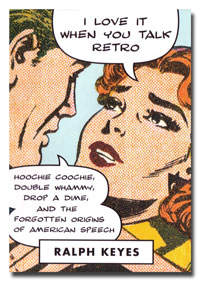
I Love It When You Talk Retro
“You sound like a broken record” doesn’t make much sense to a generation that grew up with iPod buds in their ears. Terms such as “stuck in a groove,” and “flip side” could also be perplexing. Today’s Gen-whatevers may not know who Nurse Ratched is, the size of a breadbox, or why “going postal” refers to a major uproar.
I Love It When You Talk Retro discusses verbal artifacts such as these, ones that hang around in our national conversation long after the topic they refer to has galloped into the sunset. This could be a person (Gorgeous George), product (Edsel), past bestseller (Catch 22), old radio show (Gang Busters), comic strip (Alphonse and Gaston), or long-forgotten advertisement (“Where’s the beef?”). We all use the catchphrase Cha-ching! but how many realize that this slang term for money was introduced in a 1992 ad for the Rally’s fast food chain?
Ralph Keyes takes us on an illuminating and engaging tour through what he calls retrotalk. His book explains where retroterms come from and why they’ve struck a chord. “Mrs. Robinson,“ the seductive character Anne Bancroft played in The Graduate, is far more evocative than “an older woman who seduces a younger man.” Cootie is much more fun to say than “lice,” doofus more pithy than “a clueless individual.” Yet few who use such terms realize that the former originated as World War I soldier slang, the latter in the comic strip Popeye.
I Love It When You Talk Retro will enrich the reader’s store of language lore. This journey along the highways of history and byways of culture is an invaluable guide for anyone who’s ever wondered “Where did that term come from?” Ralph Keyes’s book answers this question. Repeatedly. And is a lot of fun to read.
Where to buy
I Love it When You Talk Retro can be purchased at the following online retailers as well in a store near you.
Contents
A Note to Readers
1. Talking Retro
2. Story Lines
3. The Name’s Familiar
4. Fighting Words
5. Stump Speech
6. From Levittown to Jonestown
7. Law and Order
8. Good Sports
9. Getting Around
10. Yes, Virginia, There Is a Casting Couch
11. Movie Metaphors
12. Home & Hearth
13. Sizzling Widgets
14. On the Job
15. Over the Wires and in the Groove
16. Kid Stuff
17. Stay Tuned!
18. Seen in the Funny Papers
19. Between Covers
20. Retro U
21. Miscellany
22. The Future of Retrotalk
Acknowledgments
Notes
Bibliograpy
Index of Retroterms
Excerpt
A list compiled every fall at Beloit College attracts much attention. This list gathers cultural references that might puzzle first-year students. “You sound like a broken record,” for example, doesn’t make much sense to a generation that grew up with iPod buds in their ears. Terms such as “stuck in a groove” and “flip side” could also be puzzling. Today’s eighteen-year-olds may not know who Ma Bell is, why 1984 was a year to be concerned about, or how to get to Peyton Place.
Watergate is problematic too. Three decades after the break-in at that office complex in Washington, D.C., a South Carolina high school teacher asked students in her government class what “Watergate” referred to. Some had a vague idea that it had something to do with Richard Nixon. Others thought it referred to a fight between the British and Americans in 1789, or that it happened in the mid-1900s, or the late nineteenth century, and could have involved bribery, or the Clintons, or Vietnam, or possibly World War II.
And it isn’t just not-so-current events that can be perplexing. In Ohio, thirty-seven students in a Canton high school class were polled about their familiarity with everyday items barely a generation old. None knew what “45 rpm” referred to. One fifteen-year-old thought it might be a term for modem speed—the rate per minute perhaps. Another fifteen-year-old guessed that “45 rpm” referred to the rotations per minute of a car wheel. These teenagers were vaguely familiar with vinyl records (“You mean those giant black discs? My parents have some in the basement.”) and rotary phones, because a few of their grandparents still used them. On the other hand, they could only speculate that a fuzz buster might be some sort of vacuum cleaner.
Not just young students but recent immigrants are liable to be puzzled when dated allusions come up. That’s what a Harvard graduate student named Michele Gordon discovered when she surveyed twenty colleagues about their familiarity with common American expressions such as “Put your John Hancock there,” “The buck stops here,” and “You’re not in Kansas anymore.” Half of her subjects were native-born, half English-speaking students from countries such as Denmark, Switzerland, and Nigeria. Even when they realized what such expressions meant, her foreign-born subjects seldom knew why. Although most had heard the name John Hancock, none could say why his name was synonymous with signatures. As for not being in Kansas anymore, Gordon assumed that because The Wizard of Oz runs so often on television, her foreign-born group would be familiar with this expression and its meaning. She was wrong. Although some had a general idea that it meant one was no longer in a rural environment, they missed the broader connotation of leaving a provincial setting for one that’s more cosmopolitan. None realized that this catchphrase came from a movie. One guessed that it originated in the Broadway musical Oklahoma.
The foreign-born participants in Gordon’s study were taken aback by their lack of familiarity with these allusions. Some figured the references were likely to puzzle most Americans as well. But native-born participants did not find the expressions puzzling at all. Most found their meaning obvious. Asking about them was “a silly exercise” one told Gordon.
It wasn’t. Even though American discourse is filled with references we assume “everyone’s heard of,” everyone hasn’t. Those who were born after what’s alluded to took place, who grew up in another country, or who simply don’t know what it refers to, get left out in the conversational cold. After seeing “Ka-Ching” in a newspaper headline, an elderly New Yorker assumed this expression came from China and asked several Chinese acquaintances what it meant. Michele Gordon herself had no idea why “The buck stops here” refers to the final point of responsibility. (It comes from the old poker player’s expression pass the buck, discussed in chapter 21.) Any one of us is liable to be puzzled by an allusion whose meaning presumably is clear to others but not to us. Even terms we commonly use aren’t ones whose origins are always familiar. Who was Hobson and what was his choice? Why does zipless have sexual overtones? And what’s the big deal about drinking Kool-Aid?
Think of this as retrotalk. Retrotalk is a slippery slope of puzzling allusions to past phenomena. Such allusions take the form of retroterms, verbal artifacts that hang around in our national conversation long after the topic they refer to has galloped into the sunset. They are verbal fossils, ones that outlive the organism that made their impression in the first place. This could be a person, a product, a past bestseller, an old radio or TV show, an athletic contest, a comic strip, an acronym, or an advertisement long forgotten. To qualify as a retroterm, a word or phrase must be in current use yet have an origin that isn’t current. Iconic individuals can be the source of retroterms. Leftover slang is a common part of retrotalk, and old jokes that left punch lines behind but not always the setup. (“Take my wife (please).”) They’re clear to those who are familiar with these phenomena, confusing to those who aren’t. This distinguishes retroterms from idioms, which tend to be self-explanatory (e.g., “dig your own grave,” “skate on thin ice”) or easily deciphered (“born with a silver spoon in his mouth”). Retroterms have no intrinsic meaning. These words and phrases make sense only when one knows where they came from. Relying on retroterms can be problematic. For those of a certain age, making reference to things past is so routine that they’re seldom even aware of doing this. But it’s painfully apparent to those who aren’t familiar with dated verbal shorthand. Take my son Scott (please). When he was in middle school, Scott—who was born just after history’s worst nuclear power disaster—asked, “Who’s this Cher Noble I keep hearing about?”
Such verbal confusion is more than a mere curiosity for those who want to communicate with younger cohorts. Members of the media have a particular problem here. During just a few evenings of televised political coverage I’ve watched middle-aged news analysts allude to Hercule Poirot, Judge Crater, Apollo Creed, Popeye Doyle, Rain Man, Ponzi schemes, blue plate specials, and eighteen-and-a-half-minute tape gaps. Such allusions confirm shared experiences but create distance from those who didn’t share them. When Meet the Press guest David Brooks said about Hillary Clinton, “In the first debate she’s Emily Post, now she’s Howard Beale”—referencing the late etiquette maven and the angry protagonist of the 1976 movie Network—he set himself apart from viewers born in the last three decades. Those who fall back on such references might as well hang a sign around their neck reading OLDER YAKKER AT WORK. NO ONE UNDER 50 NEED PAY ATTENTION.
Journalists, teachers, and communicators of all kinds run the risk of casually using dated allusions that draw blank looks. Tom Wolfe has lamented the fact that authors of his generation so often rely on imagery from a more agrarian era such as “bark up the wrong tree,” “has blinders on,” and “a hard row to hoe.” Those phrases mean little to those who aren’t familiar with that era. When a Florida teacher told her third graders that while visiting a century-old school house they’d learn to shoot marbles, churn butter, and hoe the ground, some snickered. “Isn’t ’ho a bad word?” asked one student.
This illustrates how the same terminology can mean different things to members of different generations. To parents beta is a videotape format that lost the marketing war to VHS. To their kids it’s a software program being tested. To them thongs are an exciting type of minimalist underwear. To their mothers and fathers thongs are cheap sandals with a thingie that goes between the toes. Hoody to me is hoodlumlike behavior. To my sons it’s a sweatshirt with a hood.
Discourse between members of different generations can be a minefield of perplexing allusions. To the annoyance (and disdain) of their offspring, parents and grandparents routinely use terms such as icebox, tin foil, and dime store. Those who use such retroterms don’t necessarily mind that they’re confusing to younger ears. Language is a potent weapon in the generational wars. Older folks often complain that they can’t make head or tail out of what younger folks are talking about with all their slang. Well, duh. That’s just the point. Kids everywhere shoot slang at their parents and always have. Parents retaliate with retrotalk.
For those words to make sense one must be familiar with the experiences that gave them birth. Just as slang can be self-consciously in-group talk, allusions are an effective way to confuse outsiders. Those who don’t get the allusion clearly don’t belong. One reason for using references known only to the cognoscenti is to distinguish insiders from outsiders. This has always been an important role of language among ethnic or geographic groups, and it is just as important today when generations collide. Retroterms and modern synonyms draw lines in the generational sand. Lipstick is what our ancestors wore. We use lip gloss. They used rouge, we use blush. They ate prunes, we eat dried plums. They got crew cuts, we get buzz cuts. They got VD, we get STDs. Very important distinctions, as you can see.
Although my original intention for this book was to explore the origins of dated allusions that might puzzle young people and immigrants, the more deeply I got into this project, the more I realized how many of the words and phrases I was investigating were ones whose origins weren’t necessarily known to all. What made me realize this was how many I encountered that mystified me. In a New York Times column, Maureen Dowd referred allegorically to “Nosey Parker.” Who he? To characterize those who naively believe that managed health care drives down medical costs, Dowd’s colleague Paul Krugman used the expression “There must be a pony in there somewhere.” Say what? Upon investigation, such puzzling allusions proved to have a clear historical root, and often a fascinating one (discussed more fully in the text). After chasing down their origins I found myself repeatedly musing, “So that’s where that comes from!”
Along the way my book’s scope broadened to include a wide variety of allusions in current use whose origins aren’t always clear. It isn’t meant to compensate for a spotty education. I’m assuming that most readers can recognize a Mona Lisa smile and know what it means to “meet your Waterloo.” Shakespeare and the Bible are rich with retroterms I’ve mostly ignored on the assumption that their genesis is widely known. But assuming familiarity with a wide range of other terms is risky. Making sense of the many linguistic relics in our lexicon requires familiarity with events that left behind a verbal residue. This is what syndicated columnist Leonard Pitts discovered when he referred to Mayberry in a column. His editor, who grew up in a home without television, challenged Pitts’s reference to a town she thought could make readers ask, “Where’s that?”
That’s the type of question this book strives to answer. In examining its contents, some may wonder, “What’s X doing here? Or Y? Everyone knows what they refer to.” But everyone doesn’t. We’re all familiar with some allusions but not others. (While serving as White House press secretary, Dana Perino confessed that she didn’t know what the Cuban missile crisis referred to.) Which retroterms we know about and which we don’t vary with the individual. That’s why I’ve tried to err on the side of inclusiveness. But even familiar terminology may have an unfamiliar origin story. This book is full of those stories. They explain where such retroterms came from and why they’ve lingered in American discourse.
Although not a work of history as such, I Love It When You Talk Retro hits the high points: those allusions from our past that made a big enough impression to stick around. As Bill Bryson wrote in Made in America, “unless we understand the social context in which words are formed . . . we cannot begin to appreciate the richness and vitality of the words that make up our speech.” That’s why this book concerns itself with social history as much as word history. One can’t be divorced from the other. Language reflects its times. Words, phrases, and allusions are excellent barometers of what mattered to us during a given period of history: what resonated, struck our fancy, or simply tickled our funny bone. Americans love to play with words. Ever since the first hotcake was fried in bear grease, they’ve invented new terms with abandon, revised grammar on the fly, and continually moved concepts from one context to another. As visitors routinely discover, American conversation is filled with inventive terms and always has been. While visiting the United States in the early nineteenth century, an Englishman named Basil Hall discussed this topic with dictionary compiler Noah Webster. Webster was favorably impressed by the many new words Americans had coined. Hall was appalled. If a new word proved useful, asked Webster, why not add it to the lexicon? “Because there are words enough already,” Hall responded, “and it only confuses matters, and hurts the cause of letters to introduce such words.”
New circumstances demand new words, however, and Americans have always been up to the task of supplying them. A recurring question in this book is why some endure as retroterms while others don’t. In their Darwinian struggle for survival, new terms that take hold are not necessarily the flashiest, most colorful, or most widely used. The only thing that really matters when a fledgling word or phrase is being auditioned is utility. Does it improve on an existing one? Has anything better come along to take its place? Perhaps most important, do we like the terms in question? That’s why this book returns so often to the concept of striking a chord. Certain events, identify them and explore their origins but to understand why they stuck around when others didn’t. How is it that the comic strip characters Alphonse and Gaston left their names behind but the Katzenjammer Kids didn’t? Why has boxing been the source of so many analogies and football so few? And what makes us rely on sell the sizzle long after we’ve forgotten who coined that expression?
Even though it’s not always clear why some words and phrases gain traction while others don’t, here are some guidelines. Lasting retroterms:
Strike a chord. For what ever reason, some terms just strike our fancy in a lasting way. This can be seen in TV ads that contribute catchphrases which do—or don’t—stick around. “Flick my Bic” lasted for only a season, as did Alka-Seltzer’s “I can’t believe I ate the whole thing!” But “Where’s the beef?” is still part of our national conversation more than two decades after Wendy’s rolled it out, and Chiffon margarine’s “It’s not nice to fool Mother Nature!” has lasted even longer. Both struck a durable chord.
Fill a void. It is well known among lexicographers that words and phrases most likely to enter the vernacular fill a gap. They prove more useful as a form of verbal shorthand than any existing word. Gerrymander is one example, a term coined early in the nineteenth century to describe artfully drawn voting districts. (See chapter 5.) More recently, Mrs. Robinson has proved more economical and far more evocative than “an older woman who seduces a younger man,” just as the forgettable movie Mr. Mom left its title behind in our lingo because those two words allude to a stay-at-home father better than any others that have come along.
Excite strong feeling. Intense emotion, fear especially, welds content into our brains. Ask any psychiatrist. Conveying a sense of dread, as director Alfred Hitchcock did so effectively so often, guaranteed that movies such as Psycho and The Birds would be a fertile source of lasting retroterms.
Are fun to say. A retroterm’s life expectancy is helped immeasurably if it feels good on the tongue. Cootie. Cha-ching! Rope-a-dope. Sizzle. Gong. Bimbo. All these terms have endured in large part because they’re just so gosh-darn fun to say. For someone’s name to become iconic, it helps to roll smoothly off the tongue. “Kiplingesque” doesn’t work very well. Nor does “Woolfian” or “Conradian.” “Hemingwayian” is a complete nonstarter, and “Hemingwayesque” isn’t much better. Proustian works just fine though, as does Dickensian. Orwellian works best of all and Kafkaesque nearly as well.
One problem retroterms present to those unfamiliar with them is a simple matter of spelling. Phonetics are no help. Quite the contrary. While researching this book I’ve seen references to “brass tax,” “text’s bad boy,” “Mutton Jeff,” and “Profit of God.” In a Blondie comic strip, Dagwood holds a black platter, saying, “Look. Here’s our old Guy Lombardo New Year’s record.” “Let’s take it up to the attic and play it on the old Victrola,” responds Blondie. Their teenage daughter Cookie overhears this exchange. When her brother Alexander asks, “Where are Mom and Dad?” Cookie says, “I’m not sure. They’re going to play with some guy named Vic Trola who has lumbago.”
Not all retrotalk takes place on a generational fault line, however. Some allusions can be perplexing to anyone of any age or station. Take “waiting for the other shoe to drop.” I once asked a twenty-eight-year-old graduate of an Ivy League college if she knew the genesis of that common catchphrase. The woman didn’t. My subsequent minipoll found she was not alone. Most of those whom I queried realized this phrase referred to an unresolved situation; but few knew why. Where did that allusion come from?
Reviews
January 17, 2011
Publisher Weekly
The phrase “drinking the Kool-Aid” is a mystery to young people today, as is “45rpm.” Even older folks don’t know the origins of “raked over the coals” and “cut to the chase.” Keyes ( The Quote Verifier ) uses his skill…
January 16, 2011
Booklist
In his excellent introduction to this language book, Keyes defines retrotalk as a “slippery slope of puzzling allusions to past phenomena,” allusions that employ terms he refers to as “verbal artifacts,” or phrases that…
January 15, 2011
Library Journal
Keyes ( The Quote Verifier: Who Said What, Where, and When ) distinguishes this work from other slang and idiom resources by explaining retro terms, that is, words and phrases that have been used for so long that people…
January 14, 2011
Yellow Springs News (Ohio)
Ralph Keyes is known as a writer’s writer. He earned that distinction by writing well on a variety of topics over a long period of time, sometimes directly for writers, and other times on the origins of modern American…
January 13, 2011
National Post (Canada)
April 4, 2009 Our everyday speech is filled with arcane references we don’t even know we’re making, terms Ralph Keyes calls verbal fossils. Examples include “cooties” (a term for body lice that afflicted First World War…
January 12, 2011
Hartford Courant
June 20, 2009 Gen X’ers with iPod buds stuck into their ears might puzzle over the meaning of terms derived from phonograph records: “flip side,” “like a broken record” and “in the groove.” Ralph Keyes is here to help…
January 11, 2011
St. Petersburg Times
November 1, 2009 I Love It When You Talk Retro (St. Martin’s) by Ralph Keyes explains the origins of colorful phrases for which younger people may have no cultural context, like saying someone sounds like a broken…
January 10, 2011
Philadelphia Inquirer
January 17, 2010 As for gung-ho, Ralph Keyes points out in his new I Love It When You Talk Retro that it was the motto of a New Zealand group, taken from the Chinese words kung and ho – work and together. A colonel in…
January 9, 2011
Buffalo News
February 7, 2010 From pink slips to red tape, from asking “Where’s the beef?” to looking a gift horse in the mouth, American English has thousands of interesting colloquialisms. Benchmarks are still vital today, but who…
January 8, 2011
Regina's Books for All Ages
Regina Sunderland’s book reviews, book announcements, book introductions and book discussion club. It’s all about books! April 19, 2010 Buzz up! What a find at my local Library. I am one of those goofy people who simply…
January 7, 2011
The Land of Curly Hair
March 31, 2010 BOOKS I FINISHED – MARCH 2010 This was another totally random selection off an endcap at the library. I read it in little snippets over the month. Loved it! I’ll probably buy a copy for our family, as I…
January 6, 2011
Little Blog of Stories
March 13, 2010 Ah, the title says it all! I Love It When You Talk Retro , by Ralph Keyes, is a wonderful peek into the lost origins of some of America’s most beloved and obscure words and phrases. Did you know that the…
January 5, 2011
Melinda Joy
Living, Laughing, Loving March 12, 2010 When I first saw this book advertised in the Philadelphia Inquirer , I knew it was something I needed to add to my collection. I work with many ‘senior’ individuals, and they…
January 4, 2011
GenTrends
May 2009 To Ponder. . . Back in woodshed times, American boys itching for a fight sometimes announced this fact by placing a chip on their shoulder,then daring someone to knock it off. Although fastidious contemporary…
January 3, 2011
Mouse Potato
Book Review – “I Love It When You Talk Retro,” June 1, 2009 By J.A. O’Sullivan The cover says it all: hoochie coochie, double whammy, drop a dime. “I Love It When You Talk Retro,” a new book by Ralph Keyes, explores the…
January 2, 2011
Swordplay
News, views and insight for the professional and corporate community It’s Retro – But What Does It Mean? June 3, 2009 Many of us in the professional sector will today bemoan the deadlines that govern our every move…
January 1, 2011
Kalamazoo Public Library
Staff Picks: Books, June 18, 2009 I Love It When You Talk Retro Retrotalk and retroterms. These words are used by Ralph Keyes to describe the subject of his 2009 book I Love It When You Talk Retro. The main point of…
December 31, 2010
PhillyBurbs.com
This book is the bee’s knees . I have no idea what that means, June 30, 2009 I have a love/hate relationship with expressions and phrases. I use them constantly; hair of the dog, hold your horses, juggernaut and selling…
December 30, 2010
Arch Thinking
A repository of my thoughts about books, art, and architecture Review: I Love It When You Talk Retro July 2, 2009 Do you know what a Venn diagram is? It’s the kind of diagram with two or more circles, showing overlap…
December 29, 2010
Lee Aulson's Blog
Nerd Chic: July 3, 2009 I came for a certain book and left with this one. The cover was unattractively Lichensteinian but I didn’t judge. It’s basically a collection of western idiomatic language that dates back to…
December 28, 2010
Joe Taxpayer
Financial Commentary for the Average Joe I Love It When You Talk Retro July 14, 2009 Not long ago, I used the expression “sounds like a broken record” regarding a classmate of my 10 yr old. He had been repeating the…
December 27, 2010
Library Talk
King County Library System (Washington) I Love it When You Talk Retro by Ralph Keyes, July 14, 2009 I am having a hard time deciding what to call, I Love it When You Talk Retro– it’s American history, its etymology, its…
December 26, 2010
Rocket Man Reads
July 20, 2009 I Love It When You Talk Retro by Ralph Keyes This book is definitely best when browsed or kept in the bathroom, but as it was I got it from the Leisure section of Parks Library, thus 4 weeks only with no…
December 25, 2010
MADreads
Book News and Reviews from Madison Public Library Using the Veg-O-Matic while listening to my victrola July 30th, 2009 My mother had a saying: “That and fifty cents will get you right on the bus.” The meaning was, no…
December 24, 2010
Mississippi Library Commission Reference Blog
August 2009 We post the interesting and kooky things we find while looking for the answers to reference questions. I was especially tickled by the entry on mattresses in the furniture section of I Love it When You Talk…
December 23, 2010
Weblog van Marc De Coster
August 2009 Does anyone know the meaning of “ping-pong diplomacy” or the origin of the “Stockholm syndrome”? In case many of the history lessons from high school have been erased from your hard drive, fear not: you…
December 22, 2010
Daily Mortgage Rates
November 5, 2009 Review of I Love It When You Talk Retro: Hoochie Coochie, Double Whammy, Drop a Dime, and the Forgotten Origins of American Speech (Hardcover) When our daughter-in-law’s parents turned 60 last December…
December 21, 2010
LARGEHEARTED BOY
February 10, 2010 This is the sort of book that either makes you really fun or really boring at parties, depending on what sort of parties you go to.
December 20, 2010
FROM THE BRAIN OF CJHANNAS
October 30, 2010 Talking Retro I always enjoy when people recommend books to me, but for some reason it always takes me forever to get around to reading those titles. Ralph Keyes’ “I Love It When You Talk Retro” is a…
December 19, 2010
INVISIBLE THEME PARK
June 28, 2010 Retro Words I Love I love antiquated words. Some of the best stories about the origins of words come from a book called I Love It When You Talk Retro, by Ralph Keyes. • The word “widget” comes from a 1924…
December 18, 2010
Amazon Customer Review: So interesting!
***** 5 stars Sarah Mallory (Sacramento, CA) (REAL NAME) loved finding out about the origins of all of these common phrases. Some I had never even heard of, but some I had an idea of where they came from. Quite an…
December 17, 2010
Amazon Customer Review: Talking “Retro”
***** 5 stars Margo Dunlavey “Margo” (Rockville, MD) This delightful book gives the reader the origins and meanings of a multitude of catch phrases that you have heard, but were perhaps not sure of. It is a quick read…
December 16, 2010
Amazon Customer Review: This is essential reference
***** 5 stars Fairlee E. Winfield “Author of BUFFALOed” (Scottsdale, Arizona) Not only a reference though. It’s fun too. For a writer like me, even if you lived the retro talk, you tend to forget. This is great to…
December 15, 2010
Amazon Customer Review: Pass it on… Pass it down…
***** 5 stars G. Courter “LastWord” (Florida) When my father, age 94, hears a phrase like “juggernaut” he shows off with a convoluted–and usually incorrect–story about its origin. Now I have “I Love It When You Talk…
December 14, 2010
Amazon Customer Review: A rather interesting book
**** 4 stars By Kurt A. Johnson (Marseilles, Illinois, USA) (TOP 50 REVIEWER) Quite a few expressions we Americans use are out-of-date expressions that we nonetheless know the meaning of, more or less. But, even among…
December 13, 2010
Amazon Customer Review: A fun and informative read
***** 5 stars By Marty Hollingsworth “grammawalt.com” (CO United States) This is a fun book for finding out where phrases that you use all the time came from. It’ll give you great cocktail party chat. :-)
December 12, 2010
Amazon Customer Review: This Book is a Grand Slam Home Run
***** 5 stars Nancy H. Dickson (Garrett Park, Maryland) This book–I Love It When You Talk Retro: Hoochie Coochie, Double Whammy, Drop a Dime, and the Forgotten Origins of American Speech–is an absolute hoot for anyone…
December 11, 2010
Amazon Customer Review: Not just for Wordies
***** 5 stars P. Offen (San Diego) When our daughter-in-law’s parents turned 60 last December, my husband and I sent them a box of memorabilia from our common youth containing a “Don’t Trust Anyone over 30” button, a…
December 10, 2010
Amazon Customer Review: An E Ticket Ride!
***** 5 stars Gilah Pomeranz (Yellow Springs, OH) Ralph Keyes has a way of defying classification with his books that are a conglomeration of education, inspiration, and entertainment. In I Love It When You Talk Retro…
December 9, 2010
Amazon Customer Review: More on words from a writer's writer
**** 4 stars Virgil Hervey (Ohio) Ralph Keyes is more than a writer; he has fashioned himself into an expert on the origins of expressions used in everyday American speech. I Love It When You Talk Retro is a resource…
December 8, 2010
Amazon Customer Review: Great resource
**** 4 stars By Anyechka (Rensselaer, NY United States) (TOP 500 REVIEWER) I couldn’t stop reading this book because it was so packed with wonderful words and expressions, many of which I had never even heard of. As I…
Press
January 20, 2011
"Retro Talk": Cultural References Mystify Young
Talk of the Nation , NPR, March 10, 2009
January 19, 2011
Talk Retro to Me, Baby
Los Angeles Times , March 25, 2009
January 18, 2011
Editor & Publisher
In mid-April Editor & Publisher – the leading trade publication for journalists – ran an op-ed about retroterms used by journalists. This ignited a firestorm of response, pro, con, and somewhere in between. Here is the…
January 18, 2011
Author Digs for Phrases that Linger
Columbus Dispatch , March 29. 2009
January 17, 2011
Remembering Our Groovy Heritage of Words
Knoxville News-Sentinel , March 31, 2009
January 16, 2011
OSU Open Line
WOSU Open Line , NPR, April 2, 2009
January 15, 2011
Author Strikes Nerve with 'Retro Talk'
Herald-Times (Bloomington, IN), April 26, 2009
January 14, 2011
What's the Scuttlebutt? … And Other Slang Terms Decoded
New York Post April 12, 2009
January 13, 2011
Unusual suspects: When phrases give up the ghost
Boston Globe , May 3, 2009
January 12, 2011
Times Literary Supplement
Times Literary Supplement , May 8, 2009
January 11, 2011
NYT Talks Like Montgomery Burns
Columbia Journalism Review , May 11, 2009
January 10, 2011
Why I Write
Publishers Weekly , May 11, 2009
January 9, 2011
Talking Retro
On the Media , June 5, 2009
January 8, 2011
Summer Reading: from OED to OMG
Hartford Courant By Rob Kyff Gen X’ers with iPod buds stuck into their ears might puzzle over the meaning of terms derived from phonograph records: “flip side,” “like a broken record” and “in the groove.” Ralph Keyes is…
January 7, 2011
Some Terms That Have Outlived Their Roots but Not Their Usefulness
Voice of America , June 18, 2009
January 6, 2011
Florida Weekly
Florida Weekly July 29, 2009 THE AMERICAN LANGUAGE IS A RICH AND COLORFUL thing, full of strange words and unusual phrases. NANCY STETSON nstetson@floridaweekly.com “One thing I like about language is the way it…
January 5, 2011
Bark
Wagging the Dog
On the internet
January 21, 2011
“Where Does That Word Come From?”: Ralph Keyes Talks Retro
Faster Times February 25, 2010 Ralph Keyes is the author of fifteen books, but in some ways his most recent one—“ I Love It When You Talk Retro: Hoochie Coochie, Double Whammy, Drop a Dime, and the Forgotten Origins of…
January 19, 2011
History News Network
History News Network Ralph Keyes Our national conversation is filled with historical allusions: Ponzi schemes, smoke-filled rooms, talking turkey, even Harry and Louise (to say nothing of Thelma and Louise). Those who…
January 18, 2011
Sher-endipity
Sher-endipity Many expressions we use as adults originated in the playgrounds, classrooms, and empty lots of our childhood. “Say uncle,” “connect the dots,” “stay within the lines,” and “stuck-up” are just a few. The…
January 17, 2011
Something Good to Read
Something Good to Read “Outside of a dog, a book is man’s best friend. Inside of a dog it’s too dark to read.” ~Groucho Marx Malcolm Gladwell’s book about success, Outliers, is still selling like hotcakes. Go figure…
January 16, 2011
Twitter
Twitter Reading “I Love it When You Talk Retro” by Ralph Keyes … by flickering candlelight
January 15, 2011
Mystic Seaport, Museum of America and the Sea: News From the Collections
Just released today, I Love It When You Talk Retro: Hoochie Coochie, Double Whammy, Drop a Dime, and the Forgotten Origins of American Speech , extensively cites Mystic Seaport’s Origins of Sea Terms. Who knew that sea…
January 14, 2011
Super Punch
Super Punch The new book I Love It When You Talk Retro: Hoochie Coochie, Double Whammy, Drop a Dime, and the Forgotten Origins of American Speech by Ralph Keyes about slang sounds (and looks) great. You can read an…
January 13, 2011
Silver Wolf – Literary Commentary
Ralph Keyes is releasing a new book, called I Love it When You Talk Retro . Detailing the history of cultural slang and the evolution of popular phrases. As a word nerd, I’d probably end up buying this just for fun if I…
January 12, 2011
Phrase Finder Derivations Discussion
Posted by ESC Got a new book: I Love It When You Talk Retro by Ralph Keyes (St. Martin’s Press, New York, 2009). Interesting terms on Page 3: Retrotalk — allusions to past phenomena. Retroterms – verbal artifacts/verbal…
January 11, 2011
Sophisticated Hokum
A [screen]writer’s website and blog by J.K. Radomski Retro Speak: The Houston Chronicle ran a short interview with Ralph Keyes last week. He’s the author of the book I Love It When You Talk Retro: Hoochie Coochie…
January 10, 2011
History Geek
Eating Crow, Passing the Buck and Talking Turkey I painted this study of negative space after reading a review of Ralph Keyes lastest book, I Love It When You Talk Retro, Hoochie Coochie, Double Whammy, Drop a Dime and…
January 9, 2011
MY SKY BLUE PORTFOLIO
And, by the way, if you love the American-esque expressions of this post, you might want to check-out a new book called I Love It When You Talk Retro: Hoochie Coochie, Double Whammy, Drop a Dime, and the Forgotten…
January 8, 2011
YOU DON'T SAY
John E. McIntyre Talk retro to me May 9, 2009 This one is for the Young People, if any such lurk among my readers. Are you mystified by the peculiar turns of speech when Baby Boomers talk? Do you feel ashamed that at…
January 7, 2011
The Standard
St. Catharines, Ontario The following books are available at the St. Catharines Public Library. I LOVE IT WHEN YOU TALK RETRO: Hoochie coochie, double whammy, drop a dime, and the forgotten origins of American speech,by…
January 6, 2011
Fritinancy
Fritinancy: Names, brands, writing, and the quirks of the English language. Word of the Week: Tabloid Tabloid: A reduced-format newspaper, generally half the size of a traditional broadsheet paper, that opens like a…
February 25, 2010
"Where Does That Word Come From?" Ralph Keyes Talks Retro
Faster Times Ralph Keyes is the author of fifteen books, but in some ways his most recent one—“ I Love It When You Talk Retro: Hoochie Coochie, Double Whammy, Drop a Dime, and the Forgotten Origins of American Speech”…
August 11, 2009
Rocky Mtn. Writer
A word Throughout my professional life, I’ve worked hard to avoid using clichés in my writing (except in headlines!) and have tried to be careful with my use of idioms. After three decades, I must say it’s been an…
June 30, 2009
The Patt Morrison Show
89.3 KPCCradio (NPR) in Los Angeles My favorite part of [yesterday’s] program was with Ralph Keyes, the author of ‘’I Love It When You Talk Retro,’’ about how we use shorthand references in our language – ‘’drop a…
June 1, 2009
MOUSE POTATO
retro-book By J.A. O’Sullivan The cover says it all: hoochie coochie, double whammy, drop a dime. “I Love It When You Talk Retro,” a new book by Ralph Keyes, explores the history of America’s slang, sayings and street…
June 1, 2009
ZOOM STREET MAGAZINE
Keyes leads us on a retro-romp down Lingo Lane, where the artifacts of language are littered like roadkill. He organizes them in categories for us (Stump Speech, Law & Order, Movie Metaphors, Home & Hearth, etc.)…
May 27, 2009
BEKKI'S BOOK BLOG
Language fascinates me, and I’ve read a few books on the history of word and phrase origins. It’s always interesting. “ I Love it When You Talk Retro” by Ralph Keyes examined the origins of slang in our culture, both…
What colleagues say
A fun, fact-packed and eminently browsable guide, which cuts the mustard, hangs a few myths out to dry, and should play in Peoria.
Henry Hitchings, author of The Secret Life of Words
Everyone needs this book. Younger people need it to decipher the allusions and metaphors of their elders and older people need it to remind them of the days when today’s retro was cutting edge. Ralph Keyes has outdone himself with this intensely useful and highly entertaining work. I Love It When You Talk Retro is an absolute gem.
Paul Dickson, author of The Dickson Baseball Dictionary, Family Words, and War Slang
We love I Love It When You Talk Retro. How modern language came to be, and how it trickles into our daily speech is a fascinating subject. Ralph Keyes has done a fine job.
Jane and Michael Stern, authors of The Encyclopedia of Bad Taste, The Encyclopedia of Popular Culture, and Roadfood
At last, a genuine study of the sort of history you will actually want to know about. This book reveals the root of a large part of our culture and the way modern language has developed.
Albert Jack, author of Red Herrings and White Elephants and Shaggy Dogs and Black Sheep
I did love reading (and thumbing through) it! This book just had to be written …
Sol Steinmetz, author of Semantic Antics
A serious contribution to popular culture and word history–and a very well-written one at that.
Rosalie Maggio, author of How to Say It
What readers say
Just as you suggest in the introduction, I have been casually, and sporadically, perusing your I Love It When You Talk Retro book. I have to say, if only could remember a tenth of what I read in this book I’m certain that I would be guaranteed to be the lifeof any party…for a while.
This has been a fun book to read. As you can see, it’s had me noting other retro terms that I have been encountering in the short time since I picked up your book.
Grand Junction, CO
I was reading some of the retroterms to my husband last night. The book is so informative and funny at the same time. We really got into it. Good job!
These retroterms are so much fun. Highly rec-comend your book!!
Houston, TX
Just finished your new book and loved it! It was such fun to read and I am recommending it to all my friends. There are so many expressions that I have used over the years but never knew their origin. What research you must have done!
Loudonville, NY
I’m thoroughly enjoying your latest work. However, I think your definition of HAYMAKER (“perhaps because it generates enough wind to dry grass”) misses the mark. Before the invention of the mechanical baler hay was either formed into ricks or pitched onto wagons -PITCHFORK- In one continuous motion the hay was scooped from the ground and heaved up and over the head. It’s easy to see the same motion delivering a knockout blow!
And an addendum to the film “Deliverance”. I was recently employed by the Census Bureau, searching out living quarters in parts of rural Pennsylvania. Some of the “roads” and the dwellings at the end were pretty rough. In conversations with my co-workers my comment that “I started to hear banjo music” invariably brought a laugh of understanding.
Pennsylvania
As a tail-end baby-boomer, and a Texan at that!, I love retrotalk and am enjoying the heck out of your book.
Texas
I’ve been reading your book and thought of this. Whenever anyone walked into our home when I was a child and called out, “Anyone home?” My mother would answer “Just us chickens.” I tracked the phrase down to a story of a chicken thief who was in the chicken coop when the farmer heard some noise and went to the coop and called out, “Anyone there?” The thief responded, “Just us chickens.”
South Orange, NJ
As a tail-end baby-boomer, and a Texan at that!, I love retrotalk and am enjoying the heck out of your book.
Texas
I just finished your wonderful book “I Love it when you talk retro” and I have to say, I wish it never ended. But I guess that is point. Our English language (the American version in particular) evolves and changes “on a dime” and your book made me realize how fascinating
Berkeley Heights NJ
I’ve enjoyed “I Love It When You Talk Retro.” As an old retro-talker myself I found it fascinating and a lot of fun, and I hope you’ll do a Mencken and provide periodic supplements.
La Crescenta, CA
I very much enjoyed I Love It When You Talk Retro.
Houston, TX
I’m a Brit on vacation in Canada bought your talk retro book in Toronto. Love it.
London, England
Enjoyed your book.
Tempe AZ
I recently read and thoroughly enjoyed your I Love It When You Talk Retro.
Bloomington, IN
I hope your book was reviewed above the fold, and that you hear thatcha-ching of royalties pouring in. It sure is a doozie. Your amazing bibliography blew me away. I loved the book. It’s fun to read, and makes mewant to read some of your other work.
Madison, WI
I really had fun with your book, although I probably drove my family crazy with all my “listen to this” and “did you know . . .”
Warren, OH
I have just been reading I Love It When You Talk Retro, with great enjoyment.
…a perfectly swell book.
Enjoying your book a lot! Fascinating…so much information.
e-mail It is an AWESOME tome. I use cliches all the time not knowing the origins. Your book helps give some background and even taught a few to me I had never heard about before my reading. I devour 10-15 books a month. Yours is a rarity in that, it had such an impact, it warranted a Google search and reply. Keep up the good work!
Facebook message
Quiz
TEST YOUR RQ (Retroterm Quotient)
© Ralph Keyes 2009
Circle the number of the answer that seems most correct.
1. Cha-ching originally was
a) Mandarin for one million yuan
b) a postwar Havana dance revue that featured showgirls wearing dollar bills
c) a sound effect in a 1930s radio ad for National Cash Register
d) an expression repeated continuously in a 1992 TV ad for Rally’s hamburgers
2. A 97 or 98-pound weakling is
a) a boxer fighting above his weight class
b) the scrawny figure in ads for Charles Atlas bodybuilding
c) an anorexic model
d) an emaciated Great Dane
3. Rope-a-dope alludes to
a) someone struggling to get out of a rope hammock
b) hanging dimwitted criminals
c) a rodeo rider roping a confused calf
d) the tactic Muhammad Ali used to defeat George Foreman in 1974
4. The word scuttlebutt originally referred to
a) the water barrel where sailors gathered on ships
b) a chimpanzee who scoots about on its behind while squawking loudly
c) a bucket once used to carry coal
d) the “scut work” done by coal miners who had to work while seated
5. Nurse Ratched was
a) a character in a 1969 TV ad for GM’s Mister Goodwrench
b) a Medal of Honor-winning caregiver during the Battle of the Bulge
c) a stern psychiatric nurse in the movie One Flew Over the Cuckoo’s Nest
d) the star of a 1973 soft-porn movie called Hospital Hotties
6. A double whammy originally was a
a) drink popular in the 1950s that combined vodka and gin
b) one-two punch in boxing matches that resulted in a knockout
c) two-patty hamburger with hot sauce sold by Wendy’s in the late 1980s
d) lethal curse inflicted by Evil Eye Fleegle in the comic strip L’il Abner
7. The term gangbusters originally referred to
a) a 1930s radio show
b) an elite police unit that broke up Chicago streets gangs in the 1980s
c) a 1970s pro wrestling tag team from the South Bronx
d) a 1984 movie starring Bill Murray and Dan Aykroyd
8. Ping-pong diplomacy refers to
a) a spirited US-USSR ping pong contest in the 1976 Olympics
b) a type of elaborate tact displayed by married couples in counseling
c) a 1971 tour of China by American ping pong players
d) a diplomat bouncing back and forth between two warring countries
9. A Shermanesque statement is
a) a brusque order issued by the commander of a Sherman tank
b) a politician’s unequivocal statement that he or she is not running for office
c) a unique type of curse originated by residents of Sherman, Texas
d) a mock-eloquent expression associated with 1930s actor Halbert Sherman
10. Kumbaya refers to a
a) song sung by 1960s activists
b) famous organic restaurant in Berkeley
c) spice unique to Cape Verde
d) Pentecostal prayer characterized by spontaneous confessions of sin
11. Mrs. Robinson was
a) a strict but sexy schoolteacher in Up the Down Staircase
b) the housewife played by Deborah Kerr who beds a teenage boy in Tea and Sympathy
c) a seductive older woman played by Anne Bancroft in The Graduate
d) the unfaithful wife of Jack Robinson in an old English yarn
12. Zipless is
a) Velcro’s original name
b) a popular Ska band from Trinidad
c) a character in Walt Disney’s movie Song of the South
d) the spontaneous sex depicted in Erica Jong’s novel Fear of Flying
13. Alphonse and Gaston were
a) two comic strip characters who elaborately deferred to each other
b) a team of French trapeze artists who performed in the late nineteenth century
c) two prominent hockey players on the Quebec Nordiques in the early 1990s
d) the nicknames of two leaders of New York’s 1969 Stonewall demonstrations
14. We say that conforming people are in lockstep because
a) American prisoners were once made to march in close proximity, or “lockstep”
b) goose-stepping Nazi soldiers were said to be in lockstep
c) “Lockstep” was a 1920s dance craze involving large groups of stiff-legged dancers
d) canal locks were constructed by workers tamping down earth in unison
15. Drink the Kool-Aid alludes to slavish loyalty because
a) the makers of this drink have strict standards of employee conduct
b) online rumors allege that those who drink Kool-Aid become unusually compliant
c) followers of the Rev. Jim Jones committed mass suicide by drinking a cyanide-laced fruit drink
d) fans of the rapper Kool-Ade are notorious for doing whatever he asks them to do
16. The weight of a formidable gorilla is most often thought to be
a) 300 pounds
b) 800 pounds
c) 1000 pounds
d) 500 pounds
17. Mata Hari refers to
a) a form of suicide unique to residents of the Andalusia region of Spain
b) the stage name of an Argentinian actress popular in the 1940s
c) the nickname of a Japanese soccer star who played for Real Madrid in the 1980s
d) an exotic dancer executed by the French for spying in World War I
18. Cakewalk is
a) a game once played by children at birthday parties
b) a dance popular in the early twentieth century
c) a carnival game of chance in which players vied to win a cake
d) the name of an undemanding hiking trail outside Boulder, Colorado
19. We say that some seek the limelight because
a) early fluorescent bulbs gave off a greenish hue
b) old-time stage lighting employed intensely heated lime
c) Victorian-era actors vied to appear at London’s renowned Limelight Theater
d) the spotlight put on stars of Depression-era stage revues employed a pale green filter
20. Those who take the fifth
a) run past home plate in a baseball game
b) steal a bottle of whiskey
c) invoke their constitutional right to not incriminate themselves
d) ride the Fifth Avenue bus in New York City
Answers: 1-d, 2-b, 3-d, 4-a, 5-c, 6-d, 7-a, 8-c, 9-b, 10-a, 11-c, 12-d, 13-a, 14-a, 15-c, 16-b, 17-d, 18-b, 19-b, 20-c.
17-20 fluent retrotalker; in the catbird seat
13-16 solid command of retroterms; in the loop
9-12 a bit hazy on the concept; penny’s dropping
5-8 consider a retro-refresher; back to the salt mines
1-4 RSL (retrotalk as second language); You talkin’ to me?