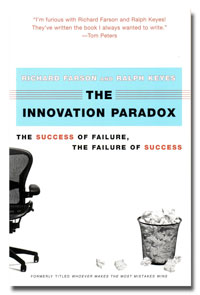
In The Innovation Paradox (originally titled Whoever Makes the Most Mistakes Wins), Richard Farson and Ralph Keyes argue that failure has its upside, success its downside. These two are not as distinct as we imagine. They co-exist, are even interdependent. Both are steps toward achievement. It’s not success or failure, but success and failure.
This truth has relevance to today’s business economy. Success there demands nonstop innovation. Genuine innovation cannot be achieved with obsolete formulas. Only an entirely new mindset will revolutionize managers’ thinking on this subject. According to Farson and Keyes, the key to innovation lies in taking risks. Doing this requires changing the way we think about success and failure. In a rapidly changing economy, managers will confront at least as much failure as success. Does that mean they’ll have failed? Only by their grandfather’s definition of failure. Both success and failure are steps toward achievement, say the authors. After all Coca Cola’s renaissance grew directly out of its New Coke debacle, and near- bankruptcy forced IBM to completely reinvent itself.
Wise leaders accept their setbacks as necessary footsteps on the path towards success. They also know that the best way to fall behind in a shifting economy is to rely on what’s worked in the past as when a once-innovative company like Xerox comes to rely too heavily on a once-successful formula that’s grown obsolete. In the process they become failure-phobic. By contrast, companies such as GE and 3M stay vibrant by encouraging innovators, even when they suffer setbacks. Farson and Keyes call this enlightened approach “productive mistake- making.” Rather than reward success and penalize failure, they propose that managers focus on what can be learned from each. Paradoxically, the authors argue, the less we chase success and run from failure, the more likely we are to genuinely succeed.
Rather than reward success and penalize failure, they propose that managers treat both alike. Not with rewards or punishments, but with engagement. Don’t penalize, they say, analyze. Focus on what can be learned from setbacks and triumphs alike. The best managers always have. Since failures so often lead to successes, and vice-versa, rather than try to sort these two out, wise managers focus on the innovation process and what can be learned from it. What went wrong? What went right? What can we learn from each experience?
In a concluding section Farson and Keyes suggest that we follow the lead of great coaches such as John Wooden and Phil Jackson and de-emphasize winning. Paradoxically, they say, this could be the best way to win. They call this approach “Samurai Success” after the Japanese warriors who focused their attention on full participation in a contest rather than on its outcome. The less we chase success and run from failure, the authors conclude, the more likely we are to genuinely succeed.
Where to buy
Follow the links to purchase The Innovation Paradox:
Contents
Acknowledgments
Introduction
1) The Success-Failure Fallacy
Tangled Line / Says Who? / Why Success
Resembles Failure, and Vice-Versa /
Failure Pride
2) The Agony of Victory, The Thrill of Defeat
Like Making Love / Peak Experiences /
Craving Excitement / Crisis Lovers /
Sweet Adversity / Management by Calamity
3) Nothing Succeeds Like Failure
Bards of Failure / Splendid Failure /
Productive Mistake Making / Success
Disguised as Failure
4) Nothing Fails Like Success
Marooned by Success / Everybody Hates a
Winner / The Personal Price of Success /
Feeling Like a Fraud / Looking Back on
a Great Future
5) The Success Hobble
The Ashes of Success / Roads Best Not Taken / Don’t Just Survive
6) Innovating with Attitude
The Risk-Friendly Workplace / Sprinters and Milers / Wild Ducks /
Minnesota Mining and Mistake-Making
7) Managing in the Post-Failure Era
Treating Success and Failure Alike / Earning Empathy / Sharing / Barnraising
8) Fear Management
The Underlying Fear / Making Friends with Fear / Putting Fear to Work
9) Samurai Success
Winning Isn’t Anything / Zen Warriors / Jackson’s Way / No Regrets /
How Do You Measure Success? / Beyond Success and Failure
Excerpt
Key Ideas From The Innovation Paradox
When ingrained attitudes about success and failure change, the meaning of every act of management changes too.
“Success” and “failure” are merely labels we hang on complex events trying to simplify them.
It’s not success or failure but success and failure.
The real pinnacle is when we are so engaged in what we’re doing that the distinction between success and failure vanishes.
Gamblers say that the next best thing to winning is losing.
We’ve evolved to feel more alive during times of crisis than periods of calm.
Adversity and upheaval can be far more powerful agents of change than planning and consultants.
A good research man, Charles Kettering liked to say, failed every time but the last one.
Those who are too afraid to make a mistake work for those who aren’t.
For corrections to occur, mistakes must be made.
It is utterly human to respond better to the travail of others than to their triumphs.
Success is at least as hazardous as failure.
Those who do well in school find it hard to take risks later on.
If it ain’t broke, fix it anyway!
Xerox is a classic example of a business that was too successful.
When working for a prize, we do only what’s necessary to get it and no more.
Employ methods that are as disorderly as life itself.
Nothing is as hard to see as what’s right before our eyes.
Innovators are seldom easy to be around.
Because it tolerates mavericks 3M attracts mavericks.
Not all failures are created equal.
To encourage innovation, take a genuine interest in employees’ work.
A blunder admitted is empathy earned.
Fresh thinking is more likely to result from collaboration than competition.
Managers who develop an atmosphere of safety put new glasses on everyone’s emotional eyes.
Only those who are willing to risk looking foolish can invent a breakthrough, give a speech, found a company, or stand up for a principle.
If we didn’t get anxious we would have vanished as a species long ago.
Excitement is the flip side of fear.
Stressing winning inhibits daring.
Success is a reward for doing a job well, not for doing a good job of pursuing success.
Remorse is far more likely about being too cautious than about being too reckless.
We may not know until late in life where we actually succeeded, and where we didn’t.
Reviews
January 27, 2011
Forbes.com
The Innovation Paradox: The Success of Failure, the Failure of Success (Free Press, $11) is the paperback edition of last year’s more boldly titled hardback, Whoever Makes the Most Mistakes Wins: The Paradox of…
January 27, 2011
Marilyn's "Must" Reads
Whoever Makes the Most Mistakes Wins by Richard Farson and Ralph Keyes is unique. It is a business book that makes its case with charm. Marilyn’s “Must” Reads (Machlowitz Consultants, Inc.)
January 27, 2011
Play for Performance
This book relates business innovation to paradox. It explores the fallacy of labeling events as success or failure. Sample practical suggestion: Retain unorthodox, difficult, imaginative employees because innovation…
January 27, 2011
Self Improvement and Personal Growth Weekly Newsletter
While slim, their book … make[s] a compelling case for “managing in the postfailure era” by supporting the type of traditionally discouraged behavior that resulted in breakthrough creativity Contrarian food for thought.
January 27, 2011
Stern & Associates
The theme of this short and interesting book is that the less we scurry after success and run from failure, the more likely we are to succeed. For success, failures must be tolerated. In short chapters and sections, the…
January 27, 2011
CIO Insight
How can you make companies, and the people who work inside them, more adventurous? The authors offer an intriguing and paradoxical solution: In order to stop demonizing failure, we need to stop deifying success…
January 27, 2011
Publishers Weekly
Recognizing obstacles is essential to victory, Farson and Keyes contend, and despite their book’s brevity, they demonstrate concrete ways to do so.
January 27, 2011
Richmond Times-Dispatch
In this extended essay, the authors deconstruct how we think about success and failure and propose a counterintuitive approach that acknowledges that both coexist in any given situation. They explain why we should…
January 27, 2011
Entrepreneur.com
… well-written, philosophical
January 27, 2011
The Business Reader Review
… the authors deconstruct how we think about success and failure and propose a counterintuitive approach that acknowledges that both coexist in any given situation. They explain why we should de-stigmatize and embrace…
January 27, 2011
Harvard Business Online
… a good antidote to the “win at all costs” school of management.
January 27, 2011
Dallas Morning News
… a fascinating little book, one that can provide encouragement to people facing setbacks
January 27, 2011
Miami Herald
… a very readable and witty meditation on winning and losing
Press
January 27, 2011
Business Prescriptions Radio
Kevin Pierce They say it is the paradox of innovation: That in order to succeed, we must learn to fail. Think of all the great inventions that came from mistakes, all the great products that were developed in pursuit of…
January 27, 2011
Toronto Star
Former ‘Lofter’ upbeat since 24-hour live TV show ended One day she’s sending off résumés and demo tapes to television networks, the next she’s licking stamps and mailing out medical school applications. Heather…
January 27, 2011
Lubes 'n' Greases
Jack Goodhue Those who want to have a better understanding of what motivates bosses, employees and peers should read Whoever Makes the Most Mistakes Wins , a new book by Richard Farson and Ralph Keyes. This small gem…
January 27, 2011
Champaign-Urbana News-Gazette (Champaign-Urbana, IL)
Jim Dey Before automobile mogul Henry Ford struck gold in the auto industry, he failed twice in previous ventures. The late chief executive officer of Coca Cola, Roberto Goizueta, presided over one of the greatest…
January 27, 2011
Los Angeles Times
Make No Mistake: Seeking Perfection Harms Innovation: Scandals’ worst effect may be to quash risk-taking. Richard Farson and Ralph Keyes At the moment, investors and politicians are trying to put out the firestorm of…
January 27, 2011
Columbus Dispatch (Columbus, Ohio)
Writer Suggests Failing Until You Can’t Fail Anymore Mike Harden Ralph Keyes of Yellow Springs, Ohio has co-written the perfect gift for someone who has been fired, laid off or upbraided for concocting a bold new…
January 27, 2011
Investor's Business Daily
Learn to Analyze Detail: Inspiration In Plain Sight by Robin Grugal Inspiration for great ideas is all around us – not hidden in shadowy recesses, but right there in plain sight. All it requires is for us to see the…
January 27, 2011
Herald-Times (Bloomington, IN)
Now Get Out There and Fail! Mike Leonard You’ve completed your course work, snatched up your diplomas and hit up all of your parents’ friends for graduation gifts. You’ve also probably heard more advice and…
January 27, 2011
Atlanta Journal and Constitution
For managers: “Innovators are seldom easy to be around. The most creative members of an organization can be irascible, annoying, touchy, intolerant, prickly, self-aggrandizing. Their lack of tact offends co-workers. It…
On the internet
January 27, 2011
Human Being Company's Book of the Month
Whoever Makes the Most Mistakes Wins: The Paradox of Innovation by Richard Farson, Ralph Keyes Success in today’s business economy demands nonstop innovation. But fancy buzzwords, facile lip service, and simplistic…
January 27, 2011
The House of Marketing
Came across Whoever Makes the Most Mistakes Wins: The Paradox of Innovation, written by Richard Farson and Ralph Keyes. An interesting discussion on the need of failures. According to the authors, in a rapidly changing…
What colleagues say
I’m furious with Richard Farson and Ralph Keyes! They’ve written the book I always wanted to write.
Tom Peters, co-author, The Pursuit of Excellence
[A] fabulous book. Tom Peters, in Re-Imagine
Farson and Keyes got it right. A timely and compelling book.
Warren Bennis, University Professor, University of Southern California, coauthor, Geeks and Geezers: How Era, Values and Defining Moments Shape Leaders
This is a wonderful book. The refreshing counter-intuitive observations of Farson and Keyes add an important new dimension to the management of creativity and the encouragement of entrepreneurial initiatives.
David McLaughlin, Chairman, Governing Board, American Red Cross,
This book has many important things to say about encouraging innovation and risk-taking. I plan to use it in my own leadership development workshops.
Daniel Yankelovich, Chairman, Viewpoint Learning and Public Agenda; founder, Yankelovich, Skelley, and White; author of The Magic of Dialogue
As a book and as a concept, Whoever Makes the Most Mistakes Wins ought to be highly visible in everyone’s office. Those of us leading traditionally risk-averse large national non-profit organizations can benefit immensely from its wisdom. I intend to buy it for my board and management team.
Gloria Feldt, Past President, Planned Parenthood Federation of America, Inc.
Richard Farson and Ralph Keyes have written a compelling book on an important subject. I especially liked the wealth of sport stories it incorporates, along with business situations and research findings. Their book’s message is as much about living as it is about leading. It illustrates a radically different way to regard ‘succeeding’ and ‘failing’-one that could deepen the moral authority of any leader.
Michael McCaskey, Chairman, Chicago Bears Football Club
It’s difficult to imagine a subject more compelling to most human beings than success and failure. Farson and Keyes present a refreshingly original point of view on the subject that illuminates a paradox and challenges our assumptions about how to tell one from the other.
Milton Glaser, President, Milton Glaser, Inc.
Truth always seems to come in small paradoxical packages. This delightfully readable package by Farson and Keyes brilliantly fuzzes the frontier between success and failure, and thus reveals the fusion of opposites as the essence of truth.
Harland Cleveland, President Emeritus of the World Academy of Art and Science
This book is a welcome antidote to the numbing conventional wisdom about what constitutes corporate success and failure. It shows how to make the business environment both vital and humane.
Richard Pollak, contributing editor, The Nation, author of The Creation of Dr. B: A Biography of Bruno Bettelheim
This will turn out to be an important book, I am sure. I have just suggested it as a course book for a course on entrepreneurialism.
John Seely Brown, author of The Social Life of Information
What a book! One of my favorite lines–and I have many–“To genuine risk takers, the contrast between triumph and tragedy isn’t as clear as it is to their more prudent brethren. One meets a lot of unvivid success stories in life, and I suppose a few vivid flops, and your book, its paradigm shift, goes way down deep to the bottom of the matter of how we feel about them, about ourselves, as we see, in them. It’s a fun delivery, but a wonderfully wise message.
Arlie Hochschild, author of The Second Shift
Whoever Makes the Most Mistakes Wins promises to become a classic in that genre of modern wisdom literature which includes Eric Berne’s Games People Play and Laurence J. Peter’s The Peter Principle. Its unexpected turns, liberating humor, and shrewd observations about social creativity and business innovation have the flavor of Mark Twain mixed with Zen and Taoist ribaldry. This is a wonderful book!
Michael Murphy, author of Golf in the Kingdom and founder of the Esalen Institute
As we move into the 21st century, an age of increasingly revolutionary technological advances, the concepts of success and failure must be reinterpreted and transcended if we are to be truly innovative in our ideas and discoveries. Richard Farson and Ralph Keyes provide an insightful and original examination of these concepts and of the critical need to redefine them in the post-modern world.
Richard C. Atkinson, President, University of California
Fabulous! I love this book. It’s like a Zen koan: concise, wise, inspiring and instructive. It is a modern guidebook for how to embrace paradox and free yourself from fear of failure. In a time when we’re subjected to a host of irrelevant, sappy, or overly simplistic self-help books, this book provides intelligent, truly useful advice.
Mary Boone, President, Boone Associates; author, Leadership and the Computer and Managing Inter@actively
As one who has led a large association with many employees, I wish I had this book years ago. It is timely and something every reader will find helpful at the personal, interpersonal and managerial levels. This is a rare “must read” book that is also easy to read.”
Horace B. Deets, former Executive Director, American Association of Retired People (AARP)
From my perspective in the field of art and design, the ‘lucky mistake’ is often the uncredited key to any significant breakthrough. In their new book, Farson and Keyes introduce the business world to the designer’s most secret ally.
John Maeda, Associate Professor of Design and Computation, MIT Media Laboratory
Richard Farson and Ralph Keyes have hit on something big with this book. I say that as a man with a large and embarrassing pile of mistakes littering the road behind him. The fact is that some of those screw-ups hurt, some even kicked off a crisis, but all of them helped me in life. Failure is to success as a second wing is to a bird. You need it and so does he. It is unlikely either of you will fly without it. Pick up this smart, influential book and find out how those mistakes you’ve made, the ones you thought crippled you, can work to your advantage.
Richard Carlson, former director-general of the Voice of America, and former president and CEO of the Corporation for Public Broadcasting
This is a valuable book for just about anyone in our competitive world. The authors make a clear case for understanding that failing precedes almost all great wins in our society, and that tolerance, if not love, of failing creates the most successful environment. There are many interesting anecdotes and arguments throughout this most persuasive book.
Jane Alexander, actress, author, former Chairman National Endowment for the Arts Chairman
In an age where everyone is looking to win with simple formulas it is so refreshing to have a more thoughtful and wise discussion of what winning and losing really mean, and how learning is more important than either one.
Edgar Schein, Sloan Fellows Professor of Management Emeritus, MIT Sloan School of Management
This book is a great read — interesting and enjoyable. Its title can be taken literally-whoever makes the most mistakes will, in fact, win. I think most successful managers reach the same conclusion, but late in their careers. Farson and Keyes have finally explained this successful style of management, one many of us have observed. I certainly hope their message reaches the business schools, so graduates can start off on the right foot. Where were they when I needed this book?
Raymond Alden, former president, Sprint
I just finished this wonderful book and fully agree with Tom Peters’s comments on the jacket.
Ellis Mottur, former Assistant Secretary of Commerce
I’ve just finished Whoever Makes The Most Mistakes Wins and loved it. I used passages from it several times in my writing workshop class last week. I know you’re talking about business, but it seemed to me to apply equally well to the creative process.
Robert Inman, author of Home Fires Burning
As a professor of management I have searched for many years to find a book, that would be useful to my students and seminar participants, on how to innovate and be creative in organizations. Farson and Keyes have written a “handbook” on organizational innovation that instructs us not be afraid to take risks in our corporate lives and encourages us to do so to achieve effective outcomes.
The book is not only written for practicing managers. It is a welcome classroom supplement for professors of management, entrepreneurship, and research and development who want to provide their students with real-world examples about risk-taking and innovation in organization.
Robert F. Scherer, Ph.D., Professor of Management, Cleveland State University
The title of the popular Britney Spears song came to mind as I read this nifty small volume by Ralph Keyes and Richard Farson. In this era of corporate arrogance and what’s-in-it-for-me philosophies, Farson and Keyes offer a refreshing contrarian point of view. They not only give readers permission to use many tries to reach success, but they offer strategies on ways to use the failures that often result from early attempts as stepping stones to ultimate victory. As with all the Ralph Keyes books I have read, this one is chock full of specific, helpful examples…well-researched…and always thought-provoking.
Louis R. Heckler, President, Heckler & Associates
What readers say
A profound and charming book.
New York, NY
Thoughtful and provocative.
Boca Raton, FL
The book’s message is simple and direct: failure is not only an option, it is a part of life. It’s how we learn, a tool for making ourselves better at what we do. The book itself spares us the typical executive what-made-me-a-success chest thumping and exhortations to “think outside the box” (which is rarely outside the box anyhow). Instead, it sticks to common sense, and is brief enough to be read in one or two sittings.
Sewell, NJ
I enjoyed this book. As a long term survivor of the innovation minefield of the corporate world, I found it right on the mark. The author’s gift is illustration…It’s chuck full of anecdotes that brilliantly illustrate each premise, very much like the stories my retired-executive MBA professors told in order to teach management principles. I found it affirming and entertaining.
Troy, OH
What I most like about this book was its simple message and the way they showed how many places it applies in your daily life. It provided a good way to look at your past in a more neutral way. Instead of looking at things as bad when you fail or good when you succeed, it provided an alternative to learn from both your success and your failure. It has had a calming affect on me when things happen to me. The book has lead to a more reflective view of the world (what is there to learn) rather than reacting to the success or failure by being emotionally attached to what had just occurred. Sometimes looking at the most basic of ideas in a new and obvious way is most enlightening.
That’s why I bought eight copies to give our company’s directors.
San Francisco, CA
I have given a copy to each of my partners and am sending one to each of my nephews who are in college. Innovation is the buzz word in our office and has been for about two years. There is great concern regarding our overly rigid management systems, and the loss of inventiveness. I think your book addresses these issues very clearly.
Chicago, IL
One of the five best books I’ve ever read.
Marin County, CA
[This] book changed the way I think about progress … parts of I read out loud to [my wife]. Boulder, CO
What an amazing jewel and gift. While reading it, I felt like the words were right at the tip of my own tongue. It has all of my feelings bottled into a perfect sized read.
Montreal, Canada
Thank you for writing The Innovation Paradox as I read it with much pleasure and it inspired me in many ways. It also inspired me to take more risks.
Amsterdam, Holland
As someone who is at midlife and evaluating what the second half of his life should look like, I found tremendous inspiration in the lessons of “Mistakes.”