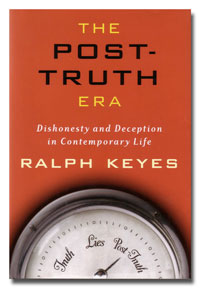
At one time we had truth and lies. Now we have truth, lies, and statements that may not be true but we consider too benign to call false. Euphemisms abound. We’re “economical with the truth,” we “sweeten it,” or tell “the truth improved.” The term deceive gives way to spin. At worst we admit to “misspeaking,” or “exercising poor judgment.” Nor do we want to accuse others of lying. We say they’re in denial. A liar is “ethically challenged,” someone for whom “the truth is temporarily unavailable.”
This is post-truth. In the post-truth era, borders blur between truth and lies, honesty and dishonesty, fiction and nonfiction. Deceiving others becomes a challenge, a game, and ultimately a habit. Research suggests that the average American tells lies on a daily basis. These fibs run the gamut from “I like sushi,” to “I love you.”
As the volume of strangers and acquaintances in our lives rises, so do opportunities to improve on the truth. The result is a widespread sense that much of what we’re told can’t be trusted. From potential mates to prospective employees, we’re no longer sure whom exactly we’re dealing with. Deception has become a routine part of the mating dance. Personnel officers take for granted that the resumes they read are padded. No wonder private investigation is a growth sector of the economy.
What motivates the casual dishonesty that’s become pandemic? Why do so many, even those with no apparent need to do so, feel a need to embellish their personal history? This question arises every time prominent figures are unmasked as fabulists: businesspeople, politicians, journalists, judges, military officers, police chiefs, beauty queens, newspaper reporters, South Carolina’s governor, the head of the United States Olympic Committee, and the manager of the Toronto Blue Jays. Branches are grafted onto their family trees. Unearned degrees show up on their resumes. Purchased medals appear in their display cases. Thousands of non-veterans say they fought in Vietnam. Scores more passed themselves off as Ground Zero rescue workers.
We can only understand the motives of such dissemblers by examining the sea in which they swim. Trends ranging from the postmodern disdain for “truth” to therapeutic non-judgment encourage deception. There is much incentive and little penalty for improving the “narrative” of one’s life. The increasing influence of therapists, entertainers, politicians, academics, and lawyers, with their flexible code of ethics, contribute to the post-truth era. So do ethical relativism, Boomer narcissism, the decline of community, and rise of the Internet.
Post-truthfulness builds a fragile social edifice based on wariness. It erodes the foundation of trust that underlies any healthy civilization. When enough of us peddle fantasy as fact, society loses its grounding in reality. Society would crumble altogether if we assumed others were as likely to dissemble as tell the truth. We are perilously close to that point.
Where to buy
Follow the links to purchase The Post-Truth Era:
Contents
I. HONESTY’S DECLINE
1) Beyond Honesty
A Whole Lotta Lyin’ / Whatever Happened
to Honesty? / Post-Truthfulness / Euphemasia / Ledger Book Morality
2) A Brief History of Lying
The Liar’s Edge / Early Ethics /The Insider’s
Guide to Honesty / Lie Regulation / Civil Society
3) The Honesty Connection
Community / Situational Dishonesty /
Ethical Memories / Impression Management
4) Whistler’s Druthers
Myth America / The Reinvented Self / Roots?
5) Great Pretenders
Petty Fibbery / A Matter of Degrees / Imposeurs / Fields of Unfulfilled Dreams / Behind the Mask
6) Why Lie?
Insecurity / Recreation / Duping Delight / Adventure / Taking Charge
7) Sex, Lies, and Sex Roles
Sex Studies / Telling it Crooked / Erotic
Deception / Relationships
II. ENABLING DISHONESTY
8) Mentors and Role Models
Therapists / Lawyers / Politicians / Entertainers
9) It’s Academic
On Campus / Larger Truths / Po Mo Profs / Heirs of Protagoras /
Applied Postmodernism
10) Narrative Truths, and Lies
Narrative Truths / New Journalists / Driven Narratives / Creative Journalism /
Ripple Effects
11) Masked Media
Hollywood Ethics / From Beaver to Baghdad / Narratives, Storylines, and
Dramatic Arcs
12) Peter Pan Morality
Origins / Looking-Glass Ethics / “I Was There” / The Boomer Code
13) Deception.com
Techno-Aided Deception / No One Knows You’re a Dog / The Tangled Web /
Enhanced Reality
III. CONSEQUENCES AND CONCLUSIONS
14) The Suspicious Society
Truth Bias to Lie Bias / Just Checking / Pinocchio’s Revenge / Wired Up /
Lies and Consequences / Credibility Gaps
15) The Price of Prevarication
No Respect / Lieaholism / Craving Truth
16) The Case for Honesty
The Post-Ethics Honesty / The Well-Intentioned Liar /
Honest Parenting / The Social Value of Honesty / Positive Trends /
Honesty Redux
Notes
Acknowledgments
Index
Excerpt
I think it’s fair to say that honesty is on the ropes. Deception has become commonplace at all levels of contemporary life. At one level that consists of “He’s in a meeting,” or “No, that dress doesn’t make you look fat.” On another level it refers to “I never had sexual relations with that woman … ” or “We found the weapons of mass destruction.” High-profile dissemblers vie for headlines: fabulist college professors, fabricating journalists, stonewalling bishops, book-cooking executives, and their friends the creative accountants. They are the most visible face of a far broader phenomenon: the routinization of dishonesty. I’m not talking just about those who try to fib their way out of a tight spot (“I wasn’t out drinking last night; I had to work late”) but casual lying done for no apparent reason (“Yes, I was a cheerleader in high school”).
Ludwig Wittgenstein once observed how often he lied when the truth would have done just as well. This Viennese philosopher has many modern disciples. The gap between truth and lies has shrunk to a sliver. Choosing which to tell is largely a matter of convenience. We lie for all the usual reasons, or for no apparent reason at all. It’s no longer assumed that truth telling is even our default setting. When Monica Lewinsky said she’d lied and been lied to all her life, few eyebrows were raised. Our attitudes toward lying have grown, to say the least, tolerant. “It’s now as acceptable to lie as it is to exceed the speed limit when driving,” observed British psychologist Philip Hodson. “Nobody thinks twice about it.”
The tattered condition of contemporary candor is suggested by how often we use phrases such as “quite frankly,” “let me be frank,” “let me be candid,” “truth be told,” “to tell you the truth,” “to be truthful,” “the truth is,” “truthfully,” “in all candor,” “in all honesty,” “in my honest opinion,” and “to be perfectly honest.” Such verbal tics are a rough gauge of how routinely we deceive each other. If we didn’t, why all the disclaimers?
Most of us lie and are lied to on a regular basis. These lies run the gamut from “I like sushi,” to “I love you.” Even though we’re more likely to deceive strangers than friends, we save our most serious lies for those we care about most. Many have to do with sex. One priest said he rarely hears a confession that doesn’t include some element of sexual deceit. A colleague of his said it’s a rare day that a parishioner doesn’t confess to telling lies, sometimes with figures in hand (“20 times to the same person, father”). He couldn’t believe that they actually keep track.
…
As long as human beings have had words to say, they’ve said words that weren’t true. At the same time, most societies have had some variation of Honesty is the best policy as a norm. What concerns me is the loss of a stigma attached to telling lies, and a widespread acceptance of the fact that lies can be told with impunity. Lying has become, essentially, a no-fault transgression. “That’s okay,” we say of those who are caught dissembling. “She meant well.” “Who am I to judge?” And the clincher: “What is truth, anyway?”
Nearly everyone trims and embroiders the truth and hopes for the best. I’ve been known to round down how many miles an hour I was driving, and round up the size of audiences at my lectures. I also get lied to a lot, big lies and small lies, stretchers and whoppers, fun lies and devious ones, petty fibs and felony lies. Who doesn’t? Not that I wring my hands and gnash my teeth when I’m deceived. Like most people, I’ve come to accept dishonesty as commonplace, even routine. Perhaps it would be better if we didn’t.
The obvious cause of dishonesty’s rise is ethical decline. From this perspective, moral compasses have broken down. Our sense of right and wrong has gone into remission. Conscience is considered old-fashioned. Conviction has been replaced by cynicism. Restoring prayer in schools, some argue, would be a giant step toward renewed morality. Or hanging the Ten Commandments on walls of public buildings. Nonsense. There is no evidence that early Americans were more moral than their descendants. It’s doubtful that former-day Americans – the ones who broke treaties with Indians, enslaved Africans, and exploited child labor – had better ethics than current ones. Nor was antebellum religious faith as devout as we like to imagine. Two centuries ago church membership was far lower than it is today, involving less than 10 percent of all Americans.
There never was an ethical nirvana in America or anywhere else; only a time when it was harder to tell lies, and the consequences were greater if one got caught. This book’s premise is that we may be no more prone to making things up than our ancestors were, but we are better able to get away with deceiving others, more likely to be let off the hook if exposed, and in the process convince ourselves that no harm’s been done. As we’ll explore, the mobility and anonymity of contemporary life facilitate dishonesty. So do deceit-friendly intellectual trends, the many celebrity role models of self-invention, and repeated instances of high-profile dissembling that desensitize us to its dangers.
…
In the Reagan-Clinton-Bush era we’re so accustomed to being deceived that we forget what a stunner it was in 1960 when Dwight Eisenhower admitted that government officials hadn’t told the truth when he said that a U-2 spy plane shot down by the Soviet Union had been doing weather research. As recently as the early 1970s we could still get outraged about Richard Nixon’s serial deceits. Jimmy Carter was elected in part because he promised never to tell us a lie. By the time of Monica Lewinsky and weapons of mass destruction, the mood had changed. Now our attitude seemed to be: Everyone lies, especially our leaders. What’s the big deal? Dishonesty has come to feel less like the exception and more like the norm. Along with our acceptance of lying as commonplace we’ve developed ingenious ways to let ourselves off ethical hooks.
Post-Truthfulness
Even though there have always been liars, lies have usually been told with hesitation, a dash of anxiety, a bit of guilt, a little shame, at least some sheepishness. Now, clever people that we are, we have come up with rationales for tampering with truth so we can dissemble guilt-free. I call it post-truth. We live in a post-truth era. Post-truthfulness exists in an ethical twilight zone. It allows us to dissemble without considering ourselves dishonest. When our behavior conflicts with our values, what we’re most likely to do is reconceive our values. Few of us want to think of ourselves as being unethical, let alone admit that to others, so we devise alternative approaches to morality. Think of them as alt.ethics. This term refers to ethical systems in which dissembling is considered okay, not necessarily wrong, therefore not really “dishonest” in the negative sense of the word.
Even if we do tell more lies more than ever, no one wants to be considered a liar. That word sounds so harsh, so judgmental. Men in particular are extremely careful to avoid giving other men any opportunity to say “You callin’ me a liar?” Once those fatal words are spoken, it’s hard for dialogue to continue without fists being thrown, or worse. The word lie itself is both a description and a weapon. According to the Oxford English Dictionary, this term “is normally a violent expression of moral reprobation, which in polite conversation tends to be avoided.” That’s why we come up with avoidance mechanisms: rationales for dishonesty, reasons why it’s okay to lie, not nearly as bad as we once thought, maybe not so bad after all. The emotional valence of words associated with deception has declined. We no longer tell lies. Instead we “misspeak.” We “exaggerate.” We “exercise poor judgment.” “Mistakes were made,” we say. The term “deceive” gives way to the more playful “spin.” At worst, saying “I wasn’t truthful” sounds better than “I lied.” Nor would we want to accuse others of lying; we say they’re “in denial.” That was sometimes said even of Richard Nixon, the premier liar of modern times, who went to his grave without ever confessing to anything more than errors of judgment. Presidential aspirant Gary Hart admitted only to “thoughtlessness and misjudgment” after reporters revealed Hart’s dishonesty (not only about his sex life but about his age). When, during a primary debate, John Kerry referred to a nonexistent poll that put his popularity well above Hillary Clinton’s, an aide later said Kerry “misspoke.” And it isn’t just male politicians who parse words this way. In the course of writing The Dance of Deception, Harriet Lerner asked women friends what lies they’d recently told. This request was invariably answered with silence. When Lerner asked the same friends for examples of “pretending,” they had no problem complying. “I pretended to be out when my friend called,” said one without hesitation.
A direct admission of lying is rare to nonexistent. (“I lied.”) Those willing to make such a bold statement cast doubt on anything they have said in the past and anything they will say in the future. This is why, rather than open the floodgates and accept lying as a way of life, we manipulate notions of truth. We “massage” truthfulness, we “sweeten it,” we tell “the truth improved.” Britain’s Cabinet Secretary Sir Robert Armstrong once created an uproar with his droll admission that he’d been “economical with the truth” (a phrase he borrowed from Edmund Burke). Since then, all manner of creative phrase-making has been devoted to explaining why lies are something else altogether. My favorite depicts a liar as “someone for whom truth is temporarily unavailable.”
When Trump: The Art of the Deal was published, Donald Trump claimed that 200,000 copies had been printed, that The Today Show planned to interview him five times, and that the issue of New York magazine with an excerpt of his book was its biggest seller ever. In fact, 150,000 copies of Trump were printed, Today interviewed him twice, and New York’s sales figures were not available at the time he made his claims. In his book, Trump called this kind of braggadocio “truthful hyperbole.” After The Apprentice became a hit, Trump claimed his television show was the season’s ratings leader (when it was actually #7) and said he was America’s highest-paid television personality. A Fortune reporter who debunked these claims, and many others, concluded that Trump’s boasts about himself were, at best, “loosely truth-based.”
Euphemasia
Dishonesty inspires more euphemisms than copulation or defecation. This helps desensitize us to its implications. In the post-truth era we don’t just have truth and lies, but a third category of ambiguous statements that are not exactly the truth but fall short of a lie. Enhanced truth it might be called. Neo-truth. Soft truth. Faux truth. Truth lite. Through such aggressive euphemasia we take the sting out of telling lies. Euphemasia calls up remarkable powers of linguistic creativity. In addition to golden oldies such as “credibility gap,” “re-framing,” and Winston Churchill’s “terminological inexactitudes,” consider the following examples of post-truthful euphemisms:
Lies:
poetic truth
parallel truth
nuanced truth
imaginative truth
virtual truth
alternative reality
strategic misrepresentations
creative enhancement
nonfull disclosure
selective disclosure
augmented reality
nearly true
almost true
counterfactual statements
fact-based information
To Lie:
enrich the truth
enhance the truth
embroider the truth
massage the truth
tamper with the truth
tell more than the truth
bend the truth
soften the truth
shade the truth
shave the truth
stretch the truth
stray from the truth
withhold the truth
tell the truth improved
present the truth in a favorable perspective
make things clearer than the truth
be lenient with honesty
spin
Eventually euphemisms themselves develop connotations and spawn progeny. As an executive tells employees in a New Yorker cartoon: “I’m not spinning – I’m contextualizing.”
Reviews
January 27, 2011
Review from Amazon.com
This well-researched and cogently written expose should be required reading for all Americans. Mr. Keyes utilizes both anecdotal evidence, and to the extent it is available, statistics and other evidence, to demonstrate…
January 27, 2011
Required Reading For All Americans
“This well-researched and cogently written expose should be required reading for all Americans.” Evan Haglund “elhaglund” (Phoenix, AZ)
January 27, 2011
Publishers Weekly
Casual duplicity picks at the threads of our social fabric,” Keyes warns, and not just because it creates a greater tendency toward suspicion and mistrust. The consequences of letting people get away with lying can be…
January 27, 2011
The Yellow Springs News (Ohio)
“Mr. Keyes’ book is both pertinent and well-timed.” When I was four or perhaps five years old I was out on the porch playing with a child’s set of plastic carpenter’s tools with a neighbor child, Curt Tacey. For reasons…
January 27, 2011
The Christian Post
“Keyes is an author of keen perception and wide-ranging observation. He has pulled together an enormous body of evidence, all pointing to the pervasive rise of dishonesty in American life.” Have we now reached a stage…
January 27, 2011
Book World (Washington Post)
“This exceptional book asks and answers a diverse series of questions. Keyes’s book deserves a wide readership.” Among the most fascinating things in Ralph Keyes’s The Post-Truth Era: Dishonesty and Deception in…
January 27, 2011
The New Republic (Online)
“an important, provocative new book .” Is all that matters in contemporary culture whether a line sounds good? That’s the thesis of an important, provocative new book , The Post-Truth Era , by Ralph Keyes. It’s Keyes’s…
January 27, 2011
Booklist
“a thoughtful, often amusing look at the way we dodge the truth and tolerate dishonesty.” Lying is so much a part of everyday life that everybody does it and everybody expects it, even while polls show Americans long…
Press
January 27, 2011
Daily Kent Stater
Continue to change, grow and learn Sean Buchanan This is it for me, my last act of participation at Kent State. There’s a lot I’ll miss. There’s also some relief, but no regrets. I’ve found a job, gotten engaged to the…
January 27, 2011
Cincinnati Post
The Debates are Producing More Smoke Than Fire Susan DeBow I assume part of the purpose for the debates by the presidential and vice-presidential candidates is to give voters clarity as to the positions of the…
January 27, 2011
Calgary Herald (Alberta)
Liar, liar: From fibs to whoppers, has lying become a way of life? Robin Summerfield He traveled a lot for business. Curious thing, though — his bags never had any airline tags. He told his wife of 30 years that he…
January 27, 2011
Herald Times (Bloomington, IN)
There’s a whole lot of lyin’ going on’ Mike Leonard Reggie Fowler, the man attempting to buy the Minnesota Vikings, had enough lies on his resume to make a con artist blush, but his bid to become an NFL owner remains on…
January 27, 2011
Champaign-Urbana News-Gazette
It’s not a lie, it’s just ‘post-truth’ Jim Dey In his memoir, Locked in the Cabinet , Robert Reich, a former U.S. Secretary of Labor, cast himself as the hero in confrontations with members of Congress during public…
January 27, 2011
Dayton Daily News
Truth falls victim to modern society; If someone claims to never lie, don’t believe it, author says Khalid Moss Few TV viewers younger than 40 probably remember the quiz show To Tell the Truth, which premiered in 1956…
January 27, 2011
San Diego Union-Tribune
The Post-Trust Society Richard Louv On Tuesday, at approximately 6:40 a.m., the Diebold optical scanner didn’t like what it tasted. The machine regurgitated the first ballot, and the second, and the third, and more…
January 27, 2011
Columbus Dispatch
Truth be Told, Book on Lying Could Not be More Timely Mike Harden When Ralph Keyes says his new book on lying in America is doing well, he might be telling the truth. Then again, Keyes, a Yellow Springs author and…
January 27, 2011
The Bob Edwards Show
Click below to listen to Ralph interviewed about The Post-Truth Era by Bob Edwards.
On the internet
January 27, 2011
The Examined Life
The Era of the Lie Albert Mohler offers us a question: “Have we now reached a stage of social evolution that is “beyond honesty?”” Dr. Mohler is reacting to a new book by author Ralph Keyes The Post-Truth Era…
January 27, 2011
perfectsound.blogspot.com/
Here’s a great article from The New Republic that I found very interesting. So much so that I’ve decided to pick up this book.
January 27, 2011
touchstonemag.com
THE POST-TRUTH ERA: Writing for The New Republic Online Gregg Easterbrook finds that “whether something is believed has become more important than whether it’s true.” As evidence, Easterbrook introduces us to The…
January 27, 2011
CYCLIC CYNCHRONICITY
To Read List, Updated. The Post-Truth Era: Dishonesty and Deception in Contemporary Life , Ralph Keyes (Still on my list, however, I was able to obtain a copy of the book, so now I do not have to forage through my local…
January 27, 2011
twoglasses.com/
Keyes’s book addresses the underreported frequency with which we all lie … Specifically, it would seem that we lie about things that happened in our past in order to make ourselves look better. Hmmmm. Interesting…
January 27, 2011
plastic.com
The Post-Truth Era cites a study that estimates people consciously fib in 28% of conversations with friends and family and 77% when engaging strangers. …
January 27, 2011
NFL.Com
TMQ recommends the just-out book The Post-Truth Era by Ralph Keyes, a fascinating and important dissection of how American culture encourages making things up. In our fabricated docudrama-world, what matters is not what…
January 27, 2011
hbfenn.com
This title is getting a lot of review buzz.
What colleagues say
Ralph Keyes analyzes a significant trend – the triumph of prevarication – and shines a light on the path back to personal integrity. The Post-Truth Era is brilliant social criticism, and sobering reading.
Landon Y. Jones, former editor of People magazine, author of William Clark and the Shaping of the West
If you’ve ever wondered why so many people aren’t telling the truth, you must read The Post-Truth Era! I was transfixed by what Ralph Keyes discovered. This eye-opening book ranges from politics to religion, résumé fraud to fraudulent courtship, compulsive lying to petty fibbery, alerting us to one of the most dangerous phenomena of our time: the decline of honesty. The Post-Truth Era is a remarkable and extremely important book.
Richard Farson, President, Western Behavioral Sciences Institute, author of Management of the Absurd
Ralph Keyes’s books always enlighten us about aspects of our contemporary culture. His latest book unravels the webs of deception in our national life and personal lives, and helps us understand why we lie so often – and are so often lied to. The Post-Truth Era is engaging and enlightening.
Robert Ellis Smith, Publisher, Privacy Journal; author of Ben Franklin’s Web Site
I read The Post-Truth Era for pure pleasure on this long-overlooked trait. A superb development of the subject, the nips and tucks we take on facts of life, especially in the self-presentation of our image.
T George Harris, former editor of Psychology Today; columnist, Beliefnet
I love The Post-Truth Era. I’ve quoted it in conversations ranging from child rearing to complexity theory. It’s one of the most provocative books I’ve read in recent years.
Mary Boone, author of Leadership and the Computer
The Post-Truth Era is an important public service. I hope it gets in the hands of leading columnists and public observers because it deserves to be part of the national dialogue.
Laurence Leamer, author of Sons of Camelot
I read The Post-Truth Era in one sitting. It is really terrific.
Patrick O’Connor, editor, author of Don’t Look Back
What readers say
I have already found out that it’s the kind of book that, when you start flipping through it, you wind up reading so much you cannot put it back down. It’s an important book, and I hope it gets the attention it deserves.
Princeton, NJ
I suspect it will be a classic.
La Jolla, CA
You have an awesome ability to capture a piece of our culture with a depth that both reflects where we are today with it and is eerily predictive of where we will be with it for at least the next decade. It is a compliment to you, albeit a sad comment about our society, to say that your timing could not be better for The Post Truth Era.
Seattle, WA
I hope this book gets the wide attention I think it deserves. The depth and breadth of your research is sensational…the crispness of your writing enviable.
Gainesville, FL
Congratulations on a job very well done. I read your book this weekend, and it really unpacks the issue of truth and lying from a variety of perspectives– cultural, psychological, and social. It is rich. It is also an extremely readable and entertaining.
New York, NY
It is thoughtful, well-organized, and persuasive.
Boston, MA
I like it – what a mass of research!
Cincinnati, OH
As soon as I started reading it, I noticed the lies everywhere. Consciousness raising and depressing. The news of course, also the funnies, the letters to the editor. The regular reports on student cheating. Not so much people. I always grit my teeth through election campaigns, now I’ve got a whole cultural context to put around that. So, I can’t exactly say I enjoy what I’ve learned from your book, though it was fun to read. Useful.
San Diego, CA
Read and enjoyed the post truth book. I found myself thinking of all the little lies I tell. I nodded my head sympathetically at your mentioning of the idea that someone able to tell a convincing lie is often considered worthy of respect. It all seems complicated and nuanced to me. Am I just another baby boomer truth compromiser? I wonder.
Willits,CA
Q & A with Ralph Keyes
Q. What got you interested in this subject?
A. The sense that I was being told more lies than ever. I think a lot of people feel that way. As I say in the book, the feeling is widespread that a whole lotta lyin’s going on.
Q. Are we telling more lies than we used to?
A. It’s hard to say whether each one of us is lying more. I do believe that it’s easier than ever to tell lies. As a result, we’re more casually dishonest than we used to be. And there is no question that we all are the targets of more dishonesty and deception than ever before.
Q. Why is that?
A. Technology for one thing. Modern technology is the midwife of the post-truth era. Television is an amoral medium. Voice mail messages are not to be taken seriously. (“I can’t come to the phone right now.”) The anonymity of the Internet makes it easy to deceive others. Cell phones offer all sorts of new possibilities to engage in creative, techno-aided hoodwinking. All contribute to an environment in which dishonesty becomes a casual activity, and ethics are ambiguous.
Q. Are there any other factors?
A. We can’t overlook the influence of mentor-figures such as therapists, lawyers, politicians, and entertainers. All have a flexible approach to honesty. Alt.ethics I call it. Practitioners of alt.ethics are enablers of post-truthfulness. Due to the media such figures loom larger than ever in our lives. So do baby boomers with their self-absorbed moral ambiguity. But nothing is more important than the breakdown of community. When we don’t feel tied to people around us, we’re more likely to deceive them. The sheer size of modern society and stepped-up mobility turbo charge this process. As the volume of strangers and acquaintances in our lives rises, so do opportunities to be deceptive.
Q. What are some of the results?
A. The epidemic of resume padding is one result. Another is simply bragging about credentials we didn’t earn: combat medals, say, or the Ph.D. we wish we’d completed but didn’t. It’s easier than ever to pass ourselves off as someone we aren’t. We become what I call “imposeurs.”
Q. Are men more likely to do this than women?
A. Yes. Research has found the men are much more likely than women to tell bragging, self-serving lies. On the other hand, women are more likely to tell accommodating fibs: “Love the dress,” say, or “You are such a great lover.” When it comes to sex, lying is routine across genders, though in different ways. Men are more likely to exaggerate their number of sexual partners, for example, women to reduce that figure.
Q. How do you assess the current political campaign in terms of honesty or dishonesty?
A. Lying is a bipartisan activity. It is engaged in by politicians of the left, right, and center. I believe there’s a difference in the types of lies they tell, however. Democrats tend to tell more petty self-serving lies, such as Clinton’s fibs about his love life. Republicans are more deceptive on policy matters: calling an easing of environmental controls a “Clean Air Act,” for example, or increased logging a “Healthy Forest Initiative.” In the case of Bush, I don’t see him as an outright liar so much as a guy who gets a story line in mind then resists and squelches any facts that don’t fit this line: the actual cost of a Medicare prescription benefit, say, or what it would take to occupy Iraq. Bush is a classic baby boomer. Like so many members of that self-righteous generation, Bush seems to feel that if he says something, it must be so. The truth, therefore is whatever he says it is. The real problem is that our standards of honesty are so degraded in the post-truth era that we let him, and so many others, get away with this.
Q. Is it possible to tell when someone’s lying to you?
A. It’s very hard. Studies have found that even those with a professional need to detect lies – judges, police officers, customs inspectors – rarely spot lies at a rate greater than chance. The cues we think betray a liar seldom do. Accomplished liars are usually very good at maintaining steady eye contact. And so-called “lie detectors” have no proven scientific validity.
Q. What are some of the results of post-truthful behavior?
A. A decline of trust and rise of suspicion primarily. A society in which suitors figure they’d better Google each other before getting too serious is one that’s lost confidence in itself. We need to reestablish that honesty is our default setting, if not guaranteed.
Q. How?
A. The news is not all bad. The same tools that make it easier to deceive others also make it easier to uncover deception. Any number of Internet sites are doing yeoman duty in exposing deception. The print media continues to be dogged in pursuing dishonesty among public figures, and in its own ranks. We also have a greater emphasis than ever on discovery in legal proceedings, transparency in business dealings, and informed consent among medical patients. At a personal level, nothing matters more than raising honest kids by modeling integrity. Most important of all is strengthening our bonds with others: feeling so tied to other people that we wouldn’t risk those relationships for the mere convenience of a lie.