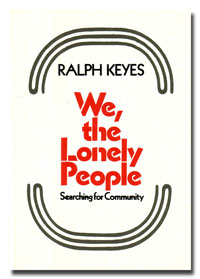
We, the Lonely People explores the loss of community in America. It considers the ways in which we are trying to rediscover a sense of community in rock concerts that become family for a few hours, shopping malls where we search for familiar faces, and talk shows with familiar voices. Instead of settling for “throwaway intimacy,” Keyes encourages readers to become more direct about their need for one another and cultivate the communities that are already sprouting in laundromats, self-help groups and corner pubs.
- Psychology Today Book Club selection
- excerpted in Intellectual Digest, The Rotarian, National Elementary Principal, Quote, Newsday
Ralph Keyes, as sensitive a young writer as the country has today, knows what America has lost in the name of progress and affluence. When I read this book there stirred in me the hope that we might get it back. This is more than a fine book; it’s a must.
Bill Moyers
This is a mosaic of hundreds of bits — small personal experiences, keen observations, ‘happenings’ and events described by friends and others. Only gradually does the reader realize that the mosaic is a picture, powerful and profound. Keyes holds up a mirror to our modern fractionated society and its isolated individuals. He provides no final answers, but he has given us a provocative book one does not forget.
Carl Rogers
Where to buy
Contents
Acknowledgments
Preface
Part I: Losing Community
1. Losing Touch
Caretakers
The Crumbling Network
Loss of Community
The Market for Intimacy
The Power of Anonymity
2. The Trade-ins
Mobility: The Stewardess Syndrome “Friendship” Growing up Gypsy
Privacy: Everyone a Howard Hughes
Autonomy-Withdrawal
Unknown Killers
Convenience: The Dishwasher Gap
The Shrinking Kitchen
Slot-Machine Meals
Noise
Cars Against Community
Of the Car, By the Car, and For the Car
Part II: Seeking Community
3. “And All in the Privacy of Your Own Home”
Here’s … Community!
Family by Subscription
Let Your Fingers Do the Walking
4. The National Home Town
Someone You Know, Wherever You Go
Laundro-Mating
Trust Uniforms
Sticking Together
No Place for Intimacy
5. Handi-Dispoz Community
Weekend Romance
All My Friends Are Gonna’ Be Strangers — And My Lovers
The “Freeway On-Ramp” Search
Queue Community
Audience
Just Add Hot Dogs and Stir
A Ten-Block Commitment
“I’m Community, Fly Me”
6. Serve the Community, Be the Community
Centering
From Bureaucracy to Brotherhood
“Family”
Agapurgy
Loneliness, Loneliness, Loneliness
Part III: Building Community
7. Known at Last!
The Fear of Being Known
New Approaches to Intimacy
Happiness
Tragically Known
Turn Back the Clock
Waiting on Uncle Sam
Take to the Hills!
Let’s Get to Work!
What’s “Community”?
Prescott
Stages of Community
Defining Community
Non-Residential Community
8. Blocks in Building Community
Manageable Size
Exclusion
Oppression
Commitment
9. Tools
Sources
A Hangout
Shared Hardship
A Sense of Deviance
Keeping the Air Clear
Ritual
A Culture All Your Own Other
Tools
My Communities
In Closing …
Notes
Excerpt
LOSS OF COMMUNITY
At one time there was no such problem, when you were known within family, including the extended family of relatives. When family became tribe and tribes villages, their members still knew each other to a large degree. Neighbors, friends, and family freely intermingled, were often one and the same. There wasn’t much alternative. One lived, worked, and died among a small number of familiar faces. One was born into community and belonged automatically; the only alternative to belonging would be to leave.
An Englishman I know grew up in such a small village in Yorkshire. he says the most striking quality of the town, and the thing he misses most, was the feeling of being known there. He said it wasn’t even a spoken thing. Nobody would say anything out loud about you shouting at your wife. But they knew, you knew they knew, they knew you knew they knew — and in that there was comfort.
There are problems with that kind of life, to be sure. Oppression and gossip. Rigidity. I wouldn’t want it. My English friend had fled it. But at least it was an existence where people knew who you were. It was a community.
Today we talk about our “loss of community” in city and suburb. Often we discuss it intellectually while sipping scotch. Sometimes mystically, passing a joint. Or nostalgically over beer.
Loss of community. That seems to cover the sense of being isolated and unknown, but when we try to pin it down, the term is elusive. We talk of the neighborhood community, the academic community, the world community, or just the community.
When we try to be more specific about just what “community” means, we usually think first of a place, the place where we live. I think this is what Carnation Milk has in mind when they implore me on their carton to “help keep our community litter free.”
But when we consider where we find a “sense of community,” it’s rarely where we live. .We use the word interchangeably, but it means two different things.
A sense of community is what we find among the people who know us, with whom we feel safe. That rarely includes the neighbors.
It wasn’t always so. For most of history man found his sense of community where he lived, with the people among whom he was born and with whom he died. For some that remains true today. But most of us in city and suburb live one place, and find “community” in another. Or nowhere.
So many of us want back the intimate sense of community, the one where the grocer knew our name and the butcher could comment on meat and life.
Reviews
January 27, 2011
Writer's Digest
I would like to recommend to poets and writers generally a new book, We, the Lonely People: Searching for Community by Ralph Keyes. An excellent reporter and lively writer himself, Keyes studies the effect of the…
January 27, 2011
Popular Psychology
We, the Lonely People marshals encyclopedic evidence of the pains of isolation in our people’s faces and some of their efforts, some sane and some curiously bizarre, to redress the community gap. Mr. Keyes is not very…
January 27, 2011
American Journal of Psychiatry
Serious, thought-provoking, and enjoyable.
January 27, 2011
The Link
A well-written, interesting and thoroughly documented book on a somewhat worn theme of the increasingly depersonalized world, yet it does bring new insights and approaches.
January 27, 2011
Quaker Life
Keyes identifies what is happening to us and our communities, and the examples he uses are sharp and clear. The word “community” is dropped so often in our talking that possibly it has become fuzzy in our minds. It’s…
January 27, 2011
Methodist Messenger
We, the Lonely People is an exciting book about the American society of today … There is humor and pathos in the knowledgeable observations of the author and in the documented human interest discussions.
January 27, 2011
The Lutheran Journal
A sensitive discussion of our “loss of community” and its resulting loneliness.
January 27, 2011
Faith/At/Work
Here is a profoundly moving book, full of relevant information about the ambivalence of most of us in America today who want both freedom and community and find it hard to experience them together.
January 27, 2011
Library Journal
Bill Moyers’s former assistant at Newsday, a self-described “habitual comer and goer” skillfully and entertainingly explores our social and individual ambivalence toward community, from Long Island to San Diego. ……
January 27, 2011
Urban Life
Keyes’s provocative analysis of modern urban life … has suggested that within anonymous, impersonal, and lonely environs, “community” assumes different forms … Git and Go’s, 7-Elevens, and shopping centers replace…
January 27, 2011
Champaign-Urbana News=Gazette
Keyes has written a thought-provoking book — one that should be read by all who are interested in rebuilding society.
January 27, 2011
St. Louis Globe-Democrat
Ralph Keyes … has written a very perceptive, very honest and very personal book on a great American malaise, the obsession with the loss of community and the search to regain or replace what has been lost.
January 27, 2011
Oklahoma City Oklahoman
The author — a former newspaperman — diagnoses the problem of our failing sense of community in a most readable way.
January 27, 2011
Psychology Today
In We, the Lonely People , Ralph Keyes describes and laments the contemporary evidence of our loss of community. His catalog is extensive, and he presents it with imagination,. concern, poignancy and humor.
January 27, 2011
Hartford Courant
Keyes writes with perception, humor and hard-won wisdom. His book is hopeful and constructive, coming at a time when it is sorely needed.
January 27, 2011
Kirkus Reviews
Mr. Keyes regards this book as comprising “optimistic comments on marriage and community.” His view is too modest. It is actually a series of unusually perceptive and entertaining chapters on the cultural and emotional…
Press
January 27, 2011
Press
Coming soon. Please check back shortly, as the website is currently in the process of being updated
On the internet
January 27, 2011
Internet
Coming soon. Please check back shortly, as the website is currently in the process of being updated.
What colleagues say
Ralph Keyes, as sensitive a young writer as the country has today, knows what America has lost in the name of progress and affluence. When I read this book there stirred in me the hope that we might get it back. This is more than a fine book; it’s a must.
Bill Moyers
This is a mosaic of hundreds of bits — small personal experiences, keen observations, ‘happenings’ and events described by friends and others. Only gradually does the reader realize that the mosaic is a picture, powerful and profound. Keyes holds up a mirror to our modern fractionated society and its isolated individuals. He provides no final answers, but he has given us a provocative book one does not forget.
Carl Rogers
What readers say
I just wanted to let you know how relevant the book is to me. I like the fact that it is so personal rather than an objective study, and it’s written colorfully and interestingly and really flows … and it’s very sensitive to people …
Washongal, WA
It is one of the few books I’ve read lately that analyzes our American life styles and gives a thinking person an opportunity to redirect in the areas he/she chooses.
Seward, NE
I just finished your book for what I’m sure will be only the first of several times, and I want to let you know that I think it’s really fine — mainly because what you’re saying is right on, and personally important to me, but also because you write like a real craftsman.
Davis, CA
I have rarely been so impressed and moved by any book.
Culver City, CA
[It is] written beautifully and with lots of profound observations — even when the writing is light and amusing. I’ve read a lot of books on alienation and seen many fine films on the subject but I’ve seldom enjoyed such an astute analysis as your presentation of the basic conflict underlying alienation — the very real desire we all have for comfort and privacy (augmented by our modern conveniences) versus the need to humanly relate. Philadelphia, PA
I just wanted to tell you that your book is hitting home, and that it means something to me.
Pasadena, CA
We, the Lonely People is fascinating, insightful & provocative. I would have welcomed such a book when I was moving around the world with my three kids.
Washington, DC
I was extremely fascinated by your book We, the Lonely People. I am able to see examples of your book in everyday life.
Toronto, Ontario
You have touched a nerve that will cause many to re-think their priorities.
Reston, VA
Your book, what you said, and how you expressed your thoughts and feelings — touched me. … Having read We, the Lonely People, I could, for the first time, verbalize my communion. It’s just as you said — there’s a small group who know and accept me, weak or strong, negative or positive or “blah,” a mess or together. There’s a second circle further away from “me” whom I see as individuals I care about and relate to and commune with professionally. (They miss me and I them.) There’s a still larger circle who know my face and name and say “Ahh, I know her.” Of course they don’t know me, but they know my face and say hello and that feels good, too. … We have a common bond of searching for community. Thanks for expressing that part of you so well in We, the Lonely People.
Urbana, IL
You’ve put in words so many of the feelings I’ve experienced. you’ve allowed me the opportunity to deal with them and understand them. Thank you for taking the time to share your feelings.
Albany, GA
I have recently finished reading We, the Lonely People and I would just like to express my congratulations on a very well represented and important book. …In reading We, the Lonely People , I became acutely aware of the ambivalence you speak of in your experience of “seeking community.” While I feel a very real sense of need for community in my own experience, the power of “anonymity” is also, at times, very appealing. My own dilemma notwithstanding, I again must congratulate you on a most important book. I hope many others become aware of this work. I know I will recommend it highly.
Oakland, CA
Your work in We, the Lonely People is indeed brilliant. Your assessment of the erosion of community is valid. There is at least a duality at work and it fuels the gnawing anxiety that somehow the process is slipping beyond our grasp.
Indianapolis, IN
As you acknowledge, the writing of a book on community is an ambiguous event: it takes time away from your family and friends (one of your most important communities), but it also creates a new circle of people who come to know you through your book. All of us, enrolled in a graduate-level “Perspectives on Community” course at [The State University of New York at] Stony Brook, have just finished reading We, the Lonely People. And rather than remaining anonymous, we are dropping a few short words of appreciation:
It is a book which challenges the accepted and unexamined notions of community. Enjoyed the stimulating perspectives you offer.
Lately, when I see a bumper sticker, I think of We, the Lonely People. My wife and I both enjoyed it and identified with it.
I enjoyed the book quite a lot. You say what many people feel, but are afraid to say.
Having emigrated from California to Long Island about 10 years ago, I read (and reread) your book with special interest.
The combination of humor, facts, and insights leaves me undecided whether to recommend it for easy reading or as a reference book.
High Point, NC
We, the Lonely People really hit home. I really identified with the feelings of individualistic, lonely detachment, trying every day to fight it off and wondering what in the world was the matter with me. I’m glad you got to me before one of Dr. Quack’s self-help books did. Now I finally understand what I only had an unclearly focused feeling about before. Thanks for helping me to understand what I’m all about and how I can get what I want from life.
Bloomington, IN
You have a fascinating book and I believe it.
Washington, DC
My husband and I just picked your book up, We the Lonely People and are just starting to dive in. … We look forward to reading the rest of your book and would like to thank you for helping us understand why we have to search for community.
Ventura, CA