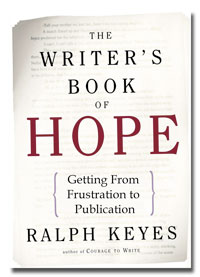
Having helped writers face their demons of fear in his acclaimed The Courage to Write, Keyes now turns to the frustration that invariably follows. Frustration is as much a part of the writing process as similes and semicolons, he suggests. If you’re not frustrated, Keyes tells readers, you’re not paying attention. Any serious writer gets discouraged. This is a sign of seriousness; evidence that their reach is exceeding their grasp. Drawing on his long experience as a writer and teacher of writing, Keyes discusses how writers cope with day-to-day frustration, and the struggle to publish. He provides fresh insight into the mind-set of publishers, suggests ways to deal with “discouragers,” and find the “encouragers” every writer needs to keep hope alive. Keyes details the many unconventional tactics writers come up with to kindle the flame of hope, and concludes with well-informed thoughts on why there has never been a better time to write and to publish the results.
Readers of Ralph Keyes’s new book will find the same encouraging tone, but fresh material and a different thrust. The Courage to Write helped writers face their demons. The Writer’s Book of Hope helps them stay the course. Keyes doesn’t try to talk writers out of feeling discouraged. He does not raise false hopes about publication being just around the corner. He does show readers what’s involved, discuss ways to cope with frustration, and give tangible reasons not to put down their pen or computer mouse to stay the course – realistic grounds for hope.
Topics that The Writer’s Book of Hope explores include:
- why all writers need encouragement
- why AFD Syndrome (anxiety/frustration/despair) is normal, even desirable
- prominent authors whose early prospects looked dim
- dealing with discouragers
- finding encouragers
- exorcising excuses (e.g., age, lack of time, or inspiration, or degrees)
- ways to keep hope alive
- publishing demystified
- unprecedented new ways to get words in print
- writing and ecstasy
A word or two of encouragement can keep writers at their desks when all seems for naught. At those times, reassurance is far more helpful than marketing tips or style pointers. In the long run, suggestions on how to write may be less helpful than thoughts on how, and why, to keep writing. Existing books on writing seldom address this need at all. None do so as their theme. The Writer’s Book of Hope does.
Where to buy
Contents
Acknowledgments
I. LOOKING IN
1. The Essential Ingredient
Is Hope Necessary? / The Ethics of Encouragement / Honest Reassurance / The Meaning of Hope
2. AFD Syndrome
Nerves Are Normal / Frustration Happens / Before Drinking Hemlock
3. Dealing with Discouragers
Discouragers / Projectors / Enviers / Goads / The Ashes of Success
4. Exorcising Excuses
I Don’t Have Enough Time / I’m Not Talented Enough / I Hardly Ever Get Inspired / I Didn’t Study Writing / I’m The Wrong Age / I’m Too Afraid I’ll Fail
II. LOOKING OUT
5. Rites of Rejection
An Occupational Hazard / Recycling Rejection / Rejection Hubris / Why Did They Have to Publish My Book? / The Vagaries of Rejection
6. The Publishing Tribe
Why Publishing Resembles High School / The Writing Way, The Publishing Way / Tribal Customs / Territoriality / Matters of Taste
7. Betting on Books
Shooting Craps / Conventional Wisdom, Publishing Division / We Just Can’t See It / That Won’t Sell! / Rhymes and Reason / Categorical Imperatives
III. BEYOND FRUSTRATION
8. Encouragers
Family / Teachers / Mentors / Colleagues / Agents / Editors / Readers
9. Keeping Hope Alive
Create a Consolation File / Study Acknowledgments / Attend Courses and Conferences / Groups / Bone Up / Be Professional / Go Easy on Yourself / Be tactical / Indulge Dubious Motives / Get Busy on Your Own Behalf
10. The Best of Times
Chicken Soup for Small-Press Dummies / In the Tradition of Thoreau / E-Publishing / The Safety Net
11. The Hope Writer
Divers / The Common Thread / No Ex-writers / The Joy of Writing / Spit in the Face of Despair
Notes
Further Reading
Index
Excerpt
1. THE ESSENTIAL INGREDIENT
Call him John. Even though John’s job paid well enough, he found it boring and unsatisfying. John dreamed of becoming a writer. Eventually, he decided to stop dreaming and start writing. This meant getting up at 5 every morning so he could go to work early and scribble fiction on a yellow legal pad. At night John would squeeze out another page or two on an old Smith-Corona word processor resting on a board wedged between the washer and dryer in the laundry room of a three-bedroom ranch home he shared with his wife and infant son. This made for slow going. John thought often about giving up writing as an impossible dream. He didn’t, however, and after three years of early morning and late night writing had a book-length manuscript.
John sent his manuscript to dozens of literary agents and publishers whose names he got from a guidebook. All sent it back. An agent finally agreed to take him on, one not considered particularly prestigious in the status-conscious world of publishing. After several more rejections, this agent sold John’s novel to an obscure publisher in Connecticut. That publisher paid a modest advance, then sold very few of the 5000 copies of John’s book that it had printed. In the meantime he’d completed a second novel. His agent had trouble selling that one too. John saw little room for hope and wondered whether it was finally time to throw in the towel. Until – but I get ahead of my story. Let’s come back to it later.
Does John’s story sound familiar? Like your own in certain respects? If so, you are not alone. Frustration is the natural habitat of writers at every level. I’ve felt it. So did John. So does anyone who aspires to write.
I’ve noticed this especially while speaking at writers’ courses and conferences. Antsiness fills the air like ions before a thunderstorm. Participants worry about lacking talent. Their submissions get rejected. Inspiration wanes. It all seems so futile. Why keep going?
Without being Pollyannish, I try to reassure those fledgling writers. Hang in there, I say. You’d be surprised by how many successful writers were once discouraged ones. Did you know that Samuel Beckett’s first novel was rejected by forty-two publishers? That a dozen agents chose not to represent J.K. Rowling? That Beatrix Potter had to self-publish The Tale of Peter Rabbit?
These are good grounds for hope. There are many more.
Is Hope Necessary?
Any writer has a legitimate, valid need to hear that it isn’t all for naught. This may sound self-evident, but it isn’t to everyone. Some of my colleagues even try to discourage new writers, on the theory that anyone who can be driven out of the business this way shouldn’t be there in the first place. They seem to feel that admitting a need for encouragement suggests one is too wimpy to be a writer. Writing isn’t for sissies, they say. If you can’t stand the grief, get out of the profession. Even Anne Lamott – whose delightful book Bird by Bird touched on writing despair – once despaired herself that addressing a writers’ conference meant offering “hope-to-the-hopeless.”
Gee. That’s awfully harsh. I’ve been involved with such a conference – the Antioch Writers’ Workshop – for nearly two decades. Every year at least one of our graduates has sold a book to the likes of Knopf, HarperCollins, Warner, and Graywolf. Others have scripts produced, stories anthologized, and articles published. The help we give these authors-in-the-making lies less in the realm of metaphors or marketing tactics than the simple idea that it’s possible to write and get published. You can be a writer, we tell them. That message alone is worth the price of admission.
Unfortunately, the most daunting problems writers face are seldom considered at courses and conferences. These gatherings usually emphasize basic principles of good writing: show, don’t tell; use active verbs; be sparing with adjectives and adverbs; make effective use of detail. Students learn about story structure and pacing and transitions and point of view. Advice is given on how to approach publishers. Such lessons are valuable, even invaluable. But mastering the elements of style can’t produce the will to keep writing. The hardest part of being a writer is not getting your commas in the right place but getting your head in the right place. Where help is really needed is in the area of countering anxiety, frustration, and despair.
In his encouraging book On Writing: A Memoir of the Craft, Stephen King admitted, “confidence during the actual writing of this book was a commodity in remarkably short supply. What I was long on was physical pain and self-doubt.” Like King, all writers need encouragement, at every step of their career – even those who win the Nobel Prize for literature. If anyone should be beyond the need for validation it’s a Nobel laureate like Saul Bellow. Yet, according to Bellow’s longtime agent Harriet Wasserman, during the years that she represented him, reassurance was exactly what he craved; constantly. After each novel, no matter how well received, Bellow was like a fledgling writer, hungry for the least scrap of reassurance. Even after he won the Nobel, every book Bellow wrote was like a maiden effort. As Wasserman put it, “For Saul, every book is his first book, and he is always the first-time writer welcoming re-enforcement.”
There is not a writer alive who couldn’t use a dose of reassurance. This has nothing to do with the quality of their work or the stage of their career. Regardless of how much one may have published, writing – books especially – is such an enervating experience that it is hard to keep the words coming without getting an occasional “You go, girl!” A word or two of encouragement can keep writers at their desks when all seems for naught. At those times, reassurance is far more helpful than marketing tips or style pointers.
This is a point of near-consensus among humane teacher-writers. The evidence can be found in their own careers. While making $6000 a year as a young freshman composition teacher at Colgate University, Frederick Busch received constant encouragement for a novel in progress from an editor at Atlantic Monthly Press. Even though she didn’t accept his novel, late in a successful career Busch still remembered the reassurance he got from this woman when he felt so unsure of himself In Busch’s words, “that sort of encouragement is underrated, usually by the writers who have received it, but it is stupendously important. … You know it’s not all over, you know it is one day going to be wonderful, and you know that someone’s caring for you – you are not, in a cruel profession, alone.”
Isn’t that the real reason we attend those writing conferences and enroll in courses on writing and read books on the subject? To feel less alone with our self-doubt? We’re not looking for the tips on how to write so much as the reasons to keep writing. And we should. How can you write without hope? Hope is the essential ingredient, as crucial to a writer as similes and semicolons. A simple nod of reassurance can keep us going when every nerve ending says STOP! ENOUGH! I SURRENDER! We can write without a computer, typewriter, desk, pen, or even paper (some excellent writing has been done in prisons on matchbook covers and toilet paper). The one thing we can’t write without is hope. Hope is to writers as oxygen is to scuba divers. No writer can survive without it
I once talked with veteran writer William Zinsser just after he’d received several pages of suggested manuscript revisions from his longtime editor at HarperCollins. Despite being the author of fourteen books and scores of articles and essays, despite having been executive editor of the Book-of-the-Month Club and a longtime teacher of writing – as well as the author of two books on the subject, including the much-assigned On Writing Well – Zinsser was taken aback. He searched in vain for any words of reassurance in his editor’s commentary. Did this man like the manuscript? That was the first question Zinsser put to his editor, followed by remonstration for not including any encouraging words in his critique. “Don’t think just because I’ve been doing this so long I don’t need encouragement,” said Zinsser.
The Ethics of Encouragement
Something I’ve discussed often with colleagues is whether it’s honorable to encourage fledgling writers when we know the odds against them are so great, and the path to publication is so torturous. The problem is that we have no idea which ones will complete this marathon. Anyone who works with writers is continually surprised by who reaches the finish line and who doesn’t. Our powers of prediction are not that accurate.
When they were senior editors at Doubleday, Loretta Barrett and Betty Prashker tried to get Barrett’s assistant to give up her dream of writing fiction. Based on their reading of a novel the young woman had spent a year and a half writing, both felt confident that she had no future as a novelist. The woman ignored them and went on to publish several books, eventually for six-figure advances that Barrett herself – now an agent – negotiated for her former assistant. Her name? Laura Van Wormer, author of the bestselling series featuring reporter Sally Harrington.
“While it may seem disingenuous to encourage a writer who seems to have no native ability,” wrote editor-turned-agent Betsy Lerner in her excellent book The Forest for the Trees: An Editor’s Advice to Writers,” “it is also arrogant to think we know how any given career will develop, or what combination of desire and will may result in a work that will have a profound effect on people even if it is never praised for its beautiful prose.”
Lerner knew a writing teacher who went out of her way to be supportive of students’ work regardless of its apparent prospects. Why? Because over time she’d so often seen students who seemed hopeless at the outset of a writing class produce outstanding work by the end. This is a common discovery among those who teach writing. During his years of working with aspiring writers at the University of Virginia, novelist George Garrett repeatedly saw his best students become unproductive graduates, while ones for whom he held little hope blossomed into publishing authors. That’s why, Garrett concluded, “It’s not our duty to discourage.”
This certainly has been my experience. After decades of working with aspiring writers, I’ve realized that it’s futile (to say nothing of presumptuous) to try to anticipate who should be encouraged and who shouldn’t. Since I have no idea which writers will stay the course and which ones won’t, I encourage them all. (This is not the same thing as praising mediocre work.) And for good reason.
After a book and author banquet in Charlotte, North Carolina, a television talk show host named Lou Heckler, who had interviewed me earlier that day, introduced me to his wife, Jonellen. She had some writing in the works, Lou told me. Mrs. Heckler looked shyly at the floor as her husband said this. Her manner was demure, soft-spoken, and reserved. Not dynamic. I gave Mrs. Heckler my standard spiel about hoping she’d stay with it, and that eventually I’d see her byline. To my astonishment, I did: in Ladies’ Home Journal and other magazines where Jonellen Heckler’s short stories and poems began to appear regularly. The next thing I knew a novel by Jonellen Heckler was in bookstores, followed by a second, a third, and more to come. One of those novels was made into a movie for television. All from a shy aspiring writer whom I’d encouraged because I try – within the boundaries of honesty and credibility – never to be discouraging.
Honest Reassurance
A phrase I like in John Gardner’s On Becoming a Novelist is ”honest reassurance.” That’s what I hope this book will offer. It is rooted in my own three-plus decades as a writer. This experience has included plenty of frustration, and despair. In the process I’ve discovered realistic grounds for hope which I’d like to share with you. They are rooted in stories of writers who felt lost at sea but kept rowing long enough to land safely on shore. The point of such stories is to show that it is possible not only to endure but to prevail, as so many writers already have, including some who became well-known authors.
It may not be possible to overcome frustration, but you can learn to live with writing’s many aggravations, even make use of them. The implicit message of too many books on writing is: “If only you’d (read more / market better / do affirmations, etc.), you’d become a better writer and conquer your frustration. This one has a different premise. Writing is inherently frustrating. Frustration is part of the literary territory. I won’t try to pep-talk you out of feeling discouraged. (Nor would I want to. As we’ll see, feeling discouraged can be a positive sign.) Rather, I will suggest informed, realistic reasons to carry on when all seems for naught. I won’t pull your leg about success being just over the horizon. I don’t have ten surefire ways to get published, or even five. I can tell you what’s involved, suggest ways to cope with feelings of frustration, and offer tangible reasons to not put down your pen or turn off your computer – realistic grounds for hope.
This book will not imply that writing is an easy pursuit with a happy outcome likely. It isn’t. Nor will it suggest that its author has a formula for publishing success. I don’t. Some aspiring writers give the impression that they’re looking for a “key,” some wisdom known only to insiders on how to write and get published. There is none. The only key is persistence and knowing what you’re about. If it’s a smooth sail you’re looking for, stop writing immediately. When it comes to writing, there’s no smooth sailing. The literary seas are all rough. Many writers get needlessly discouraged, however, and for the wrong reasons. Some turn back when they should keep sailing. This book is about reasons to persevere. There is hope.
The Meaning of Hope
What do I mean by hope? As I’ll use that term, hope is not synonymous with blind faith. Even though it is rooted in the spirit, hope can have practical legs to stand on. Faith is part of hope, of course, but it needn’t be blind. We’re better off when it isn’t. That’s why this book is about both spiritual and practical grounds for not giving up. I’ve tried to make The Writer’s Book of Hope as encouraging as possible, within reason, basing it on tangible grounds for optimism that aren’t always evident to writers when they’re mired in black lagoons of despair. My goal is to cast light on some of the darker aspects of writing, publication especially, and in the process make them less intimidating.
A lot of books are available, some of them quite good, on practical ways to become a better writer. Another genre is meant to elevate the spirit, without being practical-minded. This one integrates the two, blending consideration of a writer’s inner world with the outer one. It is grounded in the experience of working writers, based on voices of experience, including that of the author – a longtime writer who’s known his own despair. I’ll speak from my perspective as a writer who has published frequently but whose work has been rejected even more frequently.
Early in my career I decided to keep a log in which I recorded my submissions: where they had been sent, when, and what happened to them – a green check mark for acceptance, a red one for rejection. This log recorded lots of red check marks, and very few green ones. Any behavioral psychologist could have told me that this surefire way to demoralize myself. Psychologically speaking, my log-keeping method violated a basic tenet of behavioral conditioning: recognize results you want to reinforce, ignore everything else. That’s why I stopped keeping a log.
An aspiring author once asked me what trait would help most in her dream of becoming a writer? Without thinking, I responded, “A high tolerance for humiliation.” This was not flippant. Like most writers, I’ve had to endure excruciating lows alternating with exhilarating highs. My publisher had high hopes for my third book and did a substantial first printing. Sales did not meet expectations, however, and much of that printing was eventually closed out as “remainders.” Bookstores were not the only ones to buy them. Several dozens also showed up in bookcases at the IKEA furniture superstore in Philadelphia where customers looking for chairs and sofas could reflect on why so many copies of an author’s book had become ornamental objects in a furniture store’s bookcases instead of being for sale in a bookstore.
This was one of many downcast moments when I had little reason to keep going other than the hope that things would get better. And they did. After that low point I published eight more books, including The Courage to Write. That book focused on fear. This one moves along to frustration. Once we’ve faced our fear and begun to write, we step up to the plateau of frustration. Fear followed by frustration is the essence of writerly despair.
One reason writing is so frustrating is that after we’ve attended the courses, read the books, and gotten fired up to actually write, we hit the wall of working all alone, then sending what results to cold-eyed editors who couldn’t care less about our state of mind. When our writing isn’t as good as we hoped it would be (it never is), and editors seem to think our submissions aren’t much good at all (they seldom do), how do you keep from succumbing to terminal despair?
Sometimes the only reason to keep writing is “just because.” Or as a matter of faith; keeping the faith. “On some days,” wrote novelist Gail Godwin in an essay about writing, “keeping faith means simply staying there, when more than anything else I want to get out of that room. It sometimes means going up without hope and without energy and simply acknowledging my barrenness and lighting my incense and turning on my computer. And, at the end of two or three hours, and without hope and without energy, I find that I have indeed written some sentences that wouldn’t have been there if I hadn’t gone up to write them. And – what is even more surprising – these sentences written without hope or energy often turn out to be just as good as the ones I wrote with hope and energy.”
Before turning off your computer and turning on the television in moments of despair, reflect on the experience of authors such as Gail Godwin. Their situation was desperate, but far from hopeless. Like yours, perhaps. You might want to consider how many writers have felt almost terminally discouraged, but lived to write another day. As we’ll see throughout this book, nearly every writer who appears to have it made was once on the brink of collapse.
This chapter began with the story of a struggling novice novelist named John. Here is the rest of his story.
John, as you may have guessed, is John Grisham, the most commercially successful author of modern times. Even as his agent was having trouble selling Grisham’s second novel, studio scouts in Hollywood heard about it and began bidding furiously against each other to buy rights to this book. Paramount won, paying $600,000 for the privilege of making it into a movie. That piqued the interest of publishers (to put it mildly), and Doubleday offered Grisham $200,000 for The Firm. The rest, as we say, is history: book sales in the millions, multi-million dollar advances, a mansion in Mississippi, an estate in Virginia. Grisham has since mused about what his life might have been like if he’d succumbed to despair in the midst of his fledgling efforts, as he almost did.
Few writers will ever enjoy John Grisham’s success in the marketplace. But we all can learn from his example of fortitude in the face of anxiety, frustration, and despair. These constitute the sensibility of working writers everywhere, what I call AFD Syndrome.
Reviews
January 26, 2011
Reviews from Amazon.com
I’ve read enough self-help and inspirational books, and books about writing, to last a lifetime, so when I spied The Writer’s Book of Hope at my public library, I hesitated. But the title caught my eye, and I ended up…
January 26, 2011
Reviews from Amazon.com
Ralph Keyes’ The Writer’s Book of Hope manages to be most encouraging to any writer and very interesting to anyone else. This book is well-written, funny, challenging, consoling and very informative. If there is a…
January 26, 2011
Reviews from Amazon.com
The Writer’s Book of Hope is an excellent antidote to the discouragement toxins that build up in writers over time. Actually, it’s a whole medicine cabinet of antidotes. Anxiety, Frustration, and Despair are part of the…
January 26, 2011
Reviews from Amazon.com
This book really opened my eyes to the reality of the publishing world. It also helped disapate a lot of anger and self pity I was feeling. Who knew you had to work this hard? Well, now I do. So it goes. I can now forge…
January 26, 2011
The Writer
Writing is never easy, and getting your work published can be harder still. As every writer knows, a thick skin is one of the essential tools of the trade. “Rejection, to writers, is the equivalent of being knocked down…
January 26, 2011
Writer’s Digest
Even the most prolific writers need encouragement from time to time. If you’re in need of a shot in the arm, check out [this] inspiring new book …
January 26, 2011
ASJA Monthly
American Society of Journalists and Authors October 2003 – Susan K. Perry, Ph.D More than half of Keyes’ book is devoted to helping writers sustain faith in themselves once they being actively pursuing publication…
January 26, 2011
Capital Times (Madison, WI)
Heather Lee Schroeder Ralph Keyes … has a new guide out this fall. Titled The Writer’s Book of Hope: Getting From Frustration to Publication (Owl Books, $13), it is a nice companion to his 1995 book, The Courage to…
January 26, 2011
Library Journal
[Ralph] Keyes, a longtime writer and teacher of writing, is best known for The Courage To Write: How Writers Transcend Fear . In this follow-up, he offers words of encouragement to would-be scribes, inviting them to…
January 26, 2011
Publishers Weekly
To be clear: this is not a guide on how to write a book (Keyes covered that in his last volume, The Courage to Write ). Rather, it’s a tool for writers who have found their courage and now need hope: that their work is…
Press
January 26, 2011
Columbus Dispatch (Ohio)
REALITIES OF WRITING ARE NO CAUSE TO LOSE HOPE Mike Harden As a champion of the writer’s art, he tries to avoid sounding like a cross between Dr. Phil and the preface of a Chicken Soup anthology. “There are so many…
On the internet
January 26, 2011
peacecorpswriters.org
Writers take note: The Writer’s Book of Hope: Getting from Frustration to Publication by Ralph Keyes, author of The Courage to Write has just come out… Keyes has written a book that is extremely useful to writers and…
January 26, 2011
leecarlon.com
Unlike so many writing manuals Ralph Keyes’ latest book deals with aspects of the writing process that are all too often ignored. The frustration and despair that at times overcome writers at all stages of writing…
January 26, 2011
mortalmom.com
My friend Sharon sent me a book called The Writer’s Book of Hope . I love reading all the stories and examples because I feel such kinship with the people described. (Some of them are famous–John Grisham and me in the…
January 26, 2011
mathematicsbooks.org
This book really opened my eyes to the reality of the publishing world. It also helped dissipate a lot of anger and self pity I was feeling. Who knew you had to work this hard? Well, now I do. So it goes. I can now…
January 26, 2011
The Scribe's Message Board
Best Book for a Struggling Writer If any of you are writing book addicts (are all writers or is it just me?) I would strongly recommend you get a copy of The Writer’s Book of Hope by Ralph Keyes. It’s all about the…
What colleagues say
A perfect companion for every writer. Ralph Keyes gives you solid information you can put to use while he bolsters the faith you need to keep going.
Judith Appelbaum, How to Get Happily Published
Chatty, practical advice for novice and veteran alike. Clever, well-written, and inspirational.
Linda Barnes, The Big Dig
The Writer’s Book of Hope is the best gift you can give a struggling writer especially if that writer is yourself.
Betsy Lerner, The Forest for the Trees: An Editor’s Advice to Writers
No one knows the lonely, exhilarating and terrifying world of writers better than Ralph Keyes! As with his earlier book, The Courage to Write, Keyes provides us with string for the labyrinth of a writer’s day and professional life. I’ll recommend The Writer’s Book of Hope to writers and non-writers alike – its wisdom, hopefulness, and practicality will inspire all.
Julia Alvarez, writer-in-residence at Middlebury College and author of How the Garcia Girls Lost Their Accents
This book will enrich the lives of all writers, and should be on their personal bookshelves.
Jeff Herman, Jeff Herman’s Guide to Book Editors, Publishers and Literary Agents
Ralph Keyes has done it again: he’s written an indispensable book for the nervous writer and all writers are nervous. Informative, sometimes hilarious, and always wise and sympathetic, it will be an enormous help to any writer and lifesaver to the beginner. A wonderful book.
Patrick O’Connor, Don’t Look Back
Every writer needs a friend. Ralph Keyes’ new book is that and more. The Writer’s Book of Hope is destined to become an instant classic.
Eva Shaw, Writeriffic: Creativity Training for Writers
Ralph Keyes is the best kind of coach: practical, encouraging, and honest. The Writer’s Book of Hope is a perfect blend of inspiration and no-nonsense guidance, sure to speed the journey from empty page to publication.
Philip Goldberg, Roadsigns: Navigating Your Path to Spiritual Happiness
After publishing four novels, I’m wondering why I still get Dark Terrors every time I sit down to write, why the publishing process seems shrouded in mysticism, and why I crave encouragement like a tail-wagging puppy. So along comes The Writer’s Book of Hope to tell me that angst and rejection are normal, even desirable; that I shouldn’t worry that the publishing business doesn’t make much sense; and that despair and hope can co-exist quite nicely. If you’re a writer or ever even thought about writing, read this book.
Robert Inman, Captain Saturday
Pulling together hundreds of writers’ stories and reflections, Ralph Keyes weaves a blanket of hope that you can wrap around your shoulders whenever the cold winds of self-doubt come calling. I myself plan to keep this book nearby and take regular doses of “hope” vitamins.
Rosalie Maggio, author of How to Say It
After reading The Writer’s Book of Hope I felt as though I’d just attended an inspiring, supportive writers’ conference. Ralph Keyes offers specific advice I’ve seen addressed in no other booknot so much on how to write as how to keep writing. The Writer’s Book of Hope devotes an entire chapter to the “Encouragers” a writer needs in her life. This book now goes to the top of my own list of encouragers.
Katrina Kittle, author of Two Truths and a Lie
Every writer who is dreaming of publication or who is currently dealing with publishers need to read The Writer’s Book of Hope. Keyes’ insights into the world of “pub people” is refreshingly honest and humorous. A veteran writer, himself, Keyes encourages other writers by making us feel valued and by putting our frustrations into perspective. This book is an excellent companion to The Courage to Write, and one I recommend to all writers and students of writing.
Anthony Grooms, Professor of Creative Writing, Kennesaw State University, author of Bombingham
Wonderful! I love it. Very sensitive. Very informed. Very transparent. And ultimately, full of hope. For beginning writers, this book will be a god-send
The book is inspiring enough to get writers moving into happier, all-is-not-lost territories.
Meena Nayak, author of About Daddy
I just loved The Writer’s Book of Hope.
It is well written and compelling and enormously helpful. My favorite moment was Thomas Mann’s definition that a writer is someone who has more difficulty writing than other people.
Charles J. O’Leary, author of Counselling Couples and Families
What readers say
It’s great and very true. Persistence, yeah! I read it as soon as I got it and have already lent it out.
Seattle, WA
There’s a lot that’s valuable in this book, but what pleases most about the book is its tone of hopefulness. As a writer, I don’t feel him trying to sell me on hope. I hear him really talking to me in a hopeful way. His tone as much as his information convinces me sticking with writing is worth it. I look forward to using the book in classes and to recommending to others in my work as a writing coach.
San Francisco, CA
It was just what I needed, for the last few years have been very frustrating. The stories in your book about the writers and what they went through helps me remember I am not alone.
Saco, ME
This book is like my Bible. It is so well written. Just what I needed!
San Francisco, CA
I am quoting from it in class these days. We all need necessary HOPE.
Dayton, OH
The writing is smooth, lively and clear, the punchlines are zingers, the stories are hopeful and it’s fascinating.
San Diego, CA
You could make trout fishing interesting!
Philadelphia, PA
I promptly bought [The Writer’s Book of Hope] to share with my writers’ group. We read excerpts before each meeting as the publishing world can seem very far removed from frigid Butte …
Butte, MT
The Writer’s Book of Hope gave my spirits a boost. It’s honest and realistic and hopeful . . .which is why I’ve been recommending it to all my writer friends.
Kenmore, WA
I have just finished reading your latest book, and wanted to tell you how much it has helped me put things into perspective. There has never been any doubt in my mind that I want to write – and whether or not I ever enjoy any kind of commercial success that I’ll continue writing for as long as I can, it’s my single greatest pleasure in life. Just knowing that many of the authors you talk about in the book have experienced the same sense of insecurity, uncertainty and frustration is, as you said, a great sense of hope. I’ve just added your book to the recommendation page on my website, the first book I’ve added. Once again, I loved the book and the next time I get a case of AFD Syndrome, I’ll reach for The Writer’s Book of Hope to chase it away.
Brisbane, Australia
I finished my umpteenth revision of a novel in June of last year and I received a contract from a New York agent but since then not much has happened. For the past several months I have been hard at work on my next effort and, though it is going well, the last couple of weeks I have been in such a slump about it – just thinking “who am I kidding – get a real job”. Then I was at the library and I saw your book, The Writer’s Book of Hope. Thank you SO much. It really was just the lift I needed and, despite my trepidation, I shall persist.
Gloucester, MA
Thank you so much for your recent book The Writer’s Book of Hope. I am an MFA student and will graduate in May. By reading your book, I’ve been able to find inner peace with my writing and the joy of the process. Please continue to help us all keep hope alive.
Louisville, KY
I could not put your book down. Every chapter was exactly what I needed to hear. … I called my friend (a fellow writer) and told her about your book and I told her she had to drop whatever she was doing and buy your book. I said I can’t let her borrow my copy because I plan to read it again so that the lessons sink in. … Again, thank you for a great, useful, inspiring book.
Oakland, CA
For months, I have been slowly crushed by the weight of my anxiety of writing my first book. I have published my words before, locally and nationally, in respected and well-known places that people recognize and read. But those words represented other people’s thoughts and concerns, and for me, the glory of a byline. This book, however, is something I truly care about – a matter far different than just ‘byline’. I will be referring to The Writer’s Book of Hope frequently … For the first time in nearly seven months, I feel like I have some inner control over this writing project and have actually begun working on it (just a bit) again. What relief! What hope!
Columbus, OH
The Writer’s Book of Hope is fundamentally different from & better than – others of its genre. It really gets to the heart of the matter, don’t deny its demoralizing force, yet see a clear way out of the morass. The lists of famous writers who were rejected – & in some cases, insulted – by publishers & editors is balm to the weary.
Sydney, Australia
I recently read The Writer’s Book of Hope, and found it inspiring, encouraging and insightfully helpful. I wanted to thank you for your words and your willingness to share them with the world.
Washington, DC
Thank you so much for writing The Writer’s Book of Hope. I found it when I especially needed it, frustrated by being close to publication but experiencing rejection for some ridiculous reasons. I am so grateful for your encouragement to keep slogging on.
Eatonville, WA
I just wanted to tell you how wonderful I think this book is and how helpful it’s going to be to me. I was relieved to know that I’m not some evil whack job that takes on a whole different persona when I’m writing and I was grateful for the information on the pub people. I loved your book. It was very smart, humorous and a wealth of information.
Olathe, KS
Thank you for your wonderful book The Writer’s Book of Hope. Most helpful indeed. I have several friends who are writers and I purchased copies for them, too. Your words are most helpful and encouraging. You made me smile and helped me keep going when I felt a bit otherwise.
Phoenixville, PA
It gave me encouragement. I think you reached a good balance between not giving false hope but also giving hope for writers to pursue their dreams.
Dayton, OH
The Writer’s Book of Hope is by far the most important book on writing that I’ve ever read.
Naperville, IL
I chanced upon The Writer’s Book of Hope early this year. Unlike other similar books I had read which I never finished because I found them simplistic and even self-indulgent, I savored your work from start to finish. In fact, it has encouraged me to send out new proposals to more agents
Manila, The Phillipines
Thank you so much for writing both The Courage to Write and The Writer’s Book of Hope. I’ve just recently made the move to a full-time writer, and your books have helped make the transition easier as I battle the anxiety and frustration that accompany the writer’s life. Your books will remain on my bookshelf forever.
Pittsburgh, PA
Finding your book came in the nick of time. Reading the many examples of yourself and other writers going through the same struggles I’m going through really made me feel better about my own situation. I was very glad to find that in addition to examples that gave one hope, your book contained a ton of very practical advice. (I found your advice on why literary agents respond to the query letters they get to be very helpful.) You definitely did your homework when it came to researching other writer’s experiences. I’ve been writing about how much I like your book on my blog.
Flint, MI
I ADORE The Writer’s Book of Hope. I have returned to it many times over the past couple years in the course of writing and publishing my first book I teach aspiring writers and often quote from the book and recommend it. I especially like the chapter on the NY “Publishing Tribe.”
Cincinnati, OH
I just wanted to thank you for The Writer’s Book of Hope. I’ve never liked the idea of books about writing but I skimmed through this and bought it immediately afterward. It’s by far the most helpful and inspiring cluster of words I’ve read yet (and I’ve read it twice so far). Your book really helped me take a step away from the desk for a small period and really look at why I was doing what I was doing and feel better about it all the way around. I’ve been plugging both Courage and Hope to everyone I know who writes for both desire and need. There’s no doubt it’ll be as helpful to them as it was to me. I wouldn’t be surprised to see your name show up in the acknowledgments from a lucky new writer or two in the time to come.
Kalkaska, MI
Thank you for The Writer’s Book of Hope. It came to me as a gift from my husband, after I quit my job to write full time. Your book helped me not only have hope, but made me feel as if my decision was not so crazy after all. And, I’m enjoying myself!! Sometimes I pick up your book, open it randomly, and read a paragraph or two. I always get something from it.
Fort Lauderdale, FL
Thanks for your book offering HOPE for writers.
Savannah, GA
I just wanted to thank you for The Writer’s Book of Hope. I really needed to read this book right now. It really helps to know that all writers go through this trying, maddening stuff that I keep thinking is just reserved for me. But reading about some of my heroes feeling the same way I do makes it more bearable. You’ve done a lot of struggling writers a great service with this book
Calgary, Alberta
I wanted to take a few minutes to say “thank you” for The Writer’s Book of Hope. I read it last week in just over two day’s time and found it to be by far the truest book on what a writer experiences that I have ever come across. Thank you for your insight on the value of persistence and for the glimmer of hope.
Springfield, OH
I checked out your book, The Writer’s Book of Hope at the American Library in Paris yesterday. I devoured it in one night. Your book has given me the impetus, the will, to continue. I’m rushing out to buy it as well as The Courage to Write. That way, I can underline the many passages that speak to me. Many, many thanks for sharing your experience and wisdom.
Paris, France
I have just finished reading The Writer’s Book of Hope. Your writing is very inspirational for me. Your words are so encouraging I selected many sentences and phrases and printed them on 8″ x 2 1/2″ table tents. There is a different phrase on each side. I have placed them in a variety of places all over the house. In this way through your book, you have become a daily encourager.
Minneapolis, MN
Thanks so much for writing The Courage to Write and The Writer’s Book of Hope. I was at a point in my career where I felt my latest baby…I mean novel…was ready to send out into the world. I just couldn’t seem to polish it up and get it out. I thought I was seriously crazy, until I happened onto Hope at my local library. I read it, then went looking for Courage After one chapter of that, I decided I had to own both books. I think I might just be able to send my creation out into the world thanks to you. Many heartfelt thanks
Chattanooga, TN
I was at a point in my career where I felt my latest baby…I mean novel…was ready to send out into the world. I just couldn’t seem to polish it up and get it out. I thought I was seriously crazy, until I happened onto The Writer’s Book of Hope at my local library. I read it, then went looking for The Courage to Write. After one chapter of that, I decided I had to own both books. I think I might just be able to send my creation out into the world …
I just read The Writer’s Book of Hope and it left me feeling…well…hopeful. Thanks for taking the time to write it and to be an Encourager. I appreciated many of the tales and have many post-it notes of quotes to encourage me in my daily writing.
The book has indeed offered hope. I only thought that editors or agents didn’t like a book based on its merits, but that has been proven wrong. I don’t have that much talent, but now I shall pour on the determination and see how far that gets me.
I just finished reading The Writer’s Book Of Hope and it has inspired me to no end. I do not know what is going to happen tomorrow, but today I am going to write, because “writers write.”