Books · 1976
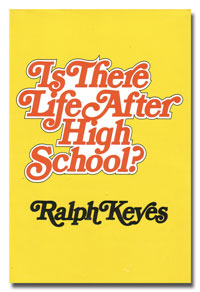
Is There Life After High School?
NOW AVAILABLE AS AN E-BOOK!
Were you Student Body President? Cheerleader captain? Or the girl nobody asked to the prom? Or a guy nobody wanted to eat lunch with? Were you an “innie” or an “outie”?
These are some of the questions raised in Is There Life After High School?.
After interviewing hundreds of people across America, obscure and famous, successful and unsuccessful, after reading countless magazine articles, books, and scholarly treatises, after listening to stacks of 45 rpm records, watching television and movies, and after attending all manner of reunions (from a fifth to a fiftieth), Ralph Keyes has come to the conclusion that Kurt Vonnegut was right — high school is “closer to the core of the American Experience than anything else I can think of.”
Is There Life After High School? takes us cruising through the hallways of our high school memories to study this national phenomenon as it is recalled by adults who were supposed to have outgrown it. (Oh yeah? Remember when you won or lost the class election, spent lunch hour alone in the cafeteria, caught the touchdown pass, or discovered a big, dark, round mark clearly visible around your armpit when you raised your hand in class?)
Ralph Keyes probes the meaning of those memories and others that are a) enduring, b) pleasurable, c) painful, d) all of the above. He uncovers the depths of feeling behind the exposed high school myths, traces patterns of success and failure, analyzes the roles played in our lives by the geeks, jocks, cheerleader, and bookworms we once knew. (Does it make anyone feel better to know that Henry Kissinger was called “a little fatso”?) Many of the country’s best-known scholars, entertainers, musicians, writers, and movie stars speak candidly — sometimes scathingly — about their high school experiences, including the man who defeated Gerald Ford for senior class president with a campaign promise of “rings and pins before Christmas.” P.J. O’Rourke explains why he constantly savages high school in his writing. And strangers eagerly volunteer to tell their reasons for going to reunions, what happened when they saw old friends — and enemies — and, for a few of the, what it was like to “go all the way” with a former flame years later.
In the end, Keyes makes some keenly perceptive observations on why high school keeps its grip on the imagination and behavior of so many American adults. He offers a closing section of inestimable value for those racked with high school fever — “101 Ways to Get High School Off Your Back.”
- excerpted in Playboy, Cosmopolitan
- author interviewed on Oprah Winfrey, Phil Donahue, the Tonight Show, ABC World News Tonight, NPR’s All Things Considered, in People Weekly, USA Today
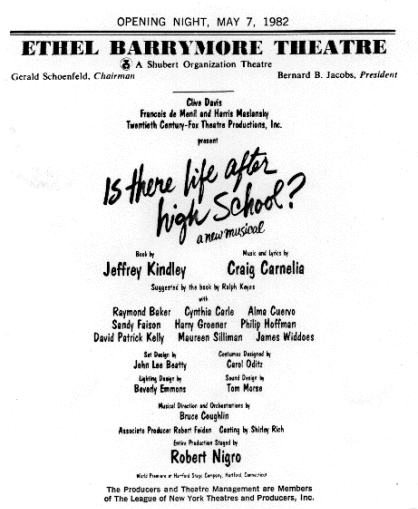
- adapted as a Broadway musical (“Is There Life After High School?”)
During the past decade and a half, a musical comedy based on Is There Life After High School? has been produced on Broadway, at Ford’s Theater in Washington, and hundreds of other theaters around the country. Since it strikes such a universal chord, Is There Life After High School? has become a staple of regional, college and high school directors. Its evocative songs include “The Kid Inside,” “Diary of A Homecoming Queen,” and “Reunion” (“Face the class/ Fail or pass”).
Since this book was published, the term “life after high school” has become a cultural catchphrase. It was the title of a 1991 Joyce Carol Oates short story in The Atlantic, a line in a novel, the title of a non-fiction book (Coping With Life After High School), appeared in a comic strip, and at least two movies. (In Rock ‘n’ Roll High School, a character shouts “There is life after high school!”)
Where to buy
Follow the links to purchase Is There Life After High School?:
Contents
1. High School Fever
2. In the Hallways of Your Mind
3. As the Tables Turn
4. Looking Back on a Great Future
5. Don’t Get Popular, Get Even
6. Re-Uning: What Will They Think of Me Now?
7. Now Can We? (Go All the Way)
8. The High School Imprint
9. Exorcising High School
Notes
Excerpt
As the guest on a Los Angeles radio show, I asked, “Is there life after high school?” In response the switchboard lit up like a pinball machine as callers competed for air time to tell their adolescent tales.
One call came from a great-grandmother who said she still liked to get out her yearbook from half a century ago and read over margin notes about dates: who she went out with, where, and what they did.
A recent graduate called to complain that his class vice-presidency had little value now, and a twenty-six-year-old bragged about the fight he’d won eight years before.
Finally, a man named Luke called, a 1939 graduate who told about his recurring dreams of high school. The dreams were vivid, Luke said, actual memories of horsing around in class, throwing spitballs, and winning a fight in his senior year. Even though he’d get out of bed and try to walk them off, the dreams kept right on coming — every week or so.
Luke, it turned out, had been a star athlete in high school, the winner of eight out of nine possible letters — “which is hard in the St. Louis system,” he assured us. Now retired and in his fifties, by his own admission Luke had done little of consequence as an adult. “My life’s been pretty mediocre since high school,” said Luke.
“You know that question you asked — ‘Is there life after high school?’
“Well, in my case there isn’t.”
Ken Minyard, the show’s host, was at first uncertain if this topic had substance. But as the show proceeded, Minyard himself began to be invaded by memories of his own Oklahoma high school days two decades before. Ken remembered in particular a guy dunking him in a pool, and said that to this day if anyone tries in the slightest way to push him around, he feels the very same rage he felt in that pool.
What impressed Ken more was that he still remembered the name of his high school tormentor — both names, first and last. He felt odd, and a little embarrassed, that such trivia should stick in his mind.
In fact, Ken is not odd at all. At Ohio Wesleyan University several hundred subjects were tested on their recall of high school classmates. Graduates fifteen years out of high school could identify by name ninety percent of their classmates’ pictures, and even those nearing their fortieth or fiftieth reunion recognized seventy-five percent of classmates’ faces. Although prompting with yearbook pictures produced the best results, the researchers found that recent graduates usually could name several dozen classmates off the top of their head, while older subjects remembered nineteen names on the average without prompting.
In my own interviewing, I’ve found it common for people to remember a roll call of high school classmates’ names and talk of these old acquaintances as if they were next-door neighbors today. “This guy,” or “that girl,” are not phrases we use to convey high school memories. What we say is, “So Ellen Markowitz reached down and grabbed my …,” or “and right there in class Jim Oates began to … ”
But names are just the most prominent detail sticking out in high school memories. I’ve also been told, down to the taffeta slip, what was once worn to a prom, and the precise phrases used to tell off Faye Clemens. Cheers from games are commonly remembered word for word, and can today be recited not just by ex-cheerleaders but by those who were listening in the crowd.
Two things I find people remember with uncommon accuracy are how many times their picture appeared in the yearbook and exactly what was written under their senior picture. One woman who couldn’t recall every word of the caption did remember its meter. “The first line was dah dah dah dah, dah dah dah — something about my heart. “Gay and carefree all the while,” I think it ended.
Just as interesting as what people do recall from high school is what they don’t — like education, the supposed reason for gathering An occasional inspiring teacher may stand out in memory, but rarely anything that went on in a classroom beyond passing notes.
The one place where academic memories do show up is in dreams. Dreams set in high school are unusually common, and one dream in particular: showing up unprepared for a big test.
The dream next most often recalled has to do with a locker that won’t open, usually because the dreamer has forgotten its combination.
But none of these standouts from high school memory — the dreams, the names, the prom dresses, or the yearbook captions — can convey the feelings with which they’re described: the way voices crack, hands grab the air, and eyes dart wildly around the room as people talk about their high school years.
It’s as if the adolescent within never dies, that inside each of us lies a high school kid napping. This kid may sleep for years without waking, and lull us into believing we’ve grown up. Then someone will nudge him awake with a rude question. Or we’ll catch a whiff of brownies baking and be cut again by that snub in Home Ec. Or hearing Johnny Mathis sing “The Twelfth of Never” will float us right to the sofa where Carla Rollins first let us touch her breast. Even a single glimpse of Happy Days on TV may be enough to take us helplessly back to all the clanging lockers in the hallways of our mind.
Finding the teenager within alive and kicking still can be exciting. It also is embarrassing. The single word I’ve heard most often used to describe the feeling of looking back on high school is “embarrassed.” After explaining in great detail why he only got two letters rather than three in his senior year (because of missing baseball practice), one forty-five year-old ex-jock told me, “I’m embarrassed about not getting that letter. But what embarrasses me more is that I’m even talking about it.”
Most embarrassing of all is how easy it is to recall now what mattered most then: status.
Reviews
January 26, 2011
The Arizona Republic
Remains one of the few books to deal with the sociological aspects of high school. Doug Carroll, The Arizona Republic , July 4, 2000
January 26, 2011
The School Counselor
In a humorous vein, Keyes refreshes our memories with numerous interviews, magazine articles, and the findings of social scientists. We are reminded that priorities are seen through a different set of lenses when we are…
January 26, 2011
School Review
Frequently poignant, occasionally profound, and very funny.
January 26, 2011
San Diego Union
Much more than just a pleasant exercise in nostalgia; it’s a learning aid — a piece in that puzzle of what makes us the way we are and why.
January 26, 2011
Washington Post
Thoroughly engaging.
January 26, 2011
St. Louis Post-Dispatch
Frequently poignant, occasionally profound, and very funny.
January 26, 2011
Austin American-Statesman
Witty, angst-ridden confessional of the joyous and heart-rending memories of high school … will start up hunts for yearbooks.
January 26, 2011
Charlotte Observer
The book is worth reading, if only to refresh your memory about what you’re compensating for.
January 26, 2011
Philadelphia Inquirer
A good, thoughtful, albeit disturbing book about how four years of one’s adolescence, consciously or otherwise, affects the following years of alleged maturation.
January 26, 2011
Santa Barbara News-Press
Keyes has turned in a serious psychological study. His book is funny, but it isn’t frivolous.
January 26, 2011
Greensboro Daily News
A delightful book … both insightful and fun.
January 26, 2011
National Observer
Deliciously titled … breezy … very good book.
January 26, 2011
Publishers Weekly
Whether you were jock or bookworm, an “innie” or an “outie” you will relish the shock of recognition and, perhaps, furtively consult your yearbook. Sociology that amuses as it informs.
January 26, 2011
Kirkus Reviews
Beneath the banter, the all-too-vivid recollections of the sock-hop, the prom, the yearbook caption under your photo, Keyes makes a serious and pathetic observation: there are people for whom high school is the peak…
January 26, 2011
Indianapolis News
Keyes brings back the sights and sounds, and most importantly, the feelings, of our high school experience
January 26, 2011
West Coast Review of Books
Keyes manages to sum up the common denominator of experiences we shared, no matter which high school we attended and the perspective in which we see our high school days now … a captivating book.
January 26, 2011
Los Angeles Times
You can take the boy and girl out of high school … but can you take high school out of that boy and girl, even when adults? In essence this is the provocative question posed by this witty book that manages to use the…
January 26, 2011
Booklist
“There is a lot of nostalgia and fun in here — but this is a meaningful look at the impact of adolescence spent in a unique American institution.”
Press
January 26, 2011
The Arizona Republic
… remains one of the few books to deal with the sociological aspects of high school. Doug Carroll, The Arizona Republic
On the internet
January 26, 2011
Internet
Ralph Keyes once wrote a book called Is There Life After High School? which proposed that all the prom queen / football hero types peaked early. High school was the pinnacle of success, Keyes said, and it was down the…
What colleagues say
A sweetheart of a book.
Susan Brownmiller
Fun to read … useful to have around the house.
Dan Wakefield
Lively, filled with facts and fun memories that will make you remember yours.
Gene Shalit
Wonderful, terrific, funny.
Joan Rivers
It is the first book I have ever seen that transmits the intensity, that recaptures the pain, the embarrassment, the struggle for status that high school is all about.
Professor James Coleman, University of Chicago
[An] underestimated book … Edgar Z. Friedenberg, Dalhousie University
[An] excellent study of the influence of high school … Bernie Zilbergeld, Male Sexuality
What readers say
t’s my #1 favorite book of all time.
Toronto, Ontario
To have conceived the idea for Is There Life After High School? and dismissed it would have been almost criminal. … I am convinced there is no other time that is as intense and kaleidoscopical. Frank Zappa is right: high school is a state of mind. You are right: high school can be exorcised. But, sometimes I’m not sure I want to exorcise high school. The pink and gray saddle-oxfords I wear please me.
Fayetteville, AR
I laughed, cried, and identified my way through Is There Life After High School? I thought I was the only person in the world who thought of the innies as still, until this day, having movie star quality.
San Francisco, CA
Absolutely super! My palms are still sweating.
New York, NY
I read Is There Life After High School? (a provocative title, if ever I saw one) last Saturday, neglecting most of my Saturday errands to do so, and staying indoors when the weather was good. It’s really great! I was impressed by the throwaways as much as by the main conclusions: the fact that the social values of the school reflect the size (and age) of the community, that they also reflect the general community orientation and value system. I was fascinated by what Mr. Keyes had found about the “famous” people in high school, too. He seems to have been very thorough in his researches, and he seems to have enjoyed himself in the process. I’ve already recommended the book with great enthusiasm to the mother of teenagers and one teacher of social studies at the high school level, as well as to one college student.
Boston, MA
It’s a delicious book, as able to invade the insides of our generation as a chocolate malt. I was surprised that so many driven people were fueled by desires to throw their success in the face of faded high school peers …
Santa Monica, CA
Is There Life After High School? That’s agood question. It’s also a very good book. Consider that the opinion of an outie — or was I an innie? I never could be quite sure, which probably explains why I’m driven to succeed in life.
Scottdale, PA
I have just finished reading your new book Is There Life After High School? Needless to say I thoroughly enjoyed it. It’s the first time I’ve been able to put into place my feelings about my high school years. I always knew I was one of the “outies” and now I realize that I, too, was out for revenge. It’s great to know others feel the same way.
Hartford, CT
Tomorrow night I shall reread the entire book. It seems to me to be tremendous fun, but tremendously important.
La Jolla, CA
I’ve just finished your delightful book. It’s the story of my life. How did you know?
Philadelphia, PA
“Life After” prompted many hours of fun but revealing discussion between my sister (who is 30) and myself (24). I was an innie who always felt like an outie, and she could have been an innie at being an outie.
Topeka, KS
I have just read your book Is There Life After High School? It is wonderful and RIGHT ON! … I think you’ve really hit on the heart of the matter. I’d like to include this on the reading list for an education class that I teach.
Colorado Springs, CO
When I quickly chose two paperbacks to take on a trip, your book Is There Life After High School? was one I chose. I read book reviews looking for likely reading material in it. the other choice was M*A*S*H Goes to Montreal, and I started it first, but our ice chest leaked on it and out atlas, so I began your book, and I’m glad I did — I think. Now I can’t sleep because I keep remembering my high school years, 1940-1944.
Long Beach, CA
I find it very comforting to know that those of us who were social lepers in school are now running the world. In thinking back to the last few classes that graduated here, I realized that while the “outies” had yet to do anything really great yet, the “innies” were in even worse shape: The student body president/basketball star/track runner is a box-boy at the local Safeway; the Prom Queen didn’t even finish school … All in all, after reading your book I may be tempted to, the next time I see her, pat the ex-head cheerleader and Senior Ball Queen on the arm and offer my condolences … Many thanks for a most enjoyable book.
Hawthorne, NV
I’m well into the final pages of your notes at the end of Is There Life After High School? I’ve enjoyed the book tremendously and have urged both my wife and teenage children to read it.
Allentown, PA
Several months ago I secured a copy of your book Is There Life After High School? Although I have read and re-read through the book so often it is now battered, I’m not yet through with it. I cannot thank you enough …
Alpine, TX
Thank you again. I have read the book thrice and skim it every so often.
Kansas City, MO
It was like a catharsis. In the few hours I spent with the book I got rid of about 85% of the high school that had been on my back since 1959. … I could write a book about praise for Is There Life After High School?
Seattle, WA
It gave me so many insights. I enjoyed it and only wished I’d read it before my reunion. I’m now one of your biggest boosters and recommend your book to anyone contemplating their reunion.
Mercer Island, WA
I have just finished your book Is There Life After High School? I enjoyed it very much. It was also very relevant because I will be starting high school in the fall. It is comforting to know that all is not lost if I happen to be an “outie”.
Fresno, CA
I very much enjoyed your book. I have already purchased 10 copies to give my friends.
—
I wrote you that I enjoyed your book so much I was ordering 10 copies. Last year for our high school reunion, I ordered 125 copies which left me several to give out to my friends.
Kansas City, MO
I read your book Is There Life After High School? and felt gratified and vindicated. I wanted to shake it under the noses of my grownup, skeptical, “I’m through with all that” friends and say “see!? see!?” … your book is a very accurate description of high school and its effects on people. The paragraph on breast size being a medium of exchange rang so true that I reread it several times for the reverberations. How true. How discouraging. Oh, well. Thanks for a great book, for taking something seriously which has too long been ignored.
Minneapolis, MN
That book was my bible in high school.
Redwood, CA
It solved a lot of problems for me.
Schenectady, NY
I love this book. I keep telling people they have to read it.
Northmont, OH
I have just finished reading your book Is There Life After High School? I am a junior in high school and I don’t want to sound too dramatic, but it has changed my life. I am at the bottom of the innies group, and it’s hard. … The other night at a dance it was slow-dance time and, as always, a friend of mine and myself were left to sit out. this always happens to us. (My friend has read your book also). All of a sudden we looked at each other and started laughing at ourselves. We know that as long as we are in high school it won’t change, but since your book came along, at least we know it will improve. My friend looked at me and said, “Meet me in Las Vegas after high school.” All I could do was to tell her that all those pretty girls would drown in their own blood. It sounds severe, but it’s nice to know it all will work out. The point is that you’ve helped all of us outies and we can’t thank you enough.
Park Forest, IL
Where did you get permission to write my biography? … I loved your book. If I ever have kids, when they say, “Mom, what were you like in high school?”, I’ll squirm a while, sweat a little, and hand them your book.
Valparaiso, IN
All set to enjoy your book, I too early glanced at the back cover of your yearbook picture. I hated you immediately … You were the enemy. You were the kind of guy in high school who was “in things.” How DARE you call yourself an outie!
Studio City, CA
I was what you would label an innie. I was a cheerleader, student council member, co-editor of the the yearbook’s student life section, a member of the literary magazine staff, in the National Honor Society and very active in intramural sports. I have no regrets about my years of secondary education and I don’t feel that I was as ruthless as the outies you describe would have me be. … Another point I would like to argue is your theory of what happens to innies after they graduate. I don’t agree that all innies end up selling insurance and getting divorced … I also must disagree with you that all outies end up running the world. I must admit, I fall into your stereotype, as I am seeking to obtain a teaching certificate (“teaching is a field shared by innies”). You said yourself that “outies control America’s means of communication.” Does that mean I shouldn’t even try? Where do I fit in?
Plano, TX
I am a 51 year-old high school teacher who owns a dog-eared copy of Is There Life After High School? I have lent the book to many friends and the book is suffering. Your book is a definite affirmation to those students who have not seen or realized their potential in high school, but who will later in life.
Denver, CO
A sociologist colleague says he refers to your book every semester!
West Lafayette, IN
I hope it can come out again – and I think it is timeless.
Cleveland, PH
Is There Life After High School? was an extremely important book to me. It’s only a slight overstatement to say it saved my life: After a high school career that was undistinguished, to say the least, I read Is There Life… during my freshman year of college. It showed that things – life – can change. That’s just what I needed to hear at that point in my life. Is There Life After High School? showed me that just because you were unpopular and unsuccessful in high school doesn’t mean the rest of your life has to be a replay of that.
Raleigh, NC
Is There Life After High School? really had a profound affect upon me. There is someone who understands!!!!
Dayton, OH
Thanks again for writing such a wonderful book!
Ft. Thomas, KY
I read your book in about 2 days! Excellent and incredibly relevant … your findings are truly timeless.
Every time someone talks about going to their high school reunion I tell them if I ever became Emperor of Washington State I would require every student who attends their high school reunion to first read Is There Life After High School? You packed so much wisdom and whimsy into this little tome!
Mercer Island, WA
I am reading Is There Life After High School? for the first time, EVER, and well, my interest has been piqued. Gee whiz, Ralph wrote this 28 YEARS ago? It took me 28 years to find this book? Have I been living in Guam, under a clam shell? Oh well, when the student is ready, the teacher appears, even if it does take 28 years.
Coal City, IL