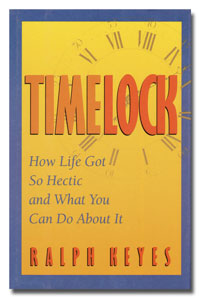
When traffic gets so congested that it can no longer move, engineers say it has reached a state of “gridlock”. According to Ralph Keyes, many of us are in a state of “timelock”. This is the condition that occurs when claims on our time grow so demanding that we find it impossible to wring one more second out of a crowded calendar. In this informative and entertaining book, which is filled with real-life examples, Keyes explains how we got ourselves into this exhausting position. He considers the “vanishing pause,” “speed inflation,” and “the convenience catch.” Paradoxically, Keyes says, a key source of timelock are the very tools we’ve adopted to save time: computers, faxes, microwave ovens. Keyes doesn’t just assess the sources of timelock but suggests how we can get out from under its pressure.
- Book-of-the-Month Club selection
- excerpted in Reader’s Digest, Sesame Street Parent
- featured in Parade
- discussed in Management Review, USA Today, Entrepreneur, Working Woman, Woman’s World, Glamour, McCall’s, Executive Female
Where to buy
Follow the links to purchase Timelock:How Life Got So Hectic and What You Can Do About It:
Contents
Introduction
I. THE RISE OF TIMELOCK
1) Never Enough / The Time Crunch / The DayTimer Syndrome / Fast Forward / Time-Phobes and Time-Philes
2) A Brief History of Timekeeping / Organic Clocks / Soft Time / The Key Machine / Hard Time / Selling Hours and Minutes / The Time Traveler
3) The American Tempo / Full Steam Ahead / On Time / Domestic Scientists / Speed Lust / The Jazzy Age / Shop Till You Drop / Turning it up a Notch / McSpeed
4) Tomorrow’s World Today / Hasty Homes / The Leisure Problem / You Deserve a Break / The 30-Second Minute / Grazing
II. HOW LIFE GREW HECTIC
5) Why Time is Scarce / Over-Choice / Life Around the Clock / Why Did God Give Us Only Two Hands? / Never Out of Touchness / Precious Time / The Affluent Society
6) The Convenience Catch / Time-Consuming Gadgets / Never Done / The Automatic Blues / Let Them Read Manuals / Compu-Confusion / The Speed Addict
7) Stepping Up the Pace / The Vanishing Pause / Speed Inflation / Chase the Metal Rabbit / A Love-Hate Relationship
III. TIMELOCK’S TOLL
8) The Hurried Body / Time Sickness / The Harried Heart / Type A+
9) Rushaholics Anonymous / Do We Do it to Ourselves? / Calendar Display / No Time to Think / Mainlining Speed / The Slivered Mind / The Rolodex Syndrome / Alicia (cont.)
10) The Timelocked Home / Fast Families / Busy Children / One-Minute Parenting / I’ll Listen Tomorrow
IV. MAKING THE MOST OF YOUR TIME
11) Zen and the Art of Time Management / Present Time / Time to be Present / Why Time Can’t be Managed / The Unused Date Book / Don’t Just Do Something / Back from the Fray
12) Modulating Time / Synchronizing Outer and Inner Clocks / Churchill’s Choice / Productive Time Wasting / Pauses that Refresh / Hassle-Free Zones / Going Watchless / Slow Tech / High Touch / Good Shabbas
13) Time Sanctuaries / Annulling Time / Semi-Sabbaths / Getting Good at Leisure / Becoming a Good Vacationer / Time Out / Going Home
14) Striking a Balance / Less is More / The Have-it-All Hustle / Money is Time / The Parent Track / Career-and-a-Half Families / Is Home Work the Answer? / Time to Call Your Own
15) The Best of Time
APPENDIX: Are You Timelocked?
NOTES
Excerpt
(Note: in lieu of an actual excerpt, the following is an article written for Parade magazine summarizing the key points of Timelock)
.
When traffic can no longer move, engineers say it’s reached a state of “gridlock.” Many of us are in a state of “timelock.” Timelock occurs when demands on our time become so overwhelming that it feels impossible to wring one more second out of crowded schedules and hectic days. As a Minneapolis businesswoman described this condition, “You prioritize, list your ‘musts,’ then you can’t even get to your musts.”
.
For the past three years I’ve studied how time pressure affects Americans from all walks of life. Nearly 450 subjects filled out my questionnaire on this subject. Of them, 57% said that their lives had grown busier during the past year. Over half agreed with the statement “there aren’t enough hours in the day to do everything I have to do.” Another 30% concurred that “on the whole I have just about enough time to do what I have to do.” In other words, the vast majority said they had virtually no free time.
.
“Our studies clearly show that people feel they have less and less time,” reports Tom Miller, editor of the Roper poll’s Public Pulse. Like many analysts, Miller believes the feeling of being overwhelmed by time demands will grow. Why should this be? In an age of fax machines and microwave ovens, how did time get so scarce? Shouldn’t rising standards of living produce more leisure? Can anything be done to alleviate time’s pressure?
.
Such questions were of intense interest to subjects I interviewed throughout the country. When asked if time was an issue for them, some simply clutched their stomachs and moaned. Others spoke right up. “Time is the most precious commodity I’ve got,” said Leon Ciferni, a veteran Manhattan lawyer. “I don’t have enough of it. It used to be money, now it’s time.”
.
“The sign of the times is that our mothers used to bake brownies,” observed Pam Gallagher, a supermarket supervisor in Providence, Rhode Island. “With a microwave mix you can have brownies in six minutes. My son and I love them. I think they’re comparable. He wouldn’t know. He once said, ‘Mom, what’s apple pie?'”
.
Many of those I interviewed wondered how their parents could enjoy more relaxed lives with less money and fewer conveniences. What we too seldom realize is that modern advantages themselves put pressure on our time. Today’s average starter home is twice as big as one built after World War II. That’s a lot more house to buy, furnish and maintain. Inside our bigger homes we consider far more items “standard” than our parents did: coffee makers, microwave ovens, garage door openers, air conditioning, color TVs, cable, a VCR, stereo, Walkman, several phones, multiple bathrooms and perhaps a home computer. We want to own more, do more and be more than our parents ever dreamed of. Such ambitions sponge up time.
.
Too Many Choices. According to Carlsbad, California psychologist Larry Chamow, one problem that cuts across generational lines is coping with today’s many choices. “Most of the people I see are frustrated by them,” says Chamow. “All of these things you could do.” The number of decisions we must make in a given day — about activities, friendships, phone plans, TV shows, lifestyles, mail-order offers and cereal brands — has mushroomed. Roper’s poll of consumers finds rising concern about “brand clutter.” Last year 13,000 new products jostled for space on supermarket shelves, more than twelve times the number that were introduced a decade earlier. In 1980 Americans had 458 mutual funds to choose from. Now several thousand vie for their attention. Having so many options increases our flexibility. It also is a major source of time pressure.
.
Time-Consuming Time-Savers. One way we try to ease time pressure is with modern conveniences. Too often, however, such labor-savers consume more time than they save. By simplifying chores, appliances encourage us to do more of them. Power mowers give us less excuses for not cutting the grass. Blow dryers let us wash our hair daily. Dustbusters make it possible to suck dirt regularly from spaces vacuum cleaners can’t reach. Washer-dryers allow us to do laundry constantly rather than weekly. “We don’t wear our clothes to the limit,” pointed out Sue Robbins, a mother of two in Sacramento. “I do significantly more laundry than my mother did.”
.
Nearly every study of time spent doing chores has reached the same conclusion: labor-savers relieve drudgery and speed tasks, but on balance don’t save time. Nor do they make life less hectic. We may no longer haul water, split wood, trim wicks, clean lamps, boil clothes, feed horses or bake bread. We do chauffeur kids, fight traffic, stand in supermarket lines, fend off telemarketers, decipher manuals, and repeatedly try to figure out how to re-set the digital clocks on our many conveniences. Even a revolutionary appliance like the microwave oven has altered schedules more than it’s eased them. During a chat in her New York office, a bank executive observed that her microwave made it unnecessary to spend Sunday cooking a week’s meals. “Instead,” she said, “I come in here.”
.
The Vanishing Pause. One way in which modern technology allows us to do more is by eliminating “unnecessary” delays: to boil water, wind a watch, or put paper in the typewriter. Taken together such vanishing pauses deprive us of opportunities to catch our breath. No wonder the pace of life feels breathless.
.
Consider this progress chart:
.
SLOW MOTION
buttons
stove
washboard
pen
abacus
operator
U.S. Mail
CRUISE CONTROL
zippers
pressure cooker
wringer-washer
typewriter
adding machine
rotary dial
Federal Express
FAST FORWARD
Velcro
microwave
washer-dryer
word processor
calculator
touch-tone
fax
.
Few pieces of technology have hastened life’s pace as quickly as fax machines. One day we wondered if the mail would arrive in the next hour or two; the next day we tapped our toe impatiently for the few seconds it took a letter to roll out of the fax. Many consider civilized communication to be a victim of fax machines. “I can no longer say, ‘I’ll mail that to you,'” explained a Philadelphia businesswoman. “Now it’s, ‘Fax it to me!’ That’s stepped up the pace tremendously.”
.
It’s hard not to get caught up in today’s hectic pace. On my questionnaire, 64% said they felt rushed constantly or often. Another 30% said they sometimes felt that way. We’ve become a nation of rushaholics. Time pressure is our constant companion. The price we pay for this is steep. The impact of what physician Larry Dossey calls “time sickness” can be seen in conditions ranging from stomach disorders to heart disease. Psychologically, feeling under time’s gun makes it hard to pay attention — even to people we care about. “My mind’s always racing,” is a common explanation for chronically short attention spans. Family life is being corroded by over-crowded calendars. According to Richard Louv, author of Childhood’s Future , time is the element most lacking in today’s parent-child relations. When I asked a 10 year-old outside Philadelphia if he resented the long hours put in by his working mother, the boy replied, “not really. I’m so busy I wouldn’t be home to see her anyway.”
.
Must we all fall prey to time’s pressure? Not necessarily. Making our lives less frantic, however, takes initiative. As technology speeds the pace of life, it’s up to us to slow it down. This does not necessarily mean throwing away our microwave ovens and growing roses to smell. It does mean paying better attention to the time cost of what we do, and aspire to do.
Here are some suggestions for ways to make your life less hectic.
.
1) Plan Life, Not Time. Only after determining what we want from life (as opposed to how much we can “get done”) can we change direction timewise.
— think regularly about what your want from your life
— evaluate all activities, even the most trivial, by whether or not they add to that life
— weed ruthlessly whatever does not: tasks, errands, TV shows, people
2) Manage Time Organically. Time is uniform only to clocks. Our bodies keep irregular time, based on sunlight, temperature, and the uneven tempo of work and leisure which first set our inner clocks.
— get to know your own body’s clock, paying particular attention to peak periods
— take advantage of peak periods in scheduling work; if you don’t control your work
— schedule, try to negotiate one which allows this (it’s in everyone’s interest)
— routinely cross items off your To Do list undone
— don’t make use of every minute; this only increases tension while reducing effectiveness
3) Decelerate. Rushing is addictive. Once hooked, it’s hard to remember that the fastest way of doing things isn’t always the best way.
— when hurried, ask yourself: Do I really need to rush? What’s the worst thing that can happen to me if I don’t? Is that worse than what it’s costing me to hurry?
— distinguish between necessary haste (late for an appointment) and mere impatience (one-hour photo developing)
— make a conscious effort to not always take the faster path; use stairs at times instead of elevators; walk rather than drive; cut and grate food you used to process; use your head instead of a calculator
.
4) Reduce Awareness of Time. How often do we really need to know what time it is? The fewer reminders we have of time, the better we can make this commodity serve rather than master us.
— pay attention to how often you “check the time;” try to reduce such occasions to a minimum
— go watchless whenever possible
— create a mental map of sanctuaries from time: churches, parks, libraries, hotel lobbies; retreat to them often
— cultivate an interest in clock-free activities such as baseball, chess, quilt-making, potting, fly tying
.
5) Pay Attention. The chief reward for pruning hectic schedules is improved attention for those you care about. To take advantage:
— spend more time per person with less people
— give full attention to those people, without the TV on, a newspaper in hand, or a constant mental
— review of what else you might be doing review schedules regularly with those sharing your life; look for activities to eliminate
.
6) Accomplish More by Doing Less. Controlling the volume of our activities makes it possible not only to ease time pressure but to get more out of life overall.
— before adding a new activity, subtract an old one
— accept that you can’t have it all, and wouldn’t want to
— treat career plateaus, tempered ambition, even reduced income as a potential time bonanza
— approach growing older as an excellent opportunity to ease your pace and do more of what you really want to do
.
The key to timelock is in our own hands. Outer pressure will always be with us. Society pays lip service to smelling the roses but actual support to getting more done faster. Seeking a more balanced schedule takes personal effort.
.
Many are making that effort. Such people have concluded that they can’t have at all, and don’t want to try. They are searching for more relaxed, less frantic ways of life. One mother in Maine traded her fast-track banking career for part-time work and more time with her two daughters. A Florida family required all members to make time to be present for dinner. One in Kansas swapped lists of their activities, then pruned them to create more time for each other. A mother of four in Michigan took up beekeeping as a source of honey and serenity. “My pace automatically slows as I approach the hives,” she reported. “One never rushes up on a bee.”
.
Keeping bees is one way to ease life’s pace. There are many others. Invent your own. Making life less hectic does not suggest lack of drive. To the contrary. Only by slowing down and pruning our schedules can we reclaim the most valuable thing we own: our time.
.
Reviews
January 28, 2011
Arthouse
Read the book Timelock , by Ralph Keyes, to find out “how life got so hectic and what you can do about it.” This book provides a positive prescription for balancing the demands of work and home life in an increasingly…
January 28, 2011
Newsday
Keyes presents a scary shopping list of what can happen to people who work too much. My favorite was a short section on the risks of fast eating. Not of fast food — the danger of fried, sugar-ridden junk food is old…
January 28, 2011
Philadelphia Daily News
Keyes offers a thoughtful list of approaches to change in his final chapter, “The Timelock Antidote Handbook.” Some highlights: Decelerate — slow down. Achieve more by doing less; when you do too much, you do nothing…
January 28, 2011
Working Woman
According to Keyes, “timelock” is the state of having so many demands on our time that it’s impossible to extract one more second from an overjammed day. He traces the incredible shrinking day from the invention of the…
Press
January 28, 2011
Press
Coming soon. Please check back shortly, as the website is currently in the process of being updated.
On the internet
January 28, 2011
Internet
Ralph Keyes, in his book Timelock: How Life Got So Hectic and What You Can Do About It , notes this paradox, that, as you try and control time more, time controls you more. It’s a great book. Ralph Keyes notes in his…
What colleagues say
In his excellent book Timelock, Ralph Keyes points out that there are many supposedly time-saving devices that, because of the way we use them, don’t save us as much time as we think they do.
Elaine St. James, Simplify Your Life
Well-written, well-researched, and full of useful ideas.
Varda M., Co-Chair, Workaholics Anonymous
“Rushaholism” is a word invented by author Ralph Keyes. In his 1991 book Timelock, Keyes wrote that rushaholism is “the compulsive need to make haste and fill every spare second with activity.” That’s me! How about you? Are you a rushaholic?
Dr. Dale A. Meyer, Lutheran Hour Sermon
Read the book Timelock by Ralph Keyes to find out “how life got so hectic and what you can do about it.” This book provides a positive prescription for balancing the demands of work and home life in an increasingly time-pressured era.
Arthur K. Weathers, Own Less, Do Less, And Say No
I discovered one of your books recently, Timelock. I have to say it is the most original and innovative one I’ve read on the theories of time and time-management — and I have read many in my research.
Mike Nelson, Stop Clutter From Stealing Your Life
What readers say
I have read Timelock with passionate interest. It is a fascinating book which builds so artfully to its prescriptions they are inevitable when they arrive.
Desert Hot Springs, CA
My book is underlined throughout. It’s one of the best books I’ve read in a long time.
Rochester, NY
Thank you for a wonderful book. It helped give me the perspective that my life doesn’t have to be so crazy.
Natick, MA
I have just finished reading Timelock and, true to the kind of fast-paced world you write about, I am hurriedly telling friends about it. There is no shortage of books about time management. But not one makes me think about how I spend one of life’s greatest gifts as much as yours does. Much more than a book about time management, Timelock is a deep reflection of our sped-up society and the price we pay to maintain this pace. Hardly anyone could fail to see his — or herself somewhere in this book. Particularly noteworthy were the ideas that our parents had very different concepts of time, that every generation inherits a different sense of time (our children have the pacers of computers, velcro, and TV), and that the “tactics required for good parenting are the opposite of those recommended for effective time management.” I found your book as compelling as good novel. Not only did I want to read more and more about these crazy rushed people (recognizing myself among them at times), but I also wanted to get to the end to see what you suggested we do about it.
Silver Spring, MD
It’s a fine book, and you’ve obviously touched a nerve.
Charlotte, NC
I read your book, Timelock, years ago. It made a great difference to me and my (seven) kids. I pulled it out today and refreshed my memory about your insights.
Burlington, VT
I started leafing through the pages, thinking I’d just get a sense of the book. But once I read one sentence, I found myself reading another. And another, and another.
New York, NY
The writing is brilliant. It hit me where I live.
Yellow Springs, OH
I read it like a novel, straight through.
Fort Lauderdale, FL
My wife and I have just finished your excellent book Timelock. We have learned many things that help us lead happier lives from reading your books.
Katonah, NY
My favorite line from Timelock is “the essence of living is choosing.” As maybe you can tell, I’ve been “into” time management for years also, but why is best explained at the close of your book (re varying styles of how effective people operate). More and more this has enabled me to live according to my priorities (as a Christian I hope/pray for Lord’s priorities) instead of just to please others, unable to say “no” to external pressure, etc. Your book validates much of our lifestyle (no answering machine, VCR, cable, touch tone, computer) than many people we know and is comfortable for us.
Indianapolis, IN
It’s a wonderful book. It’s certainly been an inspiration to me.
San Francisco, CA
I’m only sending a card because I keep a file of suitable cards for every occasion so as to be able to avoid stopping for cards which as you know takes much too much time. Actually the only reason I have time to write this card is that I am simultaneously talking on the phone and bleaching my upper lip. I LOVE YOUR BOOK.
Philadelphia, PA
I love that book. It saved my life.
Columbus, OH
It’s a wonderful book. It’s certainly been an inspiration to me.
San Francisco, CA
I read your book, Timelock, years ago. It made a great difference to me and my (seven) kids. I pulled it out today and refreshed my memory about your insights.
Burlington, VT
Quiz
ARE YOU TIMELOCKED?
To determine the degree to which time pressure influences your life, take this self-scoring quiz (which is adapted from the questionnaire used to research Timelock). Answer all questions by circling the number of the best alternative, even if no single answer feels exactly right.
1) In a typical week, how often do you wear or carry a watch?
1. regularly 2. part of the time 3. occasionally 4. almost never
2) How many hours do you sleep in an average week night?
1. 5 or less 2. 6 3. 7 4. 8 or more
3) When driving, how often do you exceed the speed limit?
1. regularly 2. often 3. seldom 4. almost never
4) As you approach a stoplight while driving, if a green light turns to yellow, are you most likely to:
1. speed up to get through before it turns to red 4. slow down and wait for the next green light
5) Which statement best describes your attitude?
1. When I have a train or plane to catch, I like to arrive as closely as possible to the scheduled departure time so I won’t have to waste time sitting around.
4. I always try to leave extra time to get to an airport or train station so I won’t have to worry about missing a train or flight.
6) Which statement best describes your attitude?
1. At a restaurant, I like my food to arrive as soon as possible after I’ve ordered.
4. I don’t mind waiting a few minutes for the food I’ve ordered at a restaurant.
7) Which statement best describes your attitude?
1. What I like about microwave ovens is that they cut way down on the amount of time it takes to prepare meals.
4. I’d rather spend extra time preparing meals than use a microwave oven on a regular basis.
8) Which statement best describes your attitude?
1. I often use a remote control device to scan a lot of television channels so I can see what’s on.
4. To me a remote control device is a convenient tool for turning the television on or off from a distance, adjusting the volume or occasionally changing channels.
9) Which statement best describes your attitude?
1. I like the lively pace of today’s television programs.
4. I have trouble keeping up with the pace of today’s television programs.
10) Which statement best describes your attitude?
1. With so many other demands on my time, I find it hard to keep up friendships.
4. I try to make time to see my friends on a regular basis.
11) Compared to your life ten years ago, would you say you have more or less leisure time?
1. less 2. about the same 3. a bit more 4. a lot more
12) How would you compare the amount of time you spend running errands today with the amount you spent ten years ago?
1. more 2. about the same 3. somewhat less 4. a lot less
13) During the past year, how many books would you estimate you’ve read from beginning to end?
1. 0-2 2. 3-5 3. 6-10 4. 11 or more
14) How good are you at glancing at your watch or a clock without anyone else noticing?
1. very good 2. good 3. fair 4. not good at all
15) How would you rate your ability to conduct a conversation and appear tobe paying attention while thinking about something else at the same time?
1. excellent 2. good 3. fair 4. poor
16) How often do you find yourself interrupting the person with whom you’re talking?
1. regularly 2. often 3. occasionally 4. rarely
17) When talking on the telephone, are you more likely to:
1. do paperwork, wash dishes or some other chore 2. straighten up the surrounding area 3. do small personal tasks (e.g., file nails, re-set watch) 4. do nothing else
18) In an average week, how many evening or weekend hours do you spend working overtime or on work you’ve brought home?
1. 16 or more 2. 11-15 3. 6-10 4. 0-5
19) During a typical weekend, do you engage primarily in:
1. work for income 2. household chores and errands 3. leisure activities 4. catching up on sleep and relaxing
20) In a typical year, how many weeks of paid vacation do you take?
1. 1 or less 2. 2 3. 3 4 4 or more
21) On the whole do you find vacations:
1. frustrating 2. tedious 3. relaxing 4. rejuvenating
22) How often do you find yourself wishing you had more time to spend with family members or friends?
1. constantly 2. often 3. occasionally 4. almost never
23) During a typical day, how often do feel rushed?
1. constantly 2. often 3. occasionally 4. almost never
24) Which statement best describes your usual daily schedule?
1. there aren’t enough hours in the day to do everything Ihave to do 2. on the whole I have just about enough time to do what I have to do 3. I can usually do the things I have to do with time leftover 4. the day seems to have more hours than I’m able to fill
25) During the past year would you say that your life has grown:
1. busier 2. about the same 3. somewhat less busy 4. a lot less busy
SCORING: Add up the total of all numbers circled.
A score between
25-40 indicates you are TIMELOCKED
41-55,PRESSED FOR TIME
56-71, IN BALANCE
72-86, TIME ON HANDS